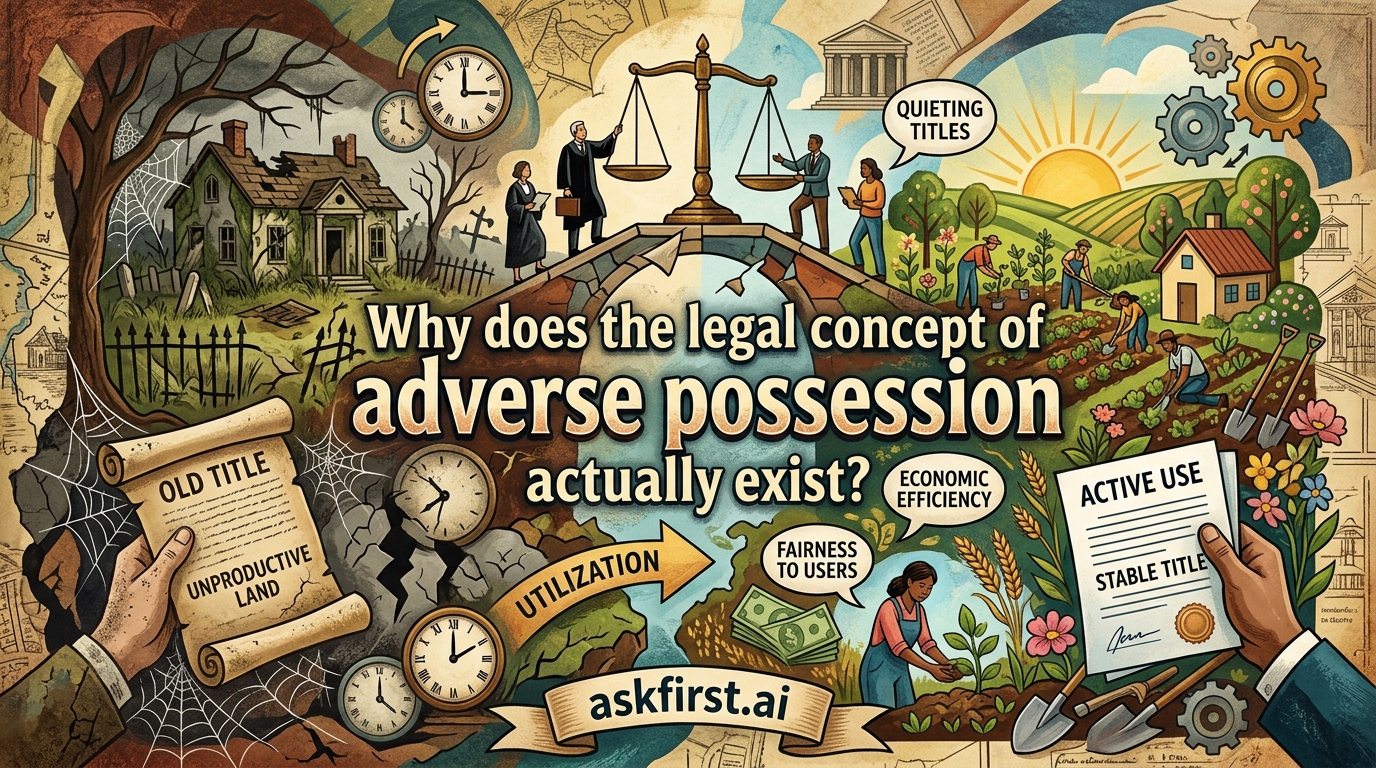
The Origins of Adverse Possession
The concept of adverse possession, often colloquially termed 'squatter's rights,' is a profound legal mechanism that allows a person to claim ownership of land simply by occupying it for a specific duration. While it may appear as a form of legalized theft, the doctrine is deeply rooted in the necessity of land utilization and economic efficiency. The law historically disfavored 'sleeping' on property rights, aiming instead to ensure that land remains a productive asset within society.
Why Does It Exist?
The primary justification for adverse possession rests on several key pillars of jurisprudence:
- Productive Use: Society benefits when land is cultivated, developed, or maintained. If an owner neglects property for decades, the law encourages someone else to step in and put that resources to use.
- Evidence Clearing: Over time, paper titles can be lost, and boundaries forgotten. Adverse possession acts as a 'statute of limitations' on property disputes, effectively clearing clouds on titles and ensuring that current occupation matches legal records.
The Requirements for Claim
For a claim to succeed, the possession must typically meet rigorous, long-standing criteria defined by common law. Each jurisdiction varies, but the occupation must generally be:
- Hostile: The possession must be without the permission of the true owner and contrary to their interests.
- Actual: The claimant must physically be using the land, perhaps by building a fence, farming, or living on the site.
- Open and Notorious: The occupancy must be visible enough that a reasonable owner would notice it if they were keeping track of their property.
- Exclusive: The occupant must be the only person using the land as their own, excluding others.
- Continuous: There can be no gaps in the occupancy. If the claimant abandons the land for a period, the clock resets.
Busting the Myth of Easy Theft
It is a common myth that someone can simply move into a mansion and claim it after a few years. In reality, most jurisdictions have incredibly long timeframes, often ranging from 10 to 30 years. Furthermore, taxes on the property must often be paid by the occupant, and the 'hostile' element is frequently defeated if the true owner provides even a hint of implied permission. Consequently, while the concept remains a fundamental part of property law, it functions less as a tool for seizing real estate and more as a final resolution for boundary disputes, such as when a neighbor inadvertently builds a fence a few inches onto an adjacent lot. Ultimately, the law prefers that land remains occupied and legally clear rather than existing in a state of eternal, silent limbo.