The Legal Framework of Extraterrestrial Habitation
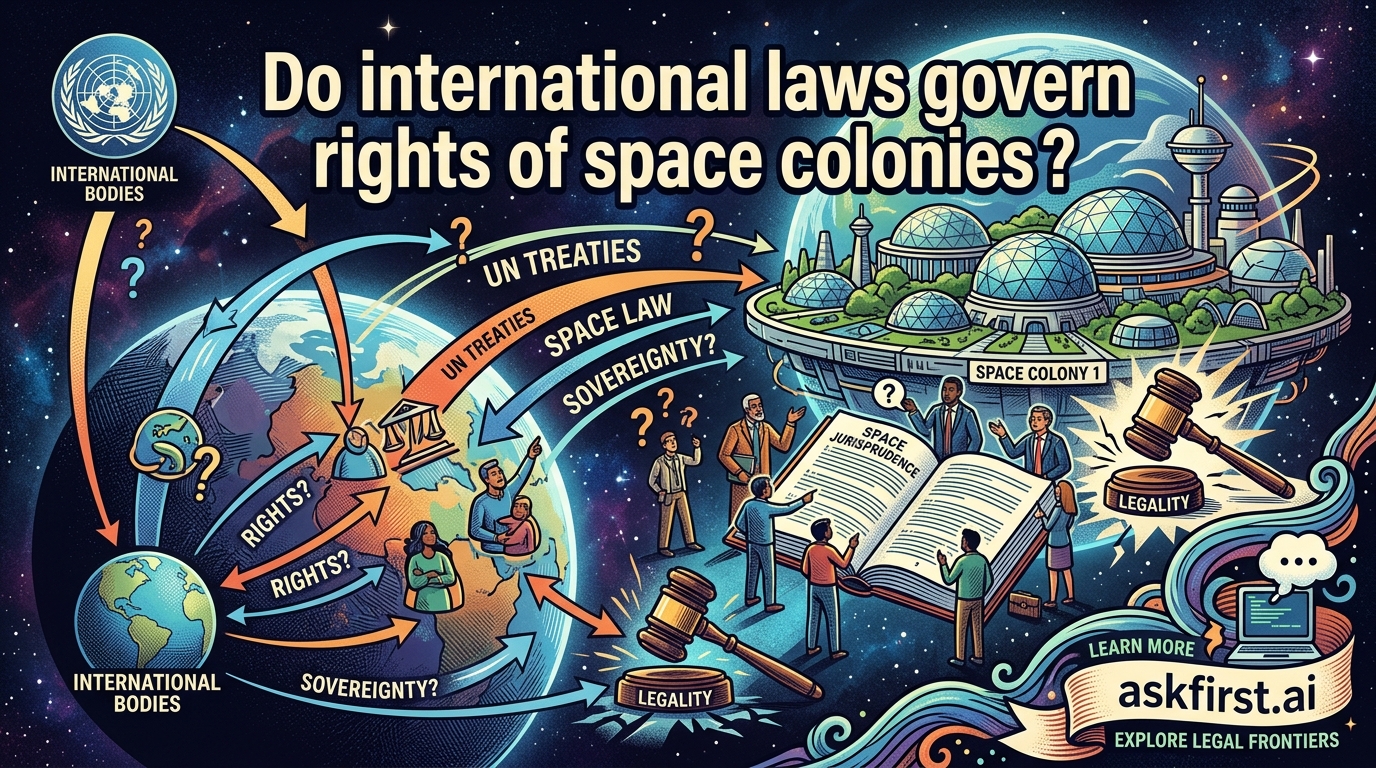
The governance of space colonies rests upon a complex foundation of international treaties, most notably the Outer Space Treaty (OST) of 1967. This foundational document serves as the 'Magna Carta' of the cosmos, establishing that space is the 'province of all mankind.' While the OST was drafted before the prospect of permanent off-world settlements became a tangible reality, its core principles provide the baseline for current legal interpretations.
Sovereignty and Territorial Claims
One of the most persistent myths regarding space colonization is the belief that private companies or individual nations can claim territory as sovereign land. Article II of the Outer Space Treaty explicitly forbids national appropriation by claim of sovereignty, by means of use or occupation, or by any other means. Consequently, a space colony cannot legally become the property of a specific country. Instead, jurisdiction is maintained through the principle of 'state of registry.' This means the nation that launches the spacecraft or colony module retains jurisdiction and control over that object and any personnel within it, regardless of where they are located in the solar system.
Human Rights in the Void
The protection of human rights within space colonies is governed by the extension of terrestrial legal systems. Under Article VIII of the OST, a state of registry maintains authority over the individuals on its registered space objects. This implies that citizens of a colony remain subject to the laws, legal rights, and ethical protections of their home nation. However, this creates a 'jurisdictional patchwork' where two neighboring modules could potentially be subject to vastly different legal codes, rights of assembly, and labor protections depending on their country of origin.
The Role of Future Legislation
As the human presence in space moves toward permanency, experts argue that existing treaties are insufficient. The Moon Agreement of 1979 attempted to establish a framework for the 'common heritage of mankind,' though it lacks the broad ratification of the OST. Critics suggest that for space colonies to thrive, international law must evolve toward a new consensus—perhaps a 'Space Colony Charter'—that addresses issues such as:
- Resource Allocation: Managing water ice and mineral rights without sparking conflict.
- Emergency Powers: Defining the authority of station commanders during life-critical failures.
- Corporate Liability: Clarifying the responsibilities of private entities providing life-support systems.
In conclusion, while the OST provides a crucial, non-militarized environment for initial exploration, it acts more as a high-level guideline than a robust constitution. The future of human settlement in space will likely require a specialized legal architecture that balances the sovereignty of nations with the collective safety and fundamental rights of the colonists who dwell among the stars.