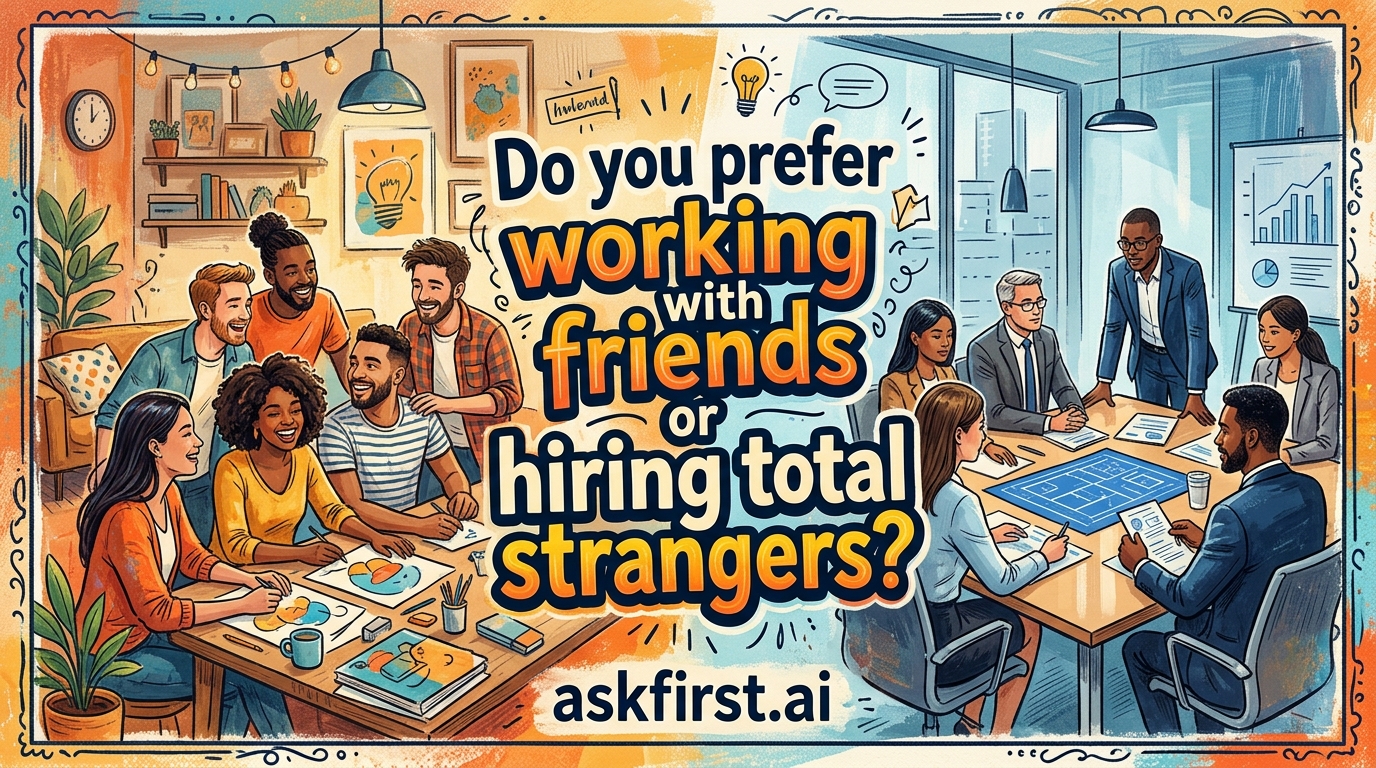
The Professional Dilemma: Friends vs. Strangers
When scaling a venture, the choice between hiring a known friend and recruiting a total stranger is a pivot point for organizational culture. Both paths carry distinct psychological and structural implications that dictate long-term success. Understanding these dynamics is essential for building resilient teams.
The Allure and Risks of Hiring Friends
Collaborating with friends offers an immediate advantage: trust. The 'Trust Dividend' facilitates faster communication, higher psychological safety, and a shared vision. According to organizational psychologists, teams with high baseline trust perform better during crises because they bypass the 'forming' stage of development.
- Advantages: High motivation, established rapport, and common values.
- Risks: Professional boundary blurring. Feedback often becomes emotional rather than objective, making difficult performance conversations awkward. If a project fails, the loss is both financial and personal, which can permanently damage a social relationship.
The Strategic Advantage of Hiring Strangers
Recruiting total strangers allows for a 'clean slate' approach. This method prioritizes skill-based fit over historical connection. Strangers bring diverse perspectives and are more likely to challenge the status quo, effectively mitigating the dangers of 'groupthink' that frequently plague insular teams.
- Advantages: Objectivity in evaluation, wider skill diversity, and predefined professional expectations. The relationship is strictly contractual, allowing for clear performance metrics.
- Risks: A longer onboarding process is required to build cultural alignment. Lack of prior interaction means the manager must invest heavily in verifying reliability before high-stakes delegation can occur.
Expert Best Practices for Decision-Making
To balance these approaches, leaders should adopt a hybrid model based on the 'Competence-First' mandate. Regardless of the personal relationship, potential hires must be evaluated through a rigorous, objective framework.
- Standardize the Interview Process: Subject every candidate—friend or stranger—to the same rigorous technical assessment and situational analysis.
- Define Clear Boundaries: If a friend is hired, explicitly document roles, responsibilities, and expectations in a contract. Clearly define how performance reviews will be handled to avoid confusion.
- Prioritize Diversity: Seek 'cognitive diversity' above all else. Research shows that homogenous groups, often formed through social networks, tend to stagnate, whereas heterogeneous groups drive innovation.
Conclusion
The choice between hiring friends and strangers is not about sentiment, but about the specific phase of the business. Early-stage startups may benefit from the high-trust, low-cost environment of working with friends, while scaling organizations require the objective, skill-optimized environment that comes from recruiting outside talent. By maintaining professional distance and clear communication, leaders can mitigate the inherent risks of both approaches and build a team that is both cohesive and highly effective.