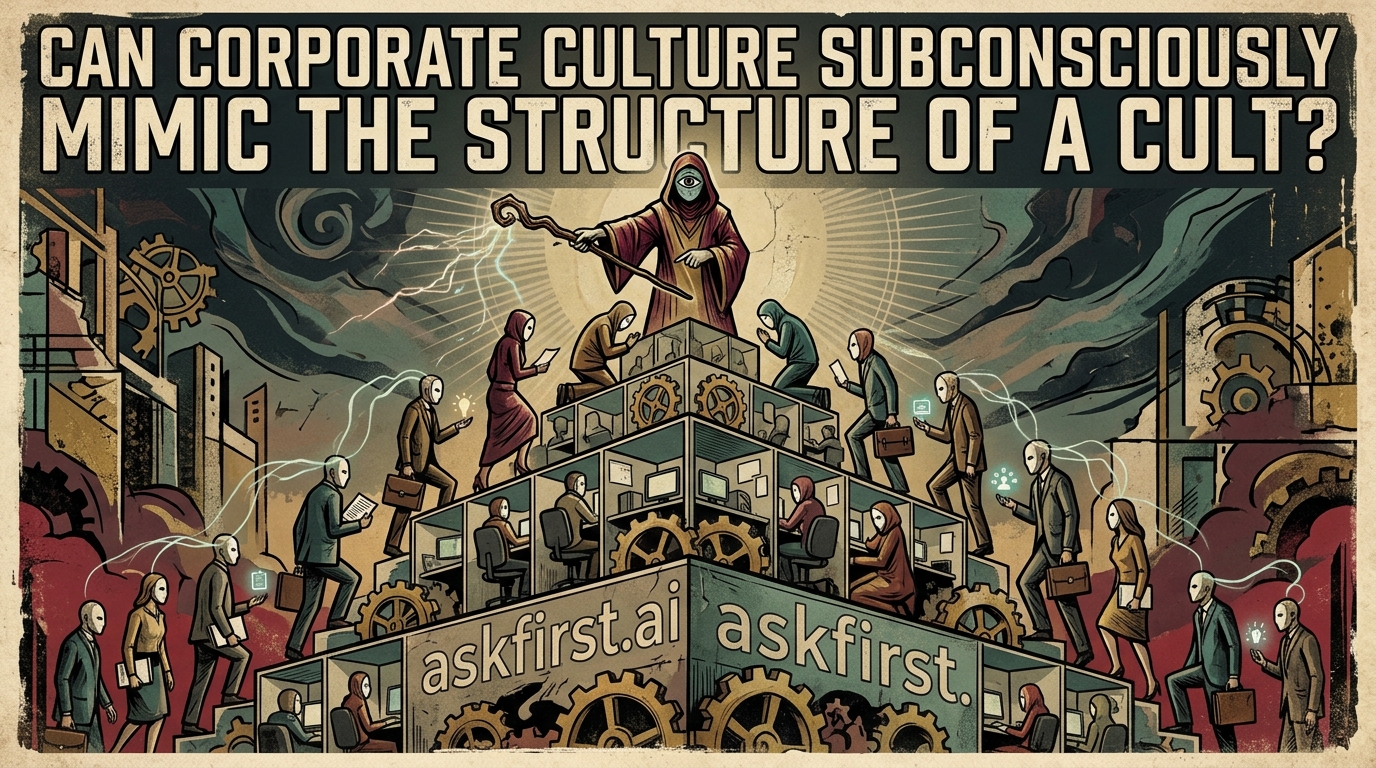
How Corporate Culture Subconsciously Mimics a Cult
The Cult of Efficiency: When Corporate Identity Turns Dogmatic
Corporate culture is designed to foster loyalty, alignment, and shared purpose, but researchers have identified striking parallels between high-intensity organizational environments and the dynamics observed in totalistic groups. While not inherently malicious, the structural mechanisms used to enforce "brand devotion" often mirror the psychological frameworks that define cultic influence.
The Anatomy of Organizational Totalism
Sociologist Margaret Singer identified several criteria for high-control groups, many of which are now commonplace in hyper-competitive startups and large-scale corporations. Key indicators include:
- Loaded Language: Companies often create internal lexicons. Employees are encouraged to use "corporate speak" or specific buzzwords, which serve to simplify complex reality and create an "in-group" that distinguishes itself from the "uninitiated" outside world.
- The Doctrine Over the Individual: When mission statements transform into rigid dogma where questioning leadership is labeled as "not being a team player" or "lacking cultural fit," the environment moves toward groupthink.
- Demand for Purity: This manifests as a requirement for total alignment with company values, often extending into the personal life, social media presence, or even lifestyle choices of the employee.
The Psychology of Belonging and Exclusion
Human beings possess a deep evolutionary drive to belong. Corporations leverage this by crafting a "family" narrative. By emphasizing that the organization is more than a workplace—a common trope in mission-driven tech firms—leaders tap into the same neurological pathways that foster extreme group cohesion. When an employee is offered identity, community, and purpose, the company becomes their primary social anchor. This creates a psychological barrier to leaving; losing the job feels akin to being exiled from a support system.
Behavioral Modification and Rewards
Modern management systems often employ gamification and extreme peer surveillance to ensure compliance. Peer-review systems, where employees must rate their colleagues' "alignment with company values," create a horizontal hierarchy of control. This shifts the burden of discipline from management to the collective, making deviation from company norms socially hazardous. This mimicry of group pressure is an efficient tool for productivity, but it effectively stifles dissenting voices, which are essential for long-term strategic success.
Striking the Balance: Healthy Identity vs. Cultic Control
To avoid these pitfalls, organizations must maintain firm boundaries. Healthy corporate cultures prioritize professional output and shared mission over ideological uniformity. Leaders should encourage constructive dissent, maintain transparency regarding the nature of the employment contract, and acknowledge that the company is a subset of an employee's life, not the totalizing force of it. By respecting individual agency, organizations can cultivate high performance without crossing the line into the subconscious manipulation characteristic of totalistic structures. Recognizing these patterns allows both employers and employees to build resilient, successful, and autonomous professional environments.