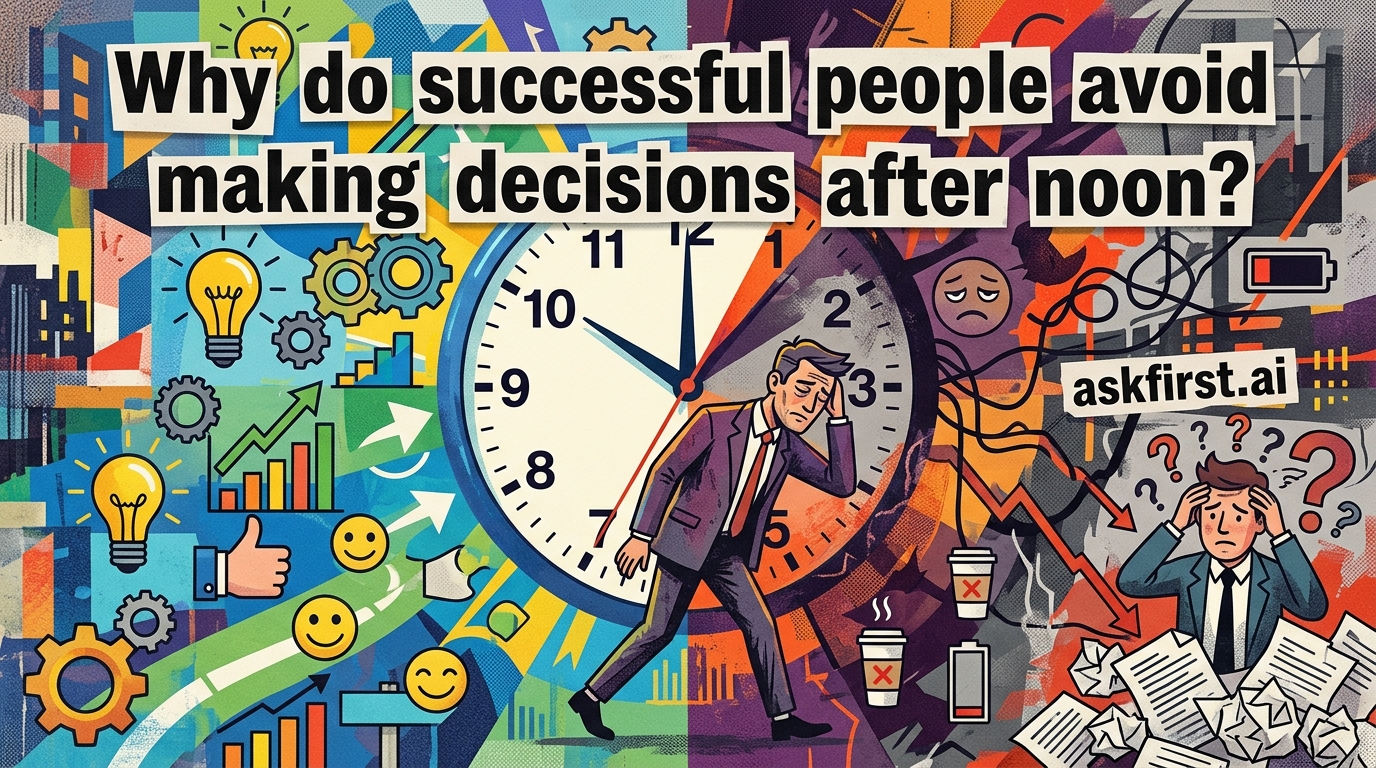
The Science of Decision Fatigue: Why High Achievers Prioritize Morning Choices
Decision fatigue is a psychological phenomenon describing the deteriorating quality of decisions made by an individual after a long session of decision-making. As the day progresses, the brain’s executive functions, particularly those housed in the prefrontal cortex, begin to experience a measurable decline in effectiveness. By the time noon arrives, a person has already navigated a barrage of choices—from what to wear and what to eat for breakfast to prioritizing complex work tasks and managing interpersonal communications.
Understanding the Mechanics of Cognitive Load
Every decision, regardless of its magnitude, requires cognitive effort. Psychologists often compare the brain to a battery; each choice drains a small amount of glucose and neuro-chemical resources. High achievers often operate on the principle that their willpower is a finite resource. By the afternoon, the brain enters a state of cognitive depletion. Research suggests that when the mind is tired, humans gravitate toward two default behaviors:
- Status Quo Bias: Choosing the path of least resistance or sticking with the current state to avoid the effort of evaluating new alternatives.
- Impulsivity: Seeking immediate gratification rather than calculating long-term consequences.
The Strategic Advantage of Morning Priming
Successful individuals, such as high-level executives and entrepreneurs, often front-load their schedules. By addressing high-stakes negotiations, strategic planning, and complex problem-solving before noon, they ensure that these critical tasks receive the full capacity of their analytical power. This practice is supported by the concept of 'Eat the Frog,' a productivity method suggesting that the most difficult task should be completed first to leverage peak mental clarity.
The Cost of Afternoon Compromise
Studies in judicial settings have famously highlighted the impact of timing on decision-making quality. In a widely cited study, parole board judges were significantly more likely to grant parole to prisoners after a food break compared to the end of a long session, where the likelihood of a favorable decision dropped toward zero. This illustrates that environmental factors and physiological needs—often ignored in the afternoon—have a profound impact on judgment.
Implementing a Decision-Making Protocol
To emulate this productivity hack, consider the following structural changes:
- Categorize Tasks: Differentiate between 'deep work' (high-value decisions) and 'administrative work' (low-value decisions).
- Time-Blocking: Dedicate the hours before 12:00 PM exclusively to deep work. Save meetings, email correspondence, and logistics for the afternoon.
- Minimize Low-Stakes Choices: Adopt habits like wearing similar clothing or following a set meal plan to preserve decision-making energy for what truly matters.
By treating mental bandwidth as a restricted asset, individuals can significantly improve the quality of their work and their long-term professional success.