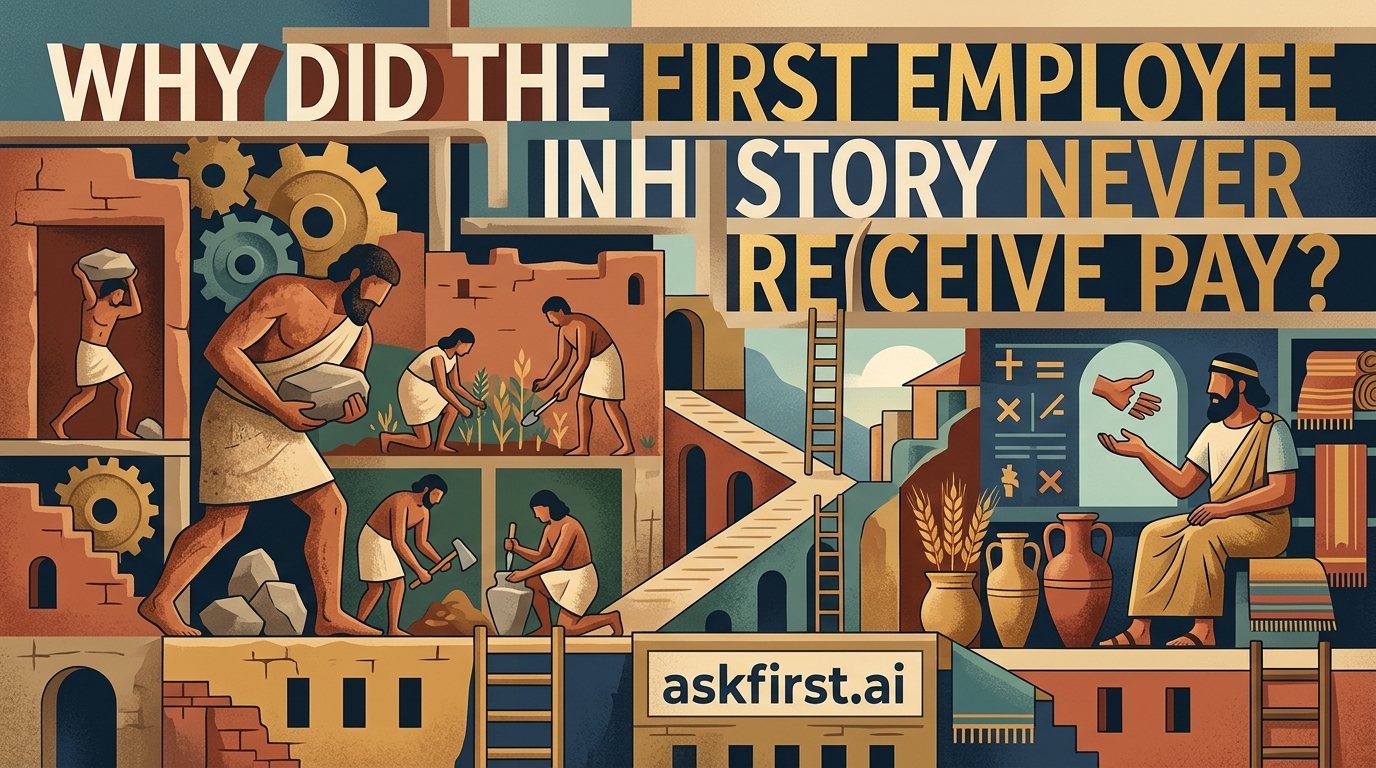
The Origin of Labor: Why the First Employee Worked for Free
To understand why the "first" employee never received a paycheck, one must first dismantle the modern misconception that employment is an ancient concept. In the prehistoric era, the survival of the individual was inextricably linked to the survival of the kin group or the tribe. Long before the invention of currency—which only appeared around 600 B.C. in the form of standardized coinage—labor was not a transaction; it was a communal obligation.
The Concept of Mutual Reciprocity
In early hunter-gatherer societies, the closest equivalent to an employee was an individual performing tasks for the benefit of the group. If an individual hunted for game or gathered berries, they were not "earning" a wage. Instead, they were fulfilling a role within a system of mutual reciprocity. This system relied on the understanding that those who contributed to the collective well-being would be fed and protected by that same collective when they were unable to provide for themselves. This is essentially the blueprint of social insurance, long before institutions existed.
The Absence of Currency and Contracts
Modern employment relies on three pillars: a contract, a specified task, and a monetary reward. None of these existed for the first laborers. Because no medium of exchange existed, there was no way to measure "pay." If someone helped build a communal shelter, the compensation was not a wage, but the shelter itself. The "payment" was the utility of the object created, rather than a store of value that could be exchanged elsewhere. To pay someone would have been functionally meaningless, as there was no market where that payment could be converted into other resources.
The Transition to Hierarchy
As civilizations evolved into hierarchical societies, the nature of work shifted. When agriculture emerged, individuals began working on plots of land, but still, these were often familial or communal efforts. The concept of an "employee" began to materialize only when specialized labor was required for non-essential tasks, such as those performed by early artisans serving a chieftain or a king. Even then, compensation was almost exclusively in the form of raw goods—grain, livestock, or protection—rather than fiat currency.
Why This Matters Today
This historical context highlights that the "paycheck" is a relatively modern psychological and social invention. Humans are hardwired for contribution and belonging, not just for the extraction of a wage. By understanding that labor existed for thousands of years as an act of survival and communal cohesion, one gains a deeper appreciation for the evolution of the modern economy. The first "employee" was not unpaid in a legal sense; they were fully compensated by the existence of their community and the direct fruits of their own labor.