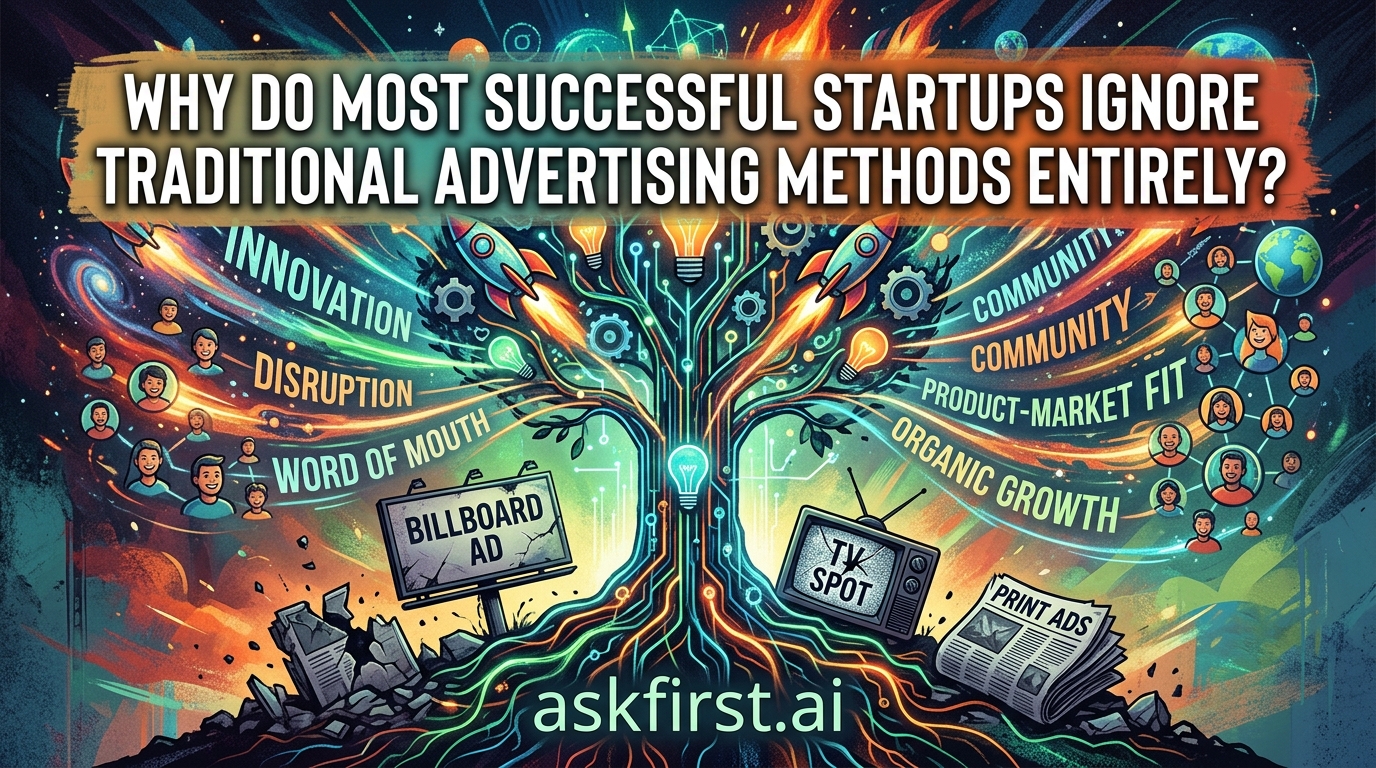
Why Modern Startups Abandon Traditional Advertising for Hyper-Growth
Traditional advertising methods, such as television spots, billboard campaigns, and print media, are often viewed as relics of a bygone industrial era. While legacy corporations continue to pump massive budgets into these top-down channels, most high-growth, successful startups intentionally avoid them. This strategic pivot is rooted in fundamental shifts regarding cost-efficiency, data precision, and the evolution of consumer psychology.
The Efficiency Paradox
The primary driver for this departure is the ROI paradox. Traditional advertising relies on mass-market penetration, assuming that by casting a wide net, some portion of the audience will convert. However, for a startup, every dollar must be optimized to prove product-market fit. Traditional methods offer little in terms of actionable attribution. In contrast, digital growth channels allow startups to track a single customer journey from initial impression to final purchase, enabling precise calculation of Customer Acquisition Cost (CAC) against Lifetime Value (LTV).
Data-Driven Decision Making
Successful startups prioritize data-centric growth loops over broad awareness campaigns. By utilizing search engine optimization (SEO), performance marketing, and influencer partnerships, these companies gather real-time feedback. If a campaign fails to generate interest, the underlying premise or creative assets can be adjusted in minutes. Traditional media formats like billboards are static; once bought, they are immutable, leaving no room for the agile iteration that defines modern entrepreneurship.
Building Organic Communities
Modern startups recognize that trust is the new currency. Traditional advertising is frequently perceived as an interruption—a distraction from the user experience. Conversely, building community through content marketing, social engagement, and viral loops creates genuine affinity. By fostering a brand identity that solves specific problems, companies like Notion, Slack, or Airbnb initially grew by creating "products users love," turning customers into vocal advocates. Word-of-mouth remains the most powerful growth engine, one that no traditional broadcast spot can replicate.
Scaling Through Network Effects
Lastly, successful startups focus on product-led growth. They bake marketing into the product itself. For example, viral referral programs or collaborative features encourage users to invite others, creating a virtuous cycle that lowers acquisition costs over time. Relying on paid media creates a "leaky bucket" scenario where growth stops the moment the advertising budget is turned off. Startups that leverage community and product mechanics ensure that their growth is compounding, autonomous, and resilient against market fluctuations. Ultimately, the choice to ignore traditional advertising is not just a budget constraint—it is a philosophical rejection of inefficient, opaque marketing in favor of scalable, measurable, and customer-centric growth.