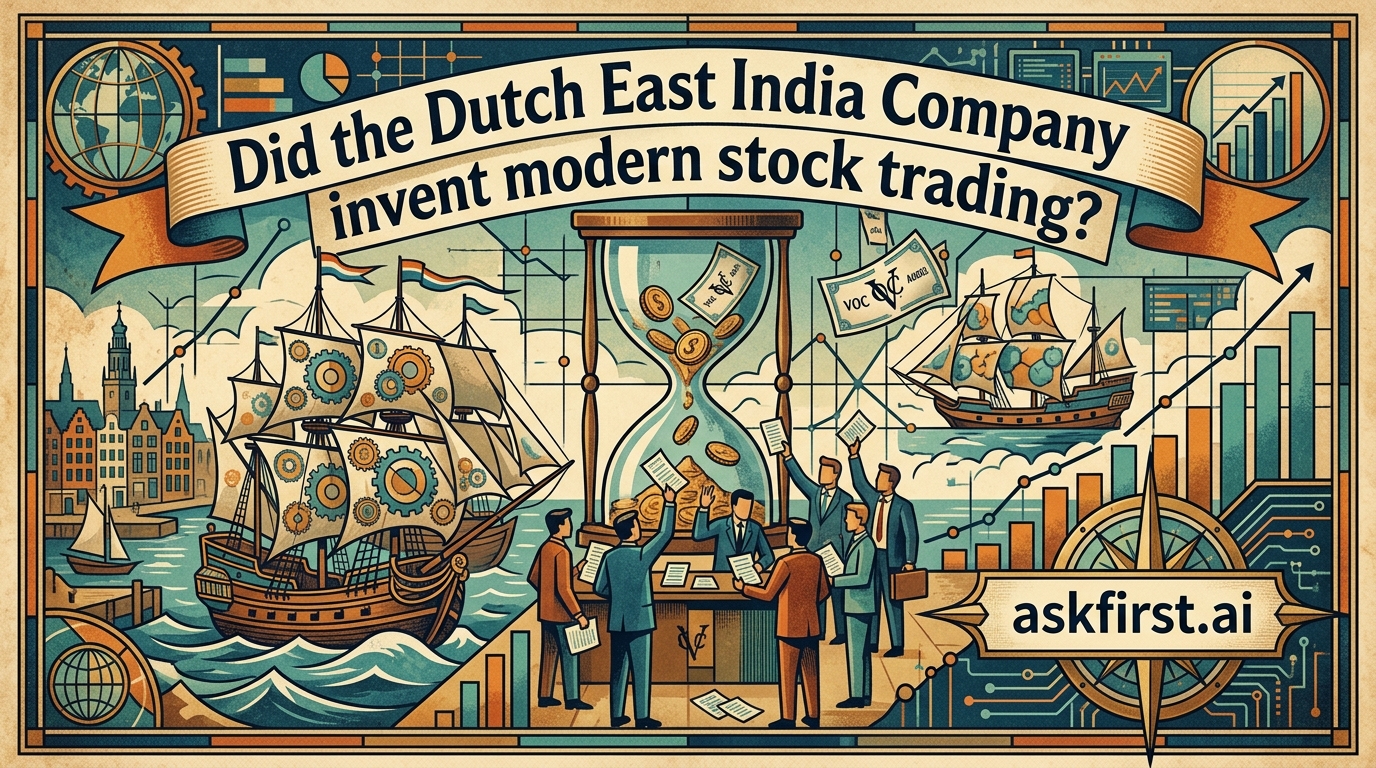
The Birth of Global Finance: The VOC and the Stock Market Revolution
The Dutch East India Company, known as the Vereenigde Oost-Indische Compagnie (VOC), founded in 1602, is widely credited with establishing the blueprint for the modern stock market. While forms of trade in debt and government bonds existed earlier in Italian city-states, the VOC revolutionized capitalism by creating the first permanent joint-stock company. This innovation fundamentally changed how humanity perceives wealth, investment, and corporate responsibility.
The Innovation of Permanent Capital
Before the VOC, maritime expeditions were typically financed by individual investors for single voyages. Once the ship returned and the cargo was sold, the entity was dissolved, and profits were divided. This system was inefficient and risky. The VOC introduced a radical alternative: permanent capital. Instead of dissolving after a voyage, the capital stayed with the company, allowing for long-term strategic planning, the building of permanent infrastructure, and the continuous funding of massive overseas fleets.
The Amsterdam Stock Exchange: A Hub of Liquidity
Because investors could not simply withdraw their capital after a single voyage, the Dutch created a secondary market on the Amsterdam Stock Exchange. This allowed shareholders to sell their stakes to other investors, providing them with the liquidity they needed without forcing the company to liquidate its assets. This transition marks the true birth of modern stock trading. Key mechanisms emerged during this period that are still standard today:
- Public Shareholding: Investors from all walks of life—from wealthy merchants to domestic servants—could buy into the company, democratizing the concept of investment.
- Secondary Market Trading: The ability to trade shares continuously on a public bourse created price discovery based on market sentiment and company performance.
- Dividend Payments: The VOC was the first company to consistently pay dividends to its shareholders, setting a precedent for return-on-investment expectations.
Challenging the Myths
While the VOC did not invent the concept of debt or commerce, it created the infrastructure of the modern financial system. Critics might point to earlier Venetian or Genoese financial instruments, but those were primarily government bonds or localized partnerships. The VOC’s genius lay in its global scale and its legal structure, which granted it the power to act as a quasi-state, signing treaties, maintaining its own army, and establishing colonies.
The Legacy of the VOC
By transforming speculative risk into tradeable equity, the VOC laid the groundwork for every public company currently listed on the New York Stock Exchange or the London Stock Exchange. The concepts of market capitalization, speculation, and institutional finance all trace their roots to the bustling halls of the 17th-century Amsterdam Exchange. Even in the digital age of high-frequency trading and cryptocurrency, the core logic established by the Dutch remains the bedrock of global financial stability and growth.