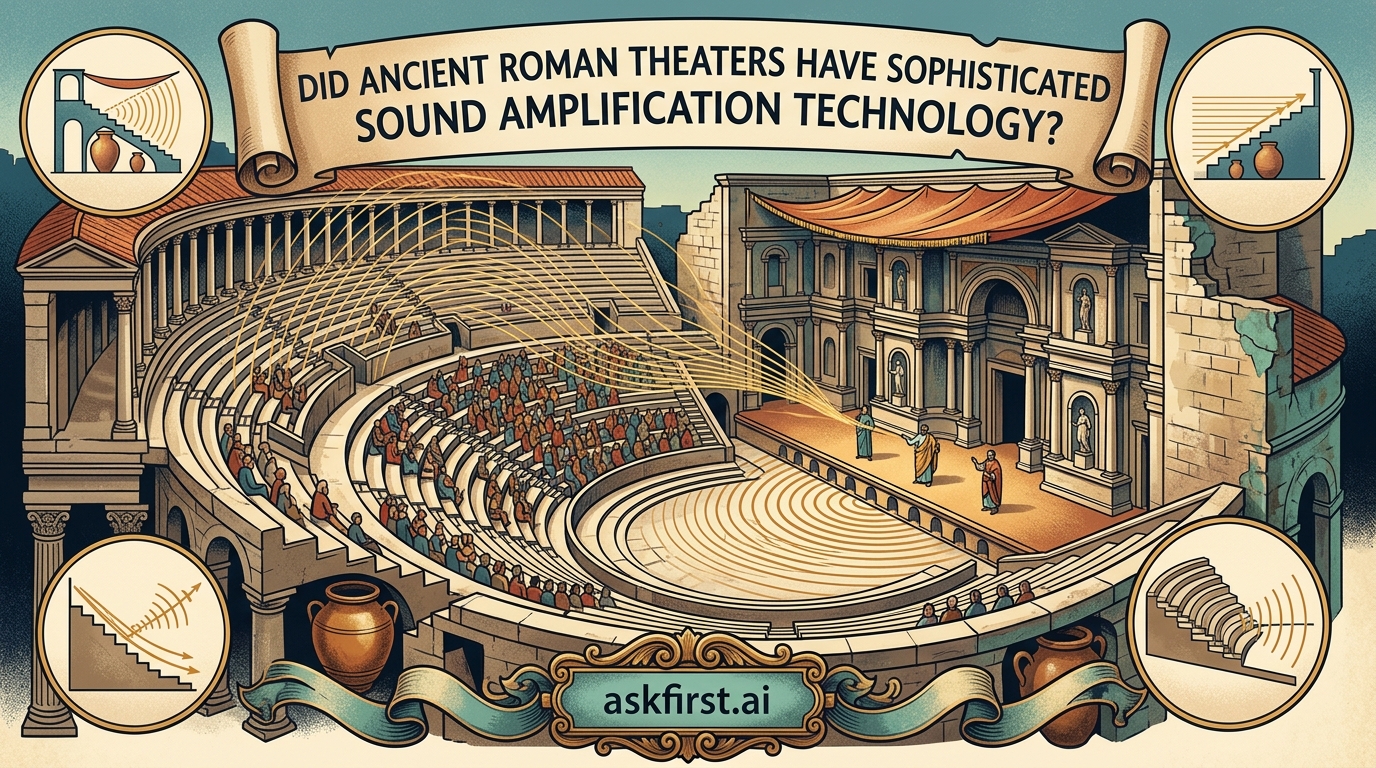
The Acoustic Secrets of Ancient Roman Theaters: Engineering Marvels
While the concept of "amplification" in the modern sense—involving electricity and speakers—did not exist, ancient Roman architects were masters of natural acoustic engineering. They designed structures that allowed a single performer's voice to carry to thousands of spectators with astonishing clarity, rivaling even modern concert halls.
The Geometry of Sound
The fundamental secret lay in the semicircular design of the theater (the cavea). Unlike the earlier Greek theaters, which were often built into hillsides with a circular orchestra, Roman architects standardized the semicircular shape to optimize sound propagation. By aligning the seating rows at precise, steep angles, they ensured that the sound waves reflected upward and outward, reaching every corner of the audience without significant dissipation.
The Role of Architecture and Materials
Several key architectural elements contributed to this acoustic excellence:
- Orchestra Surface: The floor of the orchestra (the area between the stage and the seats) was typically paved with hard stone or marble. This acted as a reflective surface, bouncing sound waves toward the audience rather than absorbing them.
- Scenae Frons: The elaborate, tall, multi-story wall behind the stage served as a sound reflector. It projected the actors' voices forward into the crowd. Without this structure, sound would have simply dissipated behind the stage.
- Slope Gradient: The rake of the seats followed specific geometric ratios that maintained a direct line of sight and sound between the performer and the spectator, effectively minimizing background noise interference.
The Mystery of Echea (Acoustic Vases)
Perhaps the most fascinating—and debated—aspect of Roman acoustics involves echea. According to the Roman architect Vitruvius in his treatise De Architectura, builders often placed bronze or ceramic vessels (vases) strategically under the seating tiers. These vessels were tuned to specific musical frequencies to amplify and clarify the sound through resonance. While modern archaeologists have found limited physical evidence of these devices, the theoretical framework proposed by Vitruvius suggests a highly sophisticated understanding of harmonic frequencies long before the development of digital sound processing.
Why This Remains Relevant
Modern acoustic engineers continue to study these Roman sites to understand how natural materials and geometric precision can achieve results that modern high-tech systems often struggle to replicate. The resilience of these structures over two millennia stands as a testament to the fact that, for the Romans, sound engineering was not just about volume, but about the purity and intelligibility of the human voice. In an age dominated by artificial amplification, the Roman theater remains the gold standard for natural, sustainable acoustic design.