The Visionary Architect of Software: Ada Lovelace and the Dawn of Computation
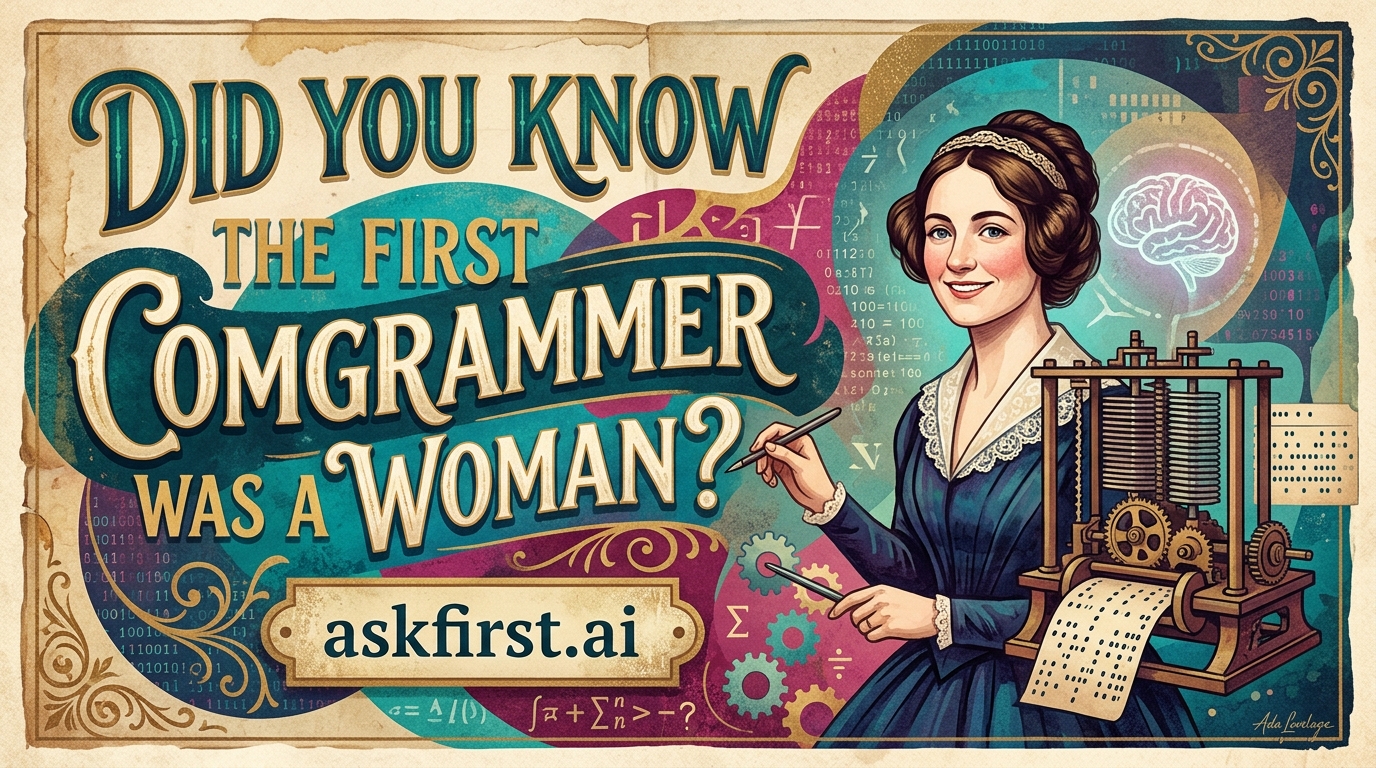
History often obscures the contributions of women in STEM, yet the foundation of modern computing rests upon the brilliant mind of Augusta Ada King, Countess of Lovelace. Born in 1815 as the daughter of the poet Lord Byron, Ada Lovelace possessed a unique intellect that bridged the gap between analytical mathematics and creative imagination. Her work in the mid-19th century effectively transformed a mechanical concept into a programmable reality, making her the world's first computer programmer.
The Collaboration with Charles Babbage
Lovelace's seminal achievement involved the Analytical Engine, a theoretical, general-purpose computer designed by Charles Babbage. While Babbage viewed his machine primarily as a calculator for numerical tables, Lovelace perceived something far more profound. She recognized that a machine capable of manipulating numbers could represent any data—including music, logic, and images—if those entities were defined by rules and symbols.
The First Algorithm
In 1843, Lovelace published her extensive notes on the Analytical Engine while translating an article by Italian engineer Luigi Menabrea. Her "Note G" contained the first algorithm intended to be processed by a machine: a complex sequence of operations to compute Bernoulli numbers. This was not merely a calculation; it was a comprehensive demonstration of how a computer could be programmed to perform iterative, logic-based tasks autonomously.
Key Contributions and Legacy
- Conceptualizing General-Purpose Computing: Lovelace was the first to articulate the idea that machines could function beyond simple arithmetic. This is now known as the "Poetical Science" approach, where she treated computing as an art form.
- The Concept of Algorithms: She pioneered the structure of looping and conditional branching, which remain the fundamental building blocks of all modern software architecture.
- Predicting AI and Digital Media: In her writings, she prophetically suggested that if music were represented through formal patterns, the engine could potentially compose elaborate, scientific pieces of music of any degree of complexity.
Debunking the Myth of the Mechanical Calculator
For decades, skeptics attempted to minimize Lovelace’s role, characterizing her contributions as mere transcription or secondary documentation. However, modern historians, such as computer scientist John Graham-Cumming, have validated that her logic was entirely original and far more advanced than that of her contemporaries. She looked at a gear-driven machine and saw a universal processor, effectively predicting the arrival of the digital age a century before the development of electronic circuitry.
Today, Ada Lovelace serves as a monumental inspiration for software engineers worldwide. Her ability to synthesize disparate fields of knowledge serves as a blueprint for modern innovation. Her legacy is not just about historical accuracy; it is about recognizing the intuitive capacity of the human mind to see potential in technology long before the hardware catches up to the vision.