The Secret Sound of History: How Ancients Mastered Acoustics
Ancient architects possessed a profound understanding of physics that continues to challenge modern engineering standards. The construction of theaters like Epidaurus in Greece reveals that acoustics were not merely a functional requirement but an obsession rooted in the necessity for clear communication across vast, unamplified open spaces.
The Geometry of Sound
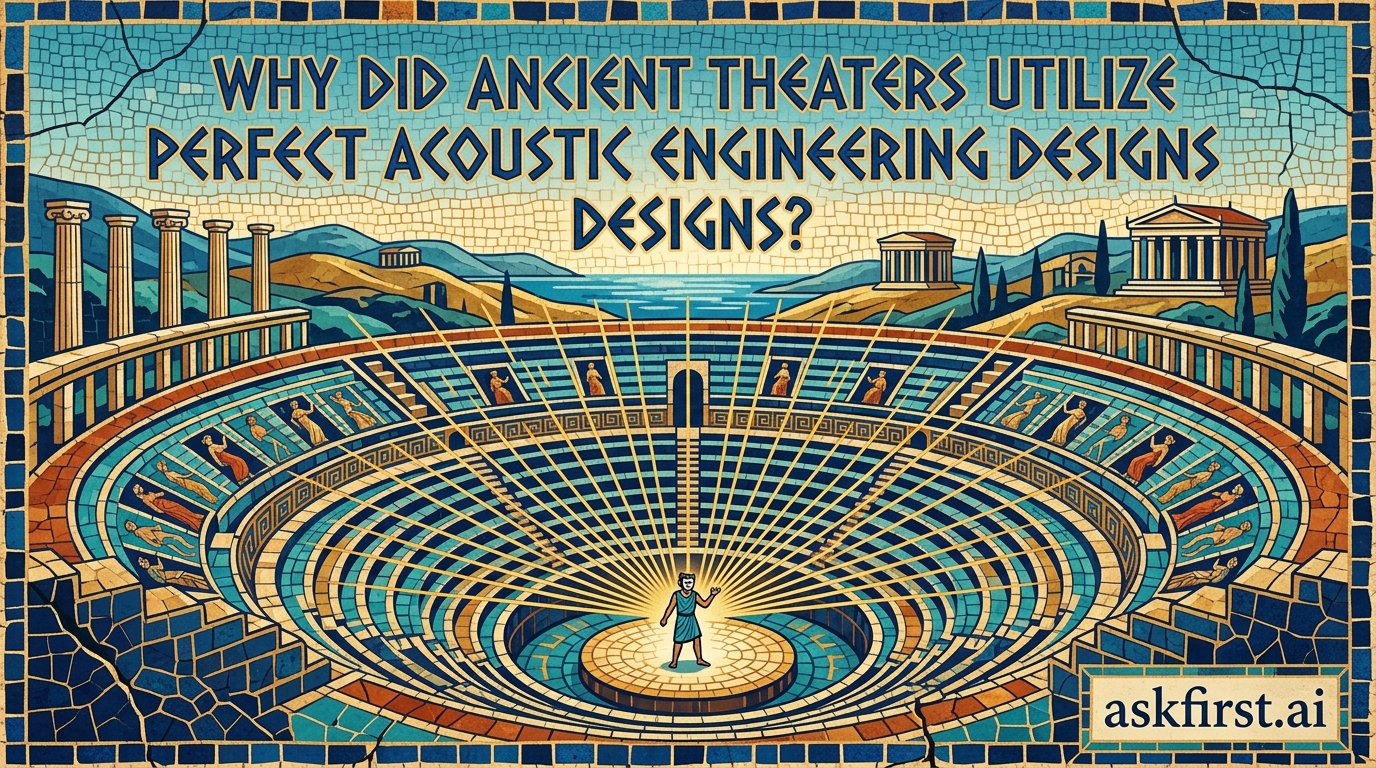
The primary genius of ancient theater design lies in the bowl-shaped structure. By building into hillsides, architects utilized the earth as a natural dampening agent against background wind noise. The seating sections, known as the cavea, were angled precisely to prevent sound absorption. Because stone is a reflective material, it acted as a giant mirror for sound waves, bouncing them back toward the stage or toward the listeners with minimal loss of intensity.
The Limestone Filter
A groundbreaking study conducted by researchers at the Georgia Institute of Technology uncovered a secret hidden in the limestone seats of Epidaurus. The jagged, corrugated texture of these seats acts as a sophisticated acoustic filter. It suppresses low-frequency noises, such as the murmurs of a restless crowd or the wind, while simultaneously amplifying the high-frequency sounds of actors' voices. This "acoustic trap" essentially filters out background interference, allowing the performers to reach the back rows with perfect clarity without electronic amplification.
Mathematical Precision and Sightlines
Beyond the material composition, the mathematical layout was key to their success. The circular orchestra floor served as the source point for sound. From this epicenter, sound waves emanated outward in concentric circles. By maintaining specific ratios between the height, width, and depth of the theater, builders ensured that time-delay issues—where sound reaches the ear at slightly different intervals—were minimized. This prevented the "echo effect" that often plagues modern concrete stadiums.
Legacy and Application
Ancient theaters were designed to honor the spoken word. In a culture without microphones, the theater was an extension of the human vocal cord. Every design choice, from the inclusion of masks to enhance resonance to the placement of limestone tiers, was intended to create an immersive experience. Today, architects study these structures to design concert halls that balance the raw power of sound with the clarity of human speech. The ancient Greeks essentially cracked the code of wave propagation long before the invention of digital signal processing. By observing how they manipulated space, geometry, and material, one discovers that the ancients were not just building monuments; they were designing the world’s first high-fidelity speaker systems, proving that sophisticated science is truly timeless.