Unearthing the Past: How Fossils Serve as Earth’s Biological Archive
Fossils are the preserved remains, impressions, or traces of ancient organisms that provide the primary evidence for the history of life on Earth. By studying these geological records, paleontologists can reconstruct ecosystems, track evolutionary transitions, and understand climate shifts that occurred millions of years ago.
The Process of Fossilization: A Rare Occurrence
Fossilization is an exceptionally rare event, as most organic matter decays completely. For an organism to become a fossil, it must typically be buried rapidly after death—often by sediment like mud, silt, or volcanic ash—which protects it from scavengers and aerobic decomposition.
Common Methods of Preservation
- Permineralization: Minerals from groundwater (such as silica or calcite) seep into the pores of bones, shells, or wood, gradually turning them into stone.
- Carbonization: Under extreme pressure, the volatile elements of an organism are squeezed out, leaving behind a thin, dark film of carbon that preserves delicate outlines, such as leaves or soft-bodied insects.
- Molds and Casts: An organism leaves an impression in sediment (the mold), which may later be filled with minerals to create a three-dimensional replica (the cast).
- Entombment: Organisms preserved in amber (fossilized tree resin), ice, or tar pits offer the most detailed specimens, sometimes even retaining soft tissue or DNA fragments.
Stratigraphy and the Geological Time Scale
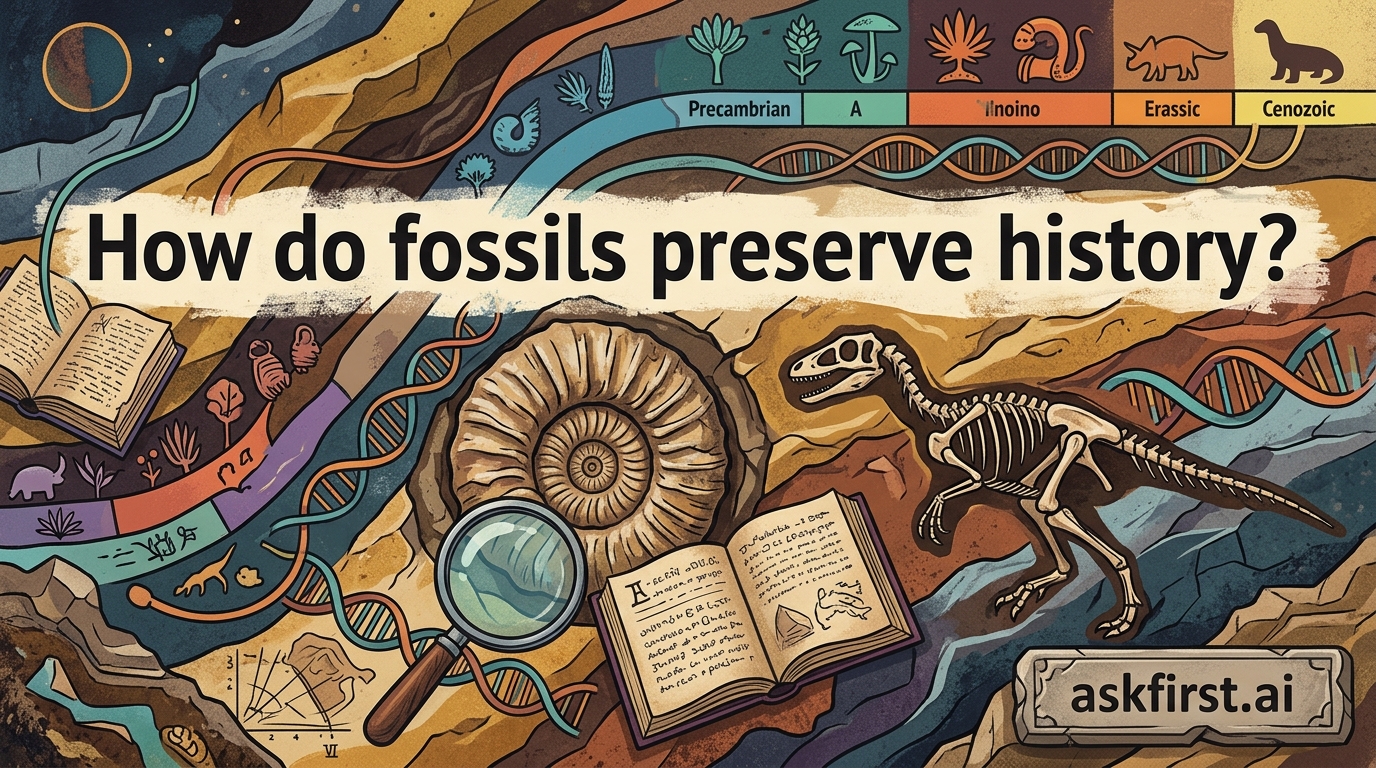
Fossils act as chronological markers. Through biostratigraphy, scientists use "index fossils"—species that were widespread but lived for a short, well-defined geological period—to date rock layers. By comparing the position of fossils in sedimentary strata (the Law of Superposition), we can establish a relative timeline of life, from the simple microbial mats of the Precambrian to the complex mammals of the Cenozoic.
Scientific Significance and Evolutionary Insights
Fossils provide the tangible "missing links" in evolutionary theory. For example, the discovery of Archaeopteryx provided the crucial bridge between non-avian dinosaurs and modern birds. Furthermore, fossils allow scientists to analyze:
- Paleoclimatology: The presence of specific plant fossils can reveal the temperature and humidity of ancient environments.
- Extinction Events: The fossil record documents the "Big Five" mass extinctions, such as the K-Pg event 66 million years ago, which wiped out the non-avian dinosaurs.
- Morphological Evolution: By examining skeletal changes over time, researchers can map the transition of life from water to land.
Limitations and Future Trends
Despite their value, the fossil record is inherently biased. It favors organisms with hard parts (bones, teeth, shells) and those that lived in sedimentary environments. Soft-bodied organisms are woefully underrepresented. However, the future of paleontology is shifting toward virtual paleontology. Using high-resolution CT scanning and synchrotron radiation, scientists can now peer inside rocks to view internal structures without damaging the specimens, allowing for unprecedented digital reconstruction of ancient life.
Ultimately, fossils are not merely dusty relics; they are the fundamental data points of Earth’s biological legacy, offering a window into the deep past that informs our understanding of global biodiversity and the resilience of life itself.