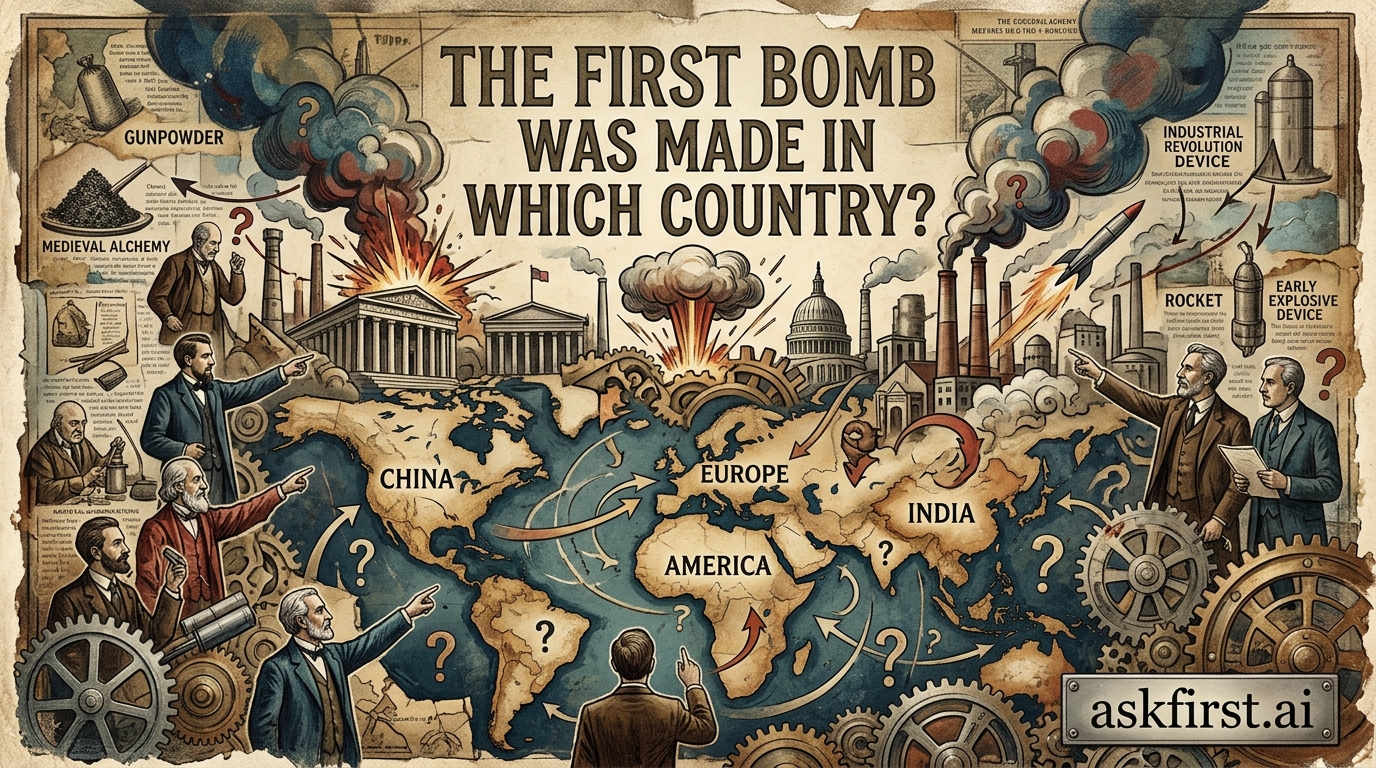
The Genesis of Atomic Power: A Historical Overview of the First Nuclear Weapon
The development of the first atomic bomb, a project that fundamentally altered the course of human history, took place in the United States of America. Known as the Manhattan Project, this massive, top-secret research and development undertaking was conducted during World War II, primarily between 1942 and 1946, under the scientific direction of J. Robert Oppenheimer and the military leadership of General Leslie Groves.
The Origins and Scientific Foundation
The impetus for the creation of the bomb began in Europe, where the discovery of nuclear fission in 1938 by German chemists Otto Hahn and Fritz Strassmann sparked international alarm. Fearing that Nazi Germany might develop a weapon of mass destruction, a group of prominent physicists, including Albert Einstein and Leó Szilárd, urged the United States government to initiate its own nuclear research program.
The project grew into a colossal industrial effort, involving over 130,000 employees and costing nearly $2 billion (equivalent to over $30 billion today). Major research sites were established across the country, most notably:
- Los Alamos, New Mexico: The primary laboratory for bomb design and assembly.
- Oak Ridge, Tennessee: Dedicated to the enrichment of uranium-235.
- Hanford, Washington: Focused on the production of plutonium-239.
The Trinity Test: First Detonation
The culmination of this research occurred on July 16, 1945, at the Jornada del Muerto desert in New Mexico. The Trinity test was the world's first detonation of a nuclear device. The plutonium-based implosion device, nicknamed "Gadget," released an energy equivalent to approximately 20 kilotons of TNT, proving that nuclear weapons were not only theoretically possible but practically deployable.
Practical Implementation and Military Use
Following the success of the Trinity test, the United States utilized the technology in the final stages of the Pacific War. Two atomic bombs were deployed over Japan:
- "Little Boy" (Uranium-235 gun-type): Dropped on Hiroshima on August 6, 1945.
- "Fat Man" (Plutonium implosion-type): Dropped on Nagasaki on August 9, 1945.
These events led to the immediate surrender of the Japanese Empire and marked the beginning of the Atomic Age.
Pros, Cons, and Ethical Implications
The creation of the bomb remains one of the most debated topics in history.
- Pros (Arguments for): Proponents argue the bomb ended the war quickly, preventing the estimated millions of casualties that would have resulted from a conventional invasion of the Japanese mainland.
- Cons (Arguments against): Critics emphasize the devastating humanitarian impact, the immediate and long-term suffering of civilians due to radiation, and the initiation of a global nuclear arms race that threatened planetary extinction for decades.
Future Trends and Legacy
Today, nine nations possess nuclear weapons. The focus of global policy has shifted from mass production to non-proliferation and nuclear disarmament. Future trends involve the modernization of existing arsenals, the development of hypersonic delivery systems, and the ongoing challenge of preventing nuclear terrorism. The legacy of the Manhattan Project remains a cautionary tale of how scientific discovery can hold the power to both protect and destroy civilization.