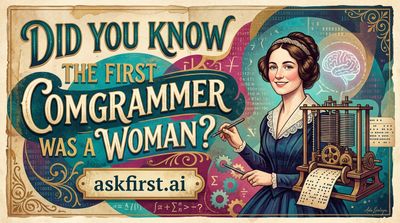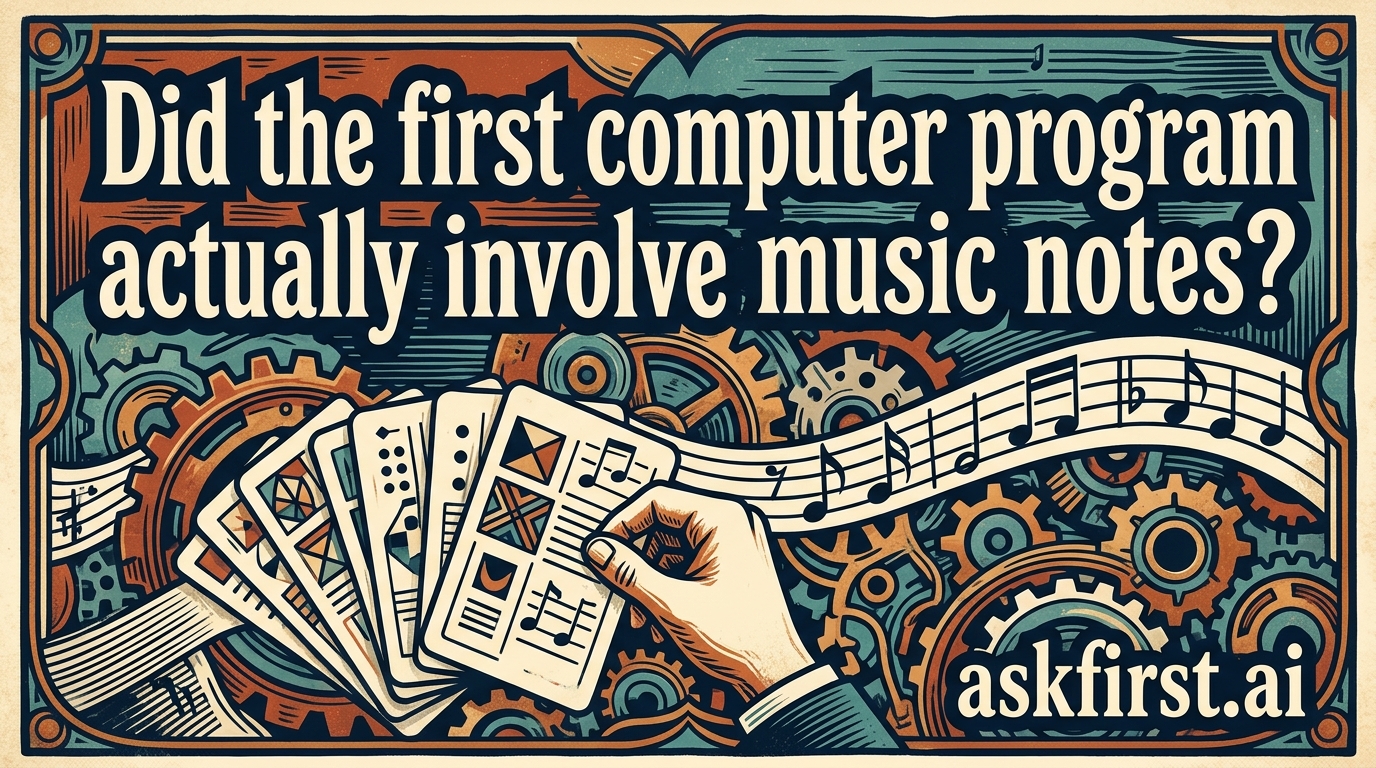
The Harmonic Origins: Did Ada Lovelace Write Musical Code? While popular culture often associates the birth of computer science with binary arithmetic or cold, mechanical calculation, the story of the first computer program is deeply intertwined with the mathematical nature of music. The first recognized computer programmer, Ada Lovelace, did not merely foresee a machine that performed simple equations; she envisioned a system capable of manipulating symbols according to rules. ## The Analytical Engine and Musical Theory In 1843, while working on a translation of Luigi Menabrea’s memoir on Charles Babbage’s Analytical Engine, Lovelace authored an extensive set of 'Notes.' Within Note G, she described an algorithm intended for the machine to calculate Bernoulli numbers. However, her vision extended far beyond arithmetic. Lovelace famously postulated that if the fundamental relations of pitched sounds in the science of harmony were susceptible to such expression, the engine might compose elaborate and scientific pieces of music of any degree of complexity or extent. ## Challenging the Myths There is a common misconception that the first program was a digital symphony. In reality, the specific program provided in the appendices of her notes was purely mathematical. However, the theoretical groundwork she laid explicitly included music as a potential application of programmable logic. By suggesting that a machine could process symbols representing anything—not just numbers—she fundamentally changed the trajectory of computing from a calculator to a universal information processor. ## Key Historical Context * Symbolic Logic: Lovelace realized that machines could process symbols representing music notes just as easily as they processed numbers representing values. * The Theoretical Bridge: Her notes serve as the first historical document to bridge the gap between computational machinery and creative expression. * Conceptual Foundations: While the hardware (Babbage’s engine) was never fully completed during her lifetime, the software logic documented in her notes remains the definitive origin point of computer programming. ## The Legacy of Algorithmic Music Lovelace’s insight was profound because it introduced the concept of the 'stored-program' paradigm long before modern silicon chips existed. She recognized that the physical hardware was less important than the symbolic instructions fed into it. This realization allowed future generations to build machines that could synthesize audio, process digital signals, and eventually lead to the creation of algorithmic composition software. By linking music to the mechanical process of calculation, she correctly predicted that machines would eventually participate in human creativity. While the first written code for the Analytical Engine was focused on Bernoulli numbers, the first conceptual framework for a computer program was explicitly designed to handle music. This duality confirms that the DNA of modern computing has always contained the spark of artistic expression.

AuthorRobert Entena Carteciano
June 25, 2026
P.S. You can ask any follow-up question on this topic by continuing the dialogue with AI in the chat below