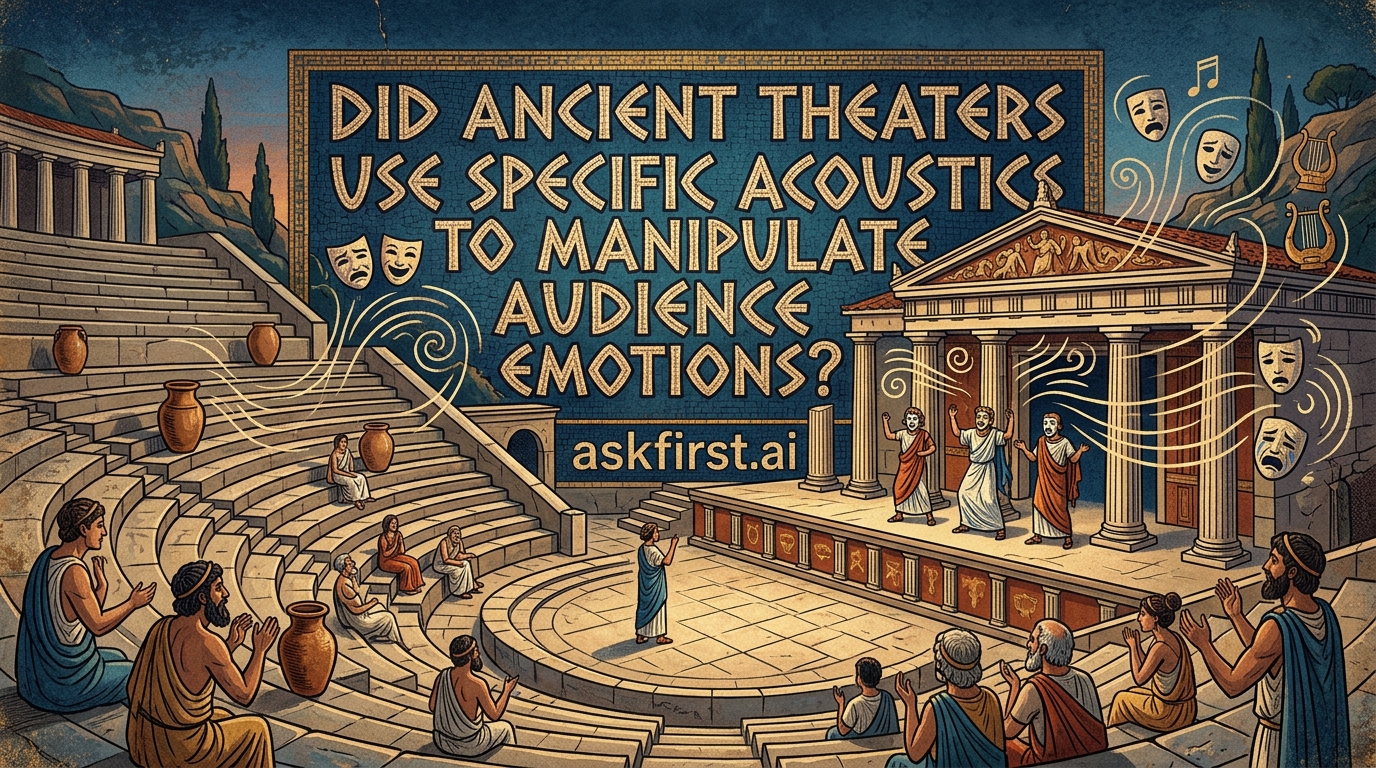
The Sonic Secrets of Ancient Theater: Architectures of Awe
Ancient Greek and Roman engineers were not merely builders; they were masters of psychoacoustics who designed theaters to harmonize human emotion with physical space. By leveraging advanced mathematical principles, these ancient architects ensured that every whisper on stage could resonate with startling clarity, creating an immersive sensory experience that predated modern sound engineering by millennia.
The Engineering of Resonance
The secret behind the success of structures like the Theatre of Epidaurus lies in the sophisticated arrangement of its limestone seats. Researchers from the Georgia Institute of Technology discovered that the rows of stepped benches act as an acoustic filter. This design suppresses low-frequency background noises—such as the murmurs of a restless crowd—while simultaneously amplifying high-frequency sounds, which carry the crisp nuances of the human voice. This intentional attenuation allows the emotional inflection of an actor to reach the furthest rows with pristine quality.
- Material Selection: The specific limestone used in these structures was chosen for its density and reflective properties, which help bounce sound waves without creating chaotic echoes.
- The Orchestral Floor: The circular area known as the orchestra was designed to serve as a soundboard, reflecting acoustic energy upward and outward toward the seating tiers.
Emotional Manipulation Through Sound
This acoustic precision was not accidental; it was a deliberate tool used to manipulate the audience's emotional response. In the context of Greek tragedy, where catharsis was the ultimate goal, the ability to transmit delicate vocal tremors or sudden shouts was vital. When an audience experiences perfectly crisp, intimate audio in a space containing thousands of people, it fosters a shared psychological intensity. This phenomenon, often referred to as "acoustic intimacy," narrows the perceived gap between the actor and the viewer, ensuring that the dramatic weight of the performance hits the spectator with profound visceral force.
A Legacy of Acoustic Mastery
Beyond their aesthetic beauty, these theaters functioned as communal psychological engines. By perfecting the transmission of vocal resonance, ancient architects enabled playwrights like Sophocles and Aeschylus to evoke fear, pity, and joy in a unified crowd. This synchronization of emotional states through high-fidelity sound helped forge a collective identity among citizens, turning individual spectators into a cohesive body that felt and reacted as one.
Ultimately, the ingenuity of these ancient structures proves that our ancestors understood human psychology as deeply as they understood geometry. The ability to direct the flow of sound—and consequently, the flow of feeling—remains a cornerstone of architectural design, reminding us that true storytelling is as much about the environment as it is about the script. By mastering the invisible physics of sound, they guaranteed that the dramas of the human condition would endure long after their stone walls had weathered away.