The Science of Swells: Understanding the Mechanics of Ocean Waves
Ocean waves are among the most dynamic phenomena on Earth, serving as the primary mechanism for energy transfer across the surface of the world's hydrosphere. While they may appear to be moving bodies of water, they are, in physical terms, energy traveling through a medium.
1. The Primary Driver: Wind Friction
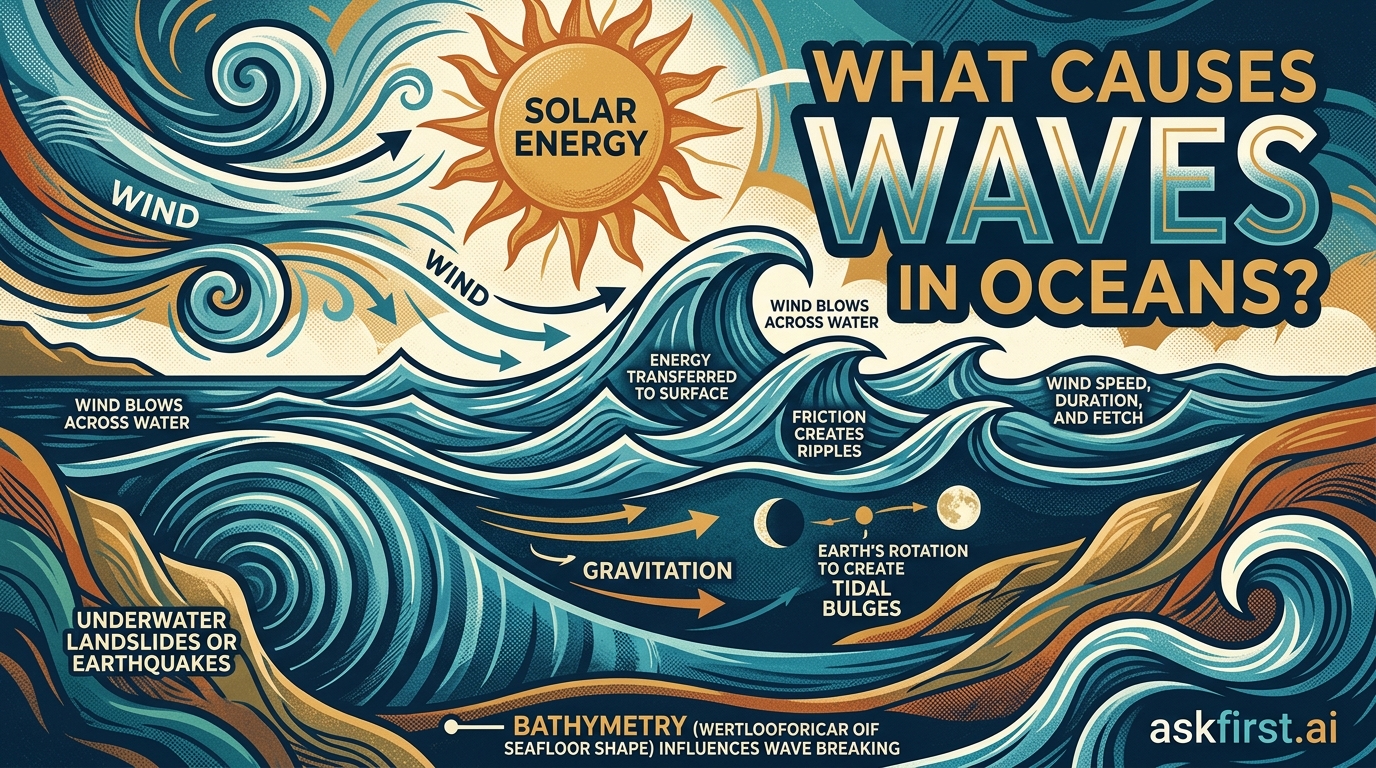
The vast majority of ocean waves are generated by wind. When wind blows across the surface of the ocean, friction occurs between the air molecules and the water molecules. This process, known as wind stress, creates tiny ripples called "capillary waves." As the wind continues to blow, these ripples grow in size, capturing more energy and transforming into larger waves.
Three critical variables dictate the size and power of these waves:
- Wind Speed: The faster the wind, the more energy is transferred to the water.
- Duration: The longer the wind blows in a consistent direction, the larger the waves grow.
- Fetch: This refers to the distance of open water over which the wind blows without obstruction. Larger fetches allow waves to accumulate significantly more energy.
2. The Physics of Wave Motion
It is a common misconception that waves represent water moving across the ocean. In reality, water particles move in a circular orbital motion. As a wave passes, a single molecule of water moves up, forward, down, and back, returning nearly to its original position. This is why a floating object, such as a buoy, bobs up and down rather than being carried forward by every passing wave.
3. Other Causes: Beyond the Wind
While wind is the primary culprit, other geological and celestial forces create waves:
- Tidal Waves: Caused by the gravitational pull of the Moon and the Sun acting on the Earth's oceans. These are long-period waves that move across the entire planet.
- Tsunamis: These are not wind-driven. They are displacement waves caused by massive underwater disturbances, such as earthquakes, volcanic eruptions, or landslides. Unlike wind waves, tsunamis involve the movement of the entire water column from surface to seafloor.
- Ship Wakes: Man-made waves generated by the displacement of water as a vessel moves through it.
4. The Lifecycle of a Wave
- Generation: Energy is transferred from the atmosphere to the ocean.
- Propagation: The wave travels across the open ocean as a "swell," losing very little energy over vast distances.
- Shoaling: As the wave approaches shallow water, the bottom of the wave drags against the seafloor. This friction slows the bottom while the top continues at high speed, causing the wave to steepen and eventually "break" onto the shore.
5. Future Trends and Climate Impact
Climate scientists are increasingly monitoring wave energy as a proxy for climate change. As global temperatures rise, wind patterns shift and intensify, leading to higher average wave heights in certain oceanic basins. Furthermore, the development of Wave Energy Converters (WECs) is gaining momentum, as engineers seek to harvest the kinetic energy of these waves as a sustainable, carbon-free power source for coastal communities. Understanding wave dynamics is thus not only a matter of geography but a vital component of future energy infrastructure.