The Mechanics of Motion: How Engines Convert Energy into Kinetic Power
At its core, an engine is a machine designed to convert one form of energy—usually chemical or thermal—into mechanical work. Whether it is an internal combustion engine (ICE) in a vehicle, a jet turbine, or an electric motor, the fundamental principle remains the transformation of potential energy into kinetic energy to produce motion.
1. Internal Combustion Engines (ICE)
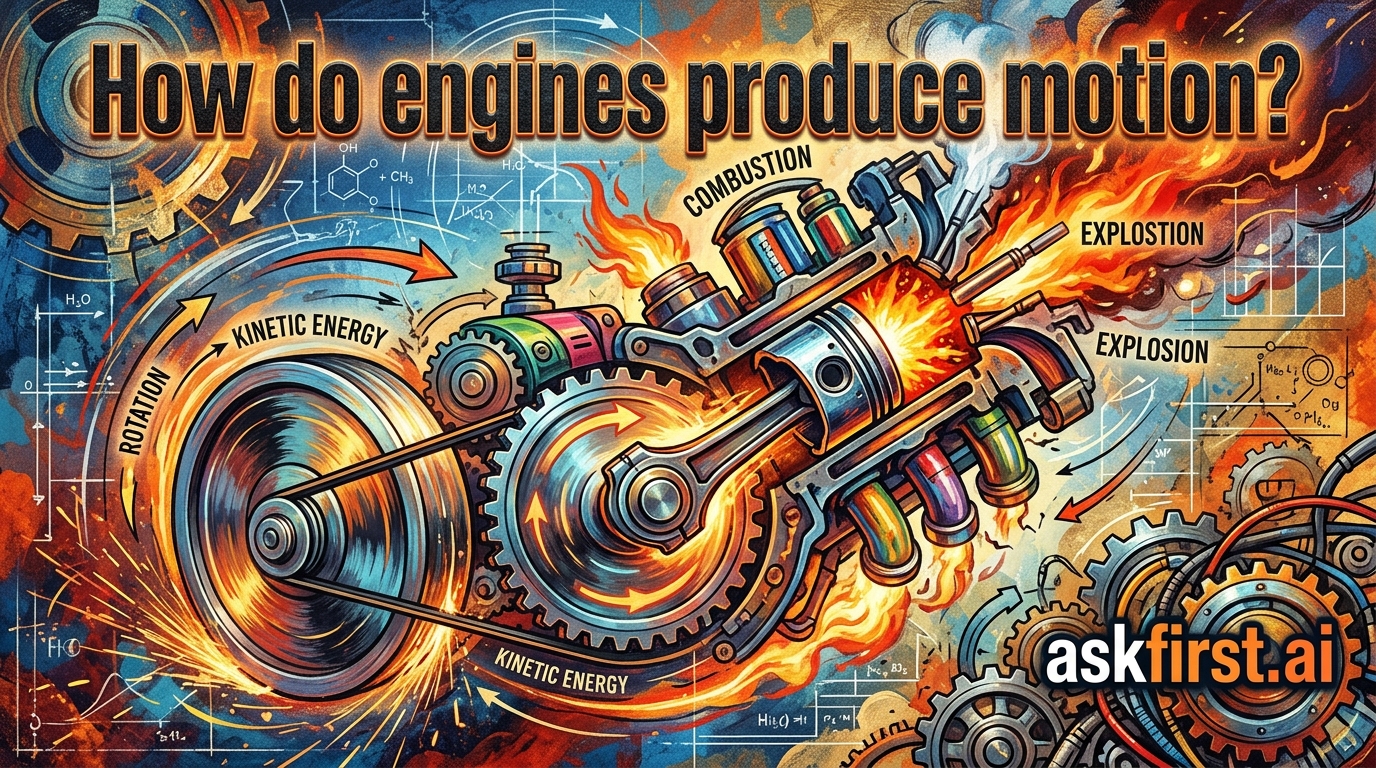
The most common engine type, the ICE, operates on the principle of controlled explosions. This process generally follows the four-stroke cycle: Intake, Compression, Power, and Exhaust.
- Intake: The piston moves downward, drawing a mixture of fuel and air into the combustion chamber.
- Compression: The intake valve closes, and the piston rises, compressing the mixture to increase its potential energy.
- Power: A spark plug ignites the pressurized mixture. The resulting rapid expansion of hot gases forces the piston downward with immense pressure. This linear, vertical motion is the "engine" of the process.
- Exhaust: The piston rises again to push the spent gases out of the exhaust valve, clearing the chamber for the next cycle.
Converting Linear to Rotational Motion
The vertical movement of the pistons is converted into rotational motion via the crankshaft. Much like a cyclist’s legs pushing pedals, the connecting rods attached to the pistons push the crankshaft, causing it to spin. This rotational energy is then transmitted through the transmission to the wheels, creating forward motion.
2. Electric Motors: The Electromagnetic Alternative
Electric motors operate on Lorentz force. When an electric current passes through a wire placed within a magnetic field, the wire experiences a force. In a motor, coils of wire (the armature) are positioned between permanent magnets. As current flows, magnetic fields interact, creating a torque that forces the armature to rotate. Because they do not rely on combustion, electric motors provide nearly instantaneous torque and possess far fewer moving parts, resulting in higher efficiency—often exceeding 90% compared to the 20–40% efficiency of traditional ICEs.
3. Comparative Analysis
| Feature | Internal Combustion | Electric Motor |
|---|---|---|
| Energy Source | Fossil Fuels / Biofuels | Electricity (Batteries/Grid) |
| Efficiency | Low (Heat loss) | High (Minimal waste) |
| Complexity | High (Hundreds of parts) | Low (Fewer moving parts) |
| Environmental Impact | Carbon emissions | Depends on power source |
4. Future Trends and Evolution
The automotive and industrial sectors are currently undergoing a massive paradigm shift. While ICEs have dominated for over a century, the future is trending toward electrification and hydrogen fuel cells. Hydrogen engines produce motion by combining hydrogen with oxygen in a fuel cell to create electricity, emitting only water vapor as a byproduct.
Furthermore, advancements in solid-state batteries and regenerative braking—where the kinetic energy of a slowing vehicle is captured and returned to the battery—are refining how we manage motion. As we move toward 2030, the integration of AI-driven engine management systems will continue to optimize fuel consumption and torque delivery, ensuring that the conversion of energy into motion becomes cleaner, quieter, and significantly more efficient.