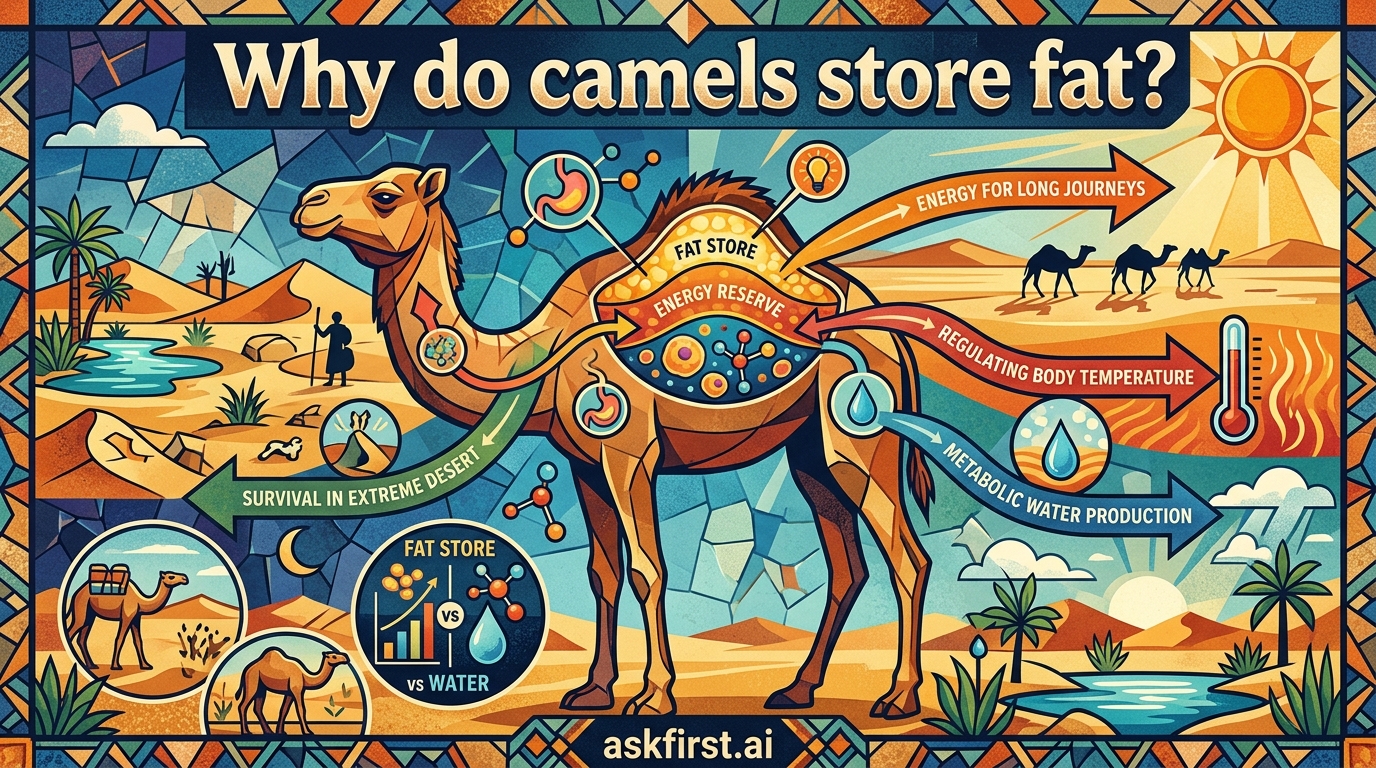
The Biological Marvel: Why Camels Store Fat in Their Humps
The camel, often referred to as the "ship of the desert," is one of nature’s most remarkable examples of evolutionary adaptation. A common misconception is that a camel’s hump stores water. In reality, the hump is a specialized reservoir for adipose tissue—or fat. Understanding why camels store fat in this localized manner requires an exploration of thermoregulation, metabolic efficiency, and desert survival strategies.
The Physiology of the Hump
The camel’s hump is composed of fibrous tissue and stored fat. When food is scarce, the camel’s body metabolizes this fat to generate energy. As the fat is broken down, it provides the camel with sustenance that can last for weeks, even months, without a significant meal.
Why Not Store Fat Evenly?
Unlike humans or other mammals that distribute fat throughout the body, camels concentrate it in the hump for a critical survival reason: thermoregulation. If a camel had a layer of fat distributed under its skin (subcutaneous fat), it would act as an insulator, trapping body heat. In the scorching temperatures of the desert, this would lead to rapid overheating. By sequestering fat in a single, dorsal mound, the rest of the camel's body remains lean, allowing excess heat to dissipate easily through the skin.
Metabolic Processes and Water Production
While the hump does not store water, it is intrinsically linked to water conservation. Through the process of cellular respiration, the metabolism of fat yields energy and metabolic water. For every gram of fat oxidized, the camel gains a small amount of water. While this is not enough to sustain the camel indefinitely without external hydration, it is a significant evolutionary advantage in extreme arid environments.
Practical Survival Mechanics
When a camel is well-fed, its hump stands tall and firm. As the camel consumes its fat reserves due to food deprivation, the hump becomes flaccid and may lean to one side. Once the animal finds food and water again, the hump regains its structure.
Key Advantages of This Adaptation:
- Energy Density: Fat provides more than twice the energy per gram compared to carbohydrates or proteins, making it the most efficient "fuel tank" for long migrations.
- Heat Dissipation: Allows the camel to keep its internal organs cool while moving across blistering sands.
- Endurance: Enables camels to travel up to 100 miles (160 km) in a day under heavy loads with minimal caloric intake.
Evolutionary Context and Future Trends
Camels evolved over millions of years, tracing their lineage back to North America before migrating to the deserts of Africa and Asia. As climate change increases desertification across the globe, the camel’s unique metabolic efficiency is becoming a subject of intense interest for agricultural scientists. Researchers are studying these mechanisms to understand how livestock might better adapt to increasingly arid farming conditions. By mastering the art of fat storage and metabolic water production, the camel remains the gold standard for survival in the world’s most inhospitable climates.