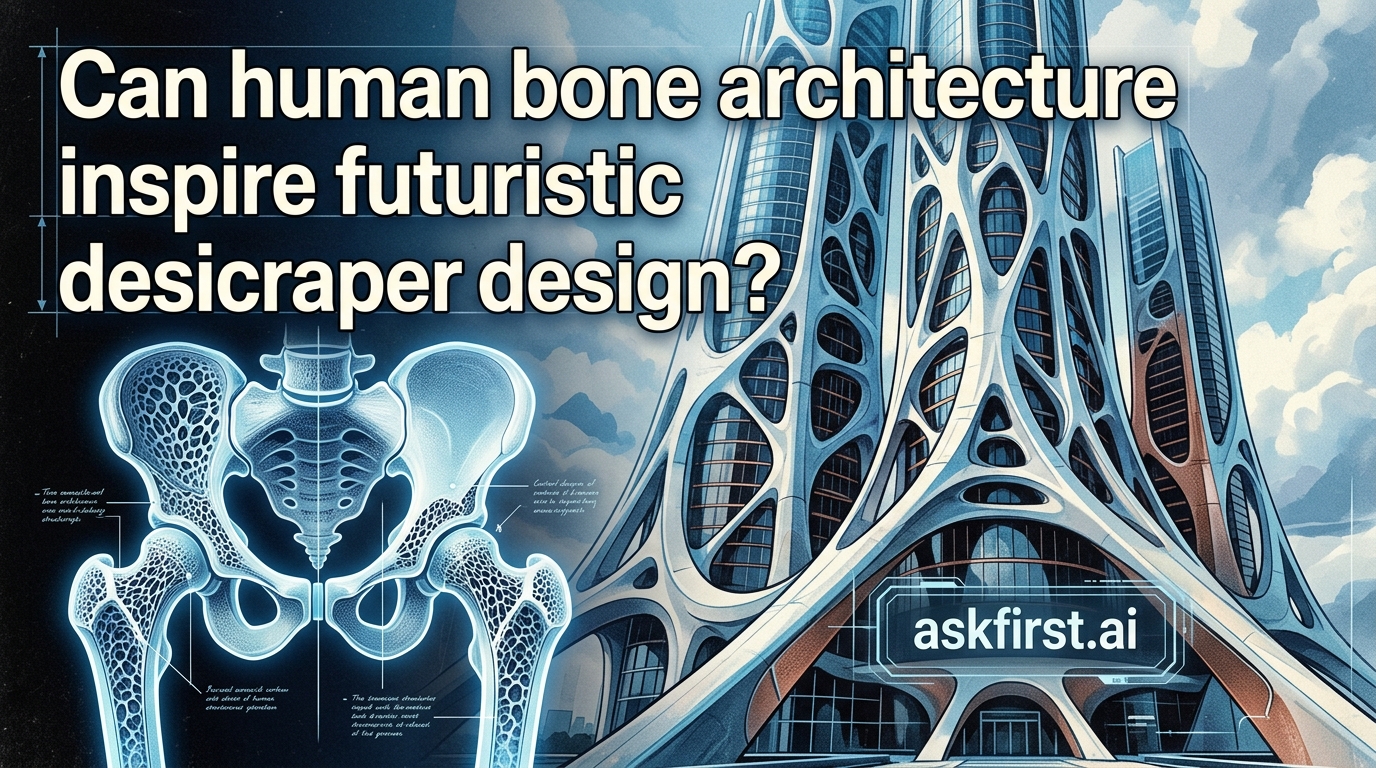
The Skeletal Blueprint: How Human Bones Redefine Skyscraper Engineering
Nature has spent millions of years perfecting the ultimate structural engineering system: the human skeleton. While traditional skyscrapers rely on massive steel frames and uniform loads, the next generation of architectural design looks toward trabecular bone—the spongy, internal tissue of bones—to achieve unprecedented efficiency, lightness, and resilience. By mimicking the way bone adapts to mechanical stress, architects are moving toward 'biomimetic' structures that use less material while standing stronger than ever before.
The Engineering Genius of Bone Density
Human bones are marvels of material optimization. They follow Wolff's Law, which states that bone grows and remodels in response to the loads placed upon it. Areas under high stress become denser, while areas with little load remain hollow or porous to reduce weight. Engineers call this concept 'topology optimization.' By utilizing computational algorithms that mimic cellular bone growth, designers can map out the precise locations where structural support is needed, eliminating excess concrete and steel from skyscraper frameworks.
- Material Efficiency: Traditional buildings are often over-engineered, using uniform beams that waste material. Biomimetic designs place matter only where the internal forces travel, leading to potential material savings of up to 40%.
- Weight Reduction: By shifting toward porous, bone-like internal architectures, buildings can significantly decrease their dead load, allowing for taller, more slender designs without the need for massive, intrusive foundation systems.
Lessons from the Trabecular Matrix
If one examines a cross-section of a femur, the internal lattice of trabecular bone resembles an intricate web. This web acts as a natural shock absorber, distributing energy evenly to prevent fractures. Skyscrapers inspired by this structure can better resist lateral forces like high-velocity wind or seismic activity. In traditional buildings, rigid columns often bear the brunt of these forces. In a 'bone-inspired' skyscraper, the entire building acts as a distributed system, where the interconnected lattice structure sheds and redirects energy, much like a living organism moves to avoid impact.
The Future of Living Cities
This biomimetic approach leads to the concept of the 'Active Building.' Just as bones heal and strengthen through microscopic remodeling, futuristic skyscraper skins could utilize 'smart' materials capable of sensing stress and self-adjusting their stiffness. Using parametric design software—such as tools that mimic cellular growth—architects are no longer drawing static grids; they are growing structures. This evolutionary approach ensures that skyscraper design is not merely aesthetic but grounded in the immutable laws of structural physics that have kept life standing for eons. By bridging the gap between biology and engineering, the skyscrapers of tomorrow will not just house inhabitants; they will function with the efficiency, grace, and resilience of a biological skeleton, proving that the best innovations are often those we have carried inside our own bodies since the dawn of time.