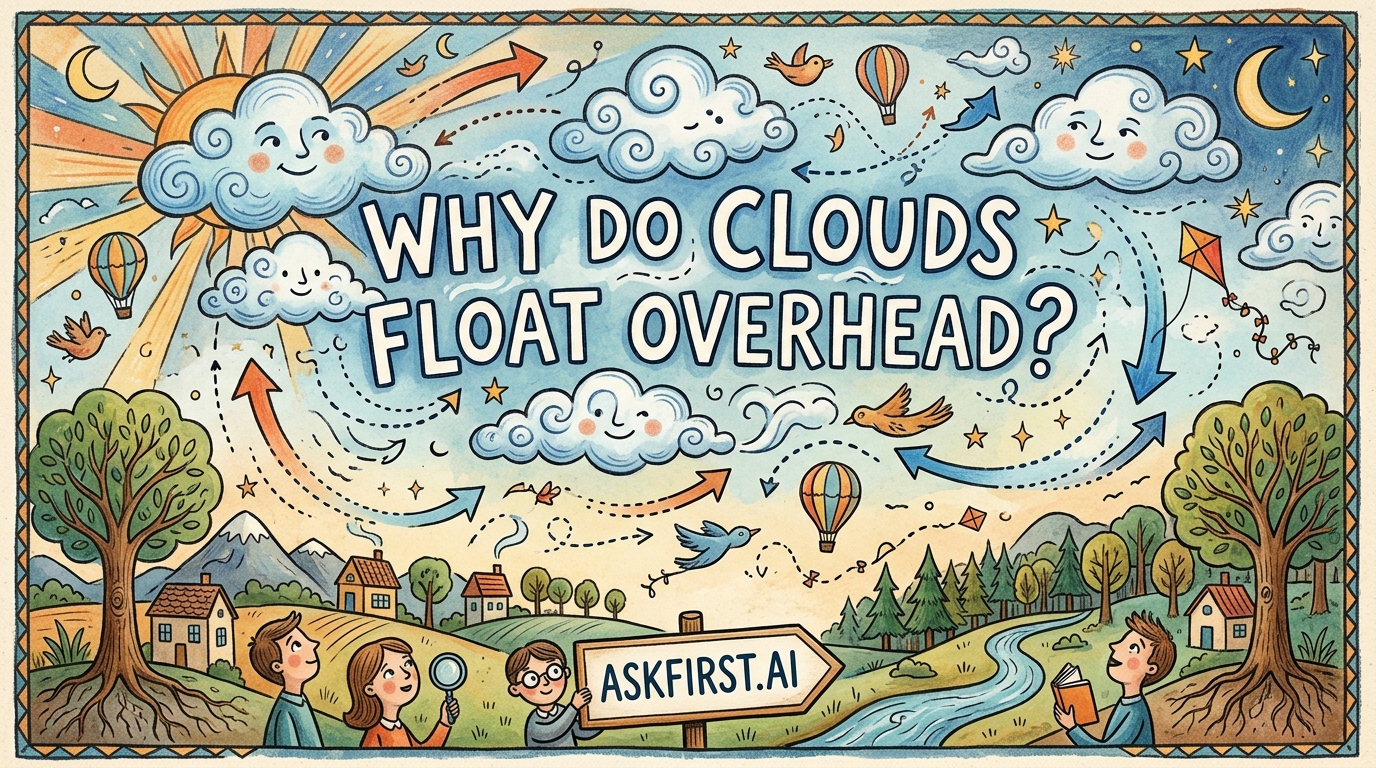
The Physics of Atmospheric Suspension: Why Clouds Float
To the casual observer, clouds appear to be fluffy, solid objects drifting lazily through the sky. In reality, they are massive collections of microscopic water droplets or ice crystals suspended in the atmosphere. The reason they "float" is a result of a complex interplay between gravity, thermodynamics, and fluid dynamics.
1. The Buoyancy Mechanism
Contrary to popular belief, clouds are not weightless. A typical cumulus cloud can weigh over a million pounds. However, these droplets are so incredibly small—often just a few micrometers in diameter—that they possess a very high surface-area-to-mass ratio.
- The Role of Updrafts: The primary reason clouds remain aloft is the presence of rising air currents, known as updrafts. As the sun heats the Earth's surface, pockets of warm air become less dense than the surrounding cooler air and rise. This rising air acts as a conveyor belt, exerting an upward force that counteracts the downward pull of gravity on the water droplets.
- Terminal Velocity: Because the water droplets are so tiny, their terminal velocity—the speed at which they fall through the air—is extremely slow. A droplet might fall at a rate of only a few centimeters per second. Updrafts are almost always moving upward faster than the droplets can fall, keeping the cloud suspended.
2. The Microphysics of Cloud Formation
Clouds form when air becomes saturated with water vapor. This occurs through three primary processes:
- Cooling by Expansion: As air rises, it encounters lower atmospheric pressure. It expands, and in doing so, it loses heat energy, causing the temperature to drop.
- Saturation: Cold air cannot hold as much water vapor as warm air. When the temperature drops to the dew point, the vapor condenses into liquid droplets.
- Cloud Condensation Nuclei (CCN): Water vapor requires a surface to condense onto. Microscopic particles such as dust, salt crystals, smoke, and pollution serve as CCN. Without these, water vapor would struggle to form droplets, even in highly saturated air.
3. Why Do Clouds Eventually "Fall"?
A cloud stays aloft only as long as the updrafts remain stronger than the settling velocity of the particles. When the droplets collide and coalesce to form larger drops (rain) or ice crystals (snow), their mass increases significantly. Once the droplets reach a size where gravity overcomes the updraft force, they fall as precipitation.
4. Pros, Cons, and Environmental Impact
- Pros: Clouds are essential for life. They regulate Earth's temperature by reflecting incoming solar radiation (cooling the planet) and trapping outgoing infrared radiation (warming the planet). They are also the primary mechanism for distributing fresh water across the globe.
- Cons: Severe cloud formations, such as cumulonimbus, are responsible for hazardous weather, including lightning, hail, and tornadoes.
- Future Trends: Climate change is altering cloud patterns. Research suggests that as the atmosphere warms, high-altitude clouds may thin, potentially changing the Earth’s "albedo" (reflectivity) and accelerating global warming trends.
In summary, clouds float because they are a dynamic, ever-changing balance of rising air and gravity-defying microscopic droplets. They are not static objects, but rather visible markers of moving energy within our atmosphere.