The Physical Roots of Computing: Why Punch Cards Ruled the World
Before the era of sleek silicon chips and elegant graphical interfaces, the bedrock of computer science was built on stiff pieces of paper: the punch card. Understanding why early pioneers relied on these tactile, mechanical tools reveals the ingenuity required to build a digital age from scratch.
The Ancestry of Automation
The punch card was not originally an invention of the computer age. It originated from the Jacquard loom, developed in 1804, which used sequences of holes in cards to dictate complex weaving patterns in textiles. This was essentially the first programmable logic system. When Herman Hollerith adapted this technology for the 1890 United States Census, the path for data processing was set. Hollerith's tabulating machines could count and sort population data significantly faster than human clerks, proving that mechanical automation could handle massive datasets.
Why Punch Cards Were the Only Choice
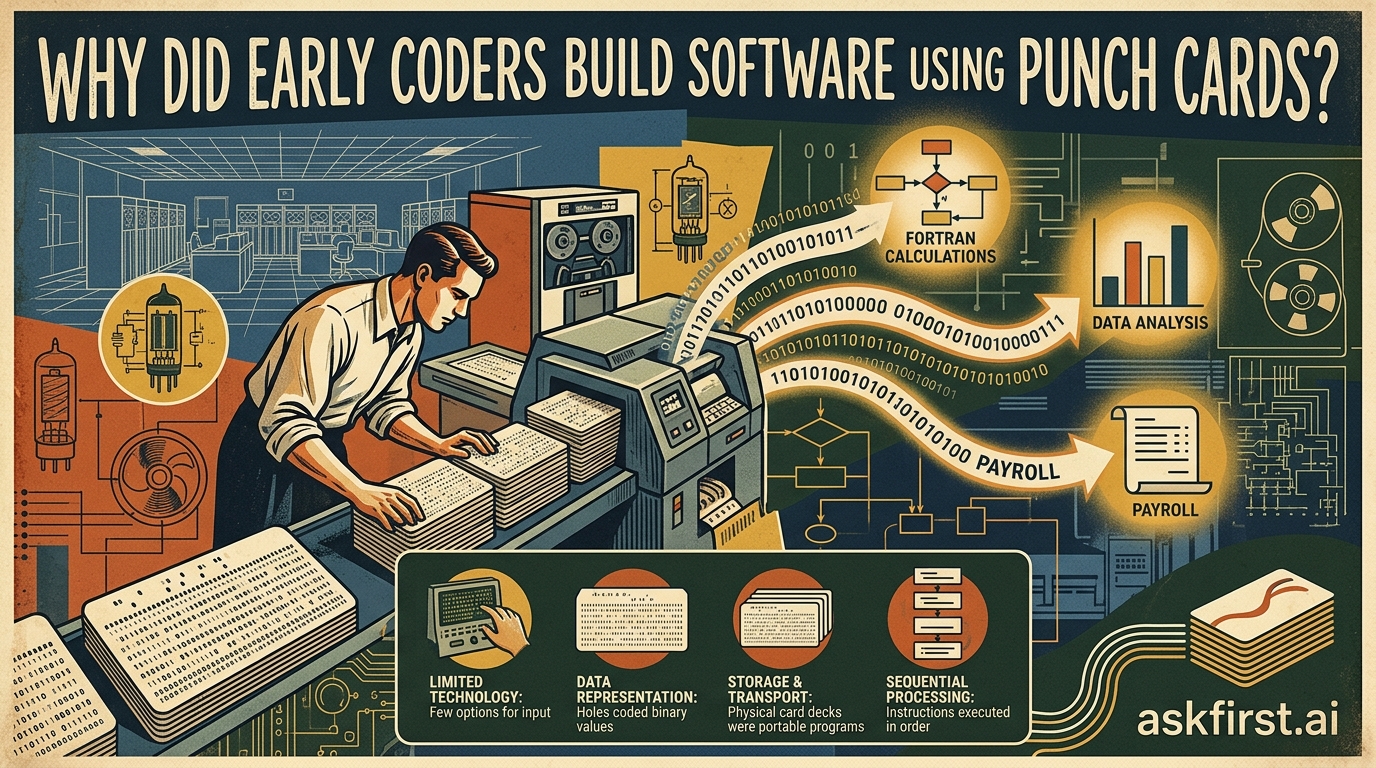
During the infancy of computers in the 1940s and 1950s, the primary challenge was input and storage. Electronic memory was prohibitively expensive and lacked the density required for long-term data archival. Punch cards offered several distinct advantages:
- Non-Volatile Storage: Unlike early magnetic core memory, which wiped clean when the power was cut, punch cards were physically permanent. A program stored on a deck of cards remained intact even if the machine lost power for weeks.
- Ease of Editing: If a programmer discovered a bug, they did not need to rewrite an entire block of code electronically. Instead, they simply swapped the erroneous card for a new, corrected one. This modularity provided a primitive but functional form of "version control."
- Input-Output Standardization: Punch cards acted as a universal bridge between different hardware systems. They provided a standard format that could be read by machines from various manufacturers, facilitating interoperability long before network protocols existed.
The Tangible Cost of Progress
Working with punch cards was an arduous, highly physical discipline. A single program could consist of thousands of cards, each representing one line of instruction. A misplaced card or a spilled deck—a nightmare scenario for any researcher—could render a complex program unreadable, requiring tedious manual re-sorting. This forced early computer scientists to be incredibly disciplined in their logic, as the "compile time" often involved physically feeding these decks into massive card readers and waiting hours for a printout to return from the facility.
Legacy and Evolution
The punch card era fundamentally shaped the modern software industry. Concepts like "batch processing" were born from this necessity, where groups of jobs were fed into a system at once. While the technology was eventually eclipsed by magnetic tape, floppy disks, and eventually cloud-based storage, the logic of sequential instruction remains embedded in the core architecture of how modern compilers process high-level code.