The Architect of Code: Artistry Meets Logic
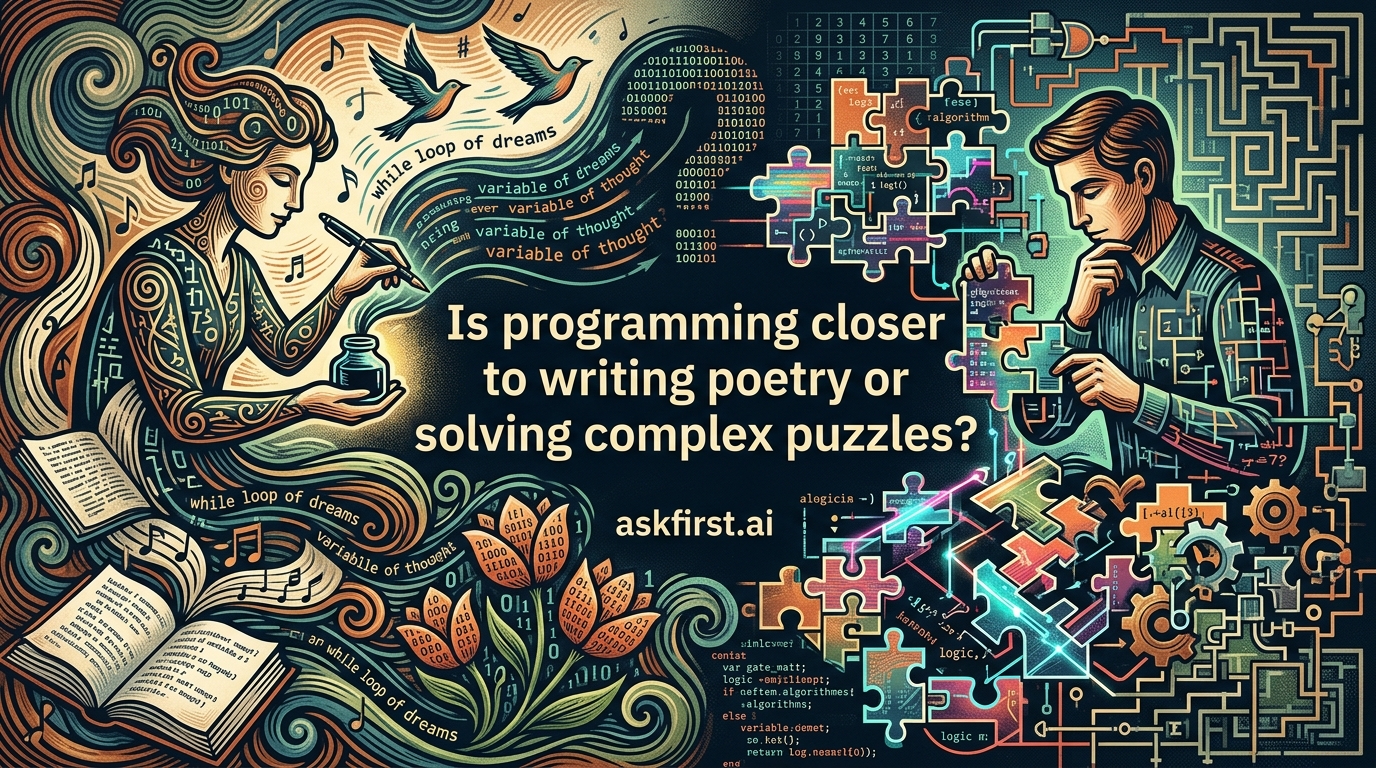
Programming occupies a unique space in human cognitive endeavor, straddling the rigorous demands of formal logic and the expressive fluidity of creative writing. To categorize it as purely a puzzle or purely a poem is to miss the essential duality that defines high-level software engineering. At its heart, programming is the manifestation of structured thought into executable reality, an act that necessitates both the precision of a mathematician and the aesthetic sensibility of a poet.
The Puzzle: The Architecture of Constraints
At the foundational level, programming is undeniably a pursuit of puzzle-solving. Computers are binary engines that operate on strict syntax and immutable laws of logic. When a developer debugs an application, they are often navigating a closed system where every variable and state transition follows a predictable path. This is the realm of the algorithmic challenge, akin to a complex chess match against an opponent who never errs. The primary objective is optimization: finding the most efficient path between two states, whether that involves time complexity, memory allocation, or data integrity. In this context, code is a blueprint where structure is paramount and errors are strictly penalized by the compiler.
The Poetry: The Expression of Intent
However, software development transcends mere problem solving when it enters the domain of design and architecture. Like poetry, great code is concise, evocative, and maintainable. A well-crafted function or a modular design pattern communicates intent to other humans, not just to the machine. Clean code is often described as having a rhythmic quality; it utilizes patterns and refactoring to turn chaotic complexity into elegant simplicity. Just as a poet uses meter and metaphor to distill complex human emotions into limited lines of verse, a developer uses abstraction and interfaces to distill complex real-world requirements into readable, scalable logic. The choice of naming conventions, the placement of whitespace, and the structural hierarchy of a project are deeply subjective, reflecting the style and philosophy of the author.
The Synthesis: A New Form of Literacy
Ultimately, programming represents a bridge between these two worlds. It is the only discipline where a person can build an entire digital cathedral out of pure thought. The logic provides the foundation, ensuring that the structure does not collapse under the weight of reality, while the poetry provides the spirit, ensuring that the system is intuitive and meaningful. Professionals who excel in this field understand that their work is not merely about producing output, but about creating systems that can survive, evolve, and be understood by future maintainers. Whether one views it as a game of logic or an exercise in linguistic creation, programming stands as the ultimate synthesis of rational science and creative art.