The Linguistic Software of the Mind: How Coding Reshapes Human Cognition
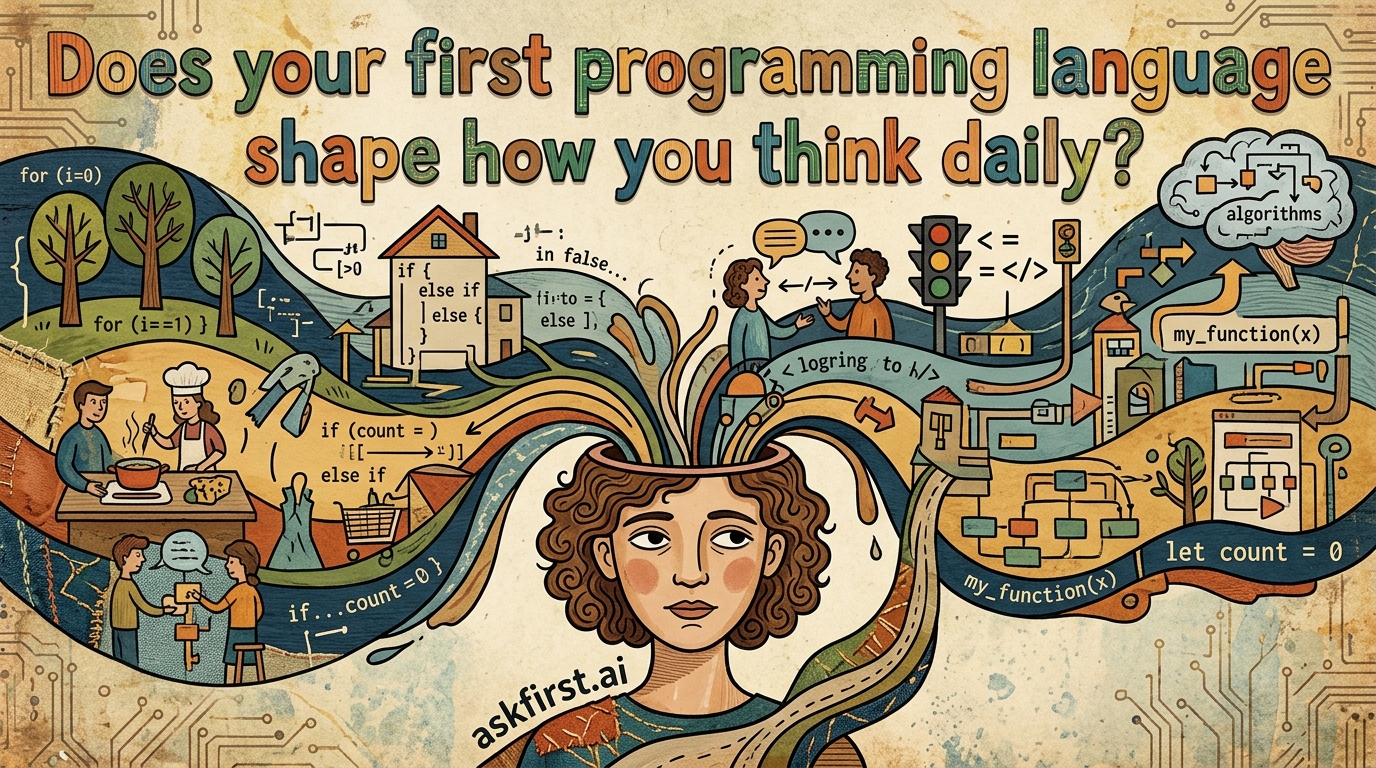
It is a widely observed phenomenon in computer science and cognitive linguistics: the first programming language a student masters often acts as a cognitive framework that persists long after they become polyglot developers. This phenomenon, often compared to the Sapir-Whorf hypothesis in linguistics, suggests that the mental models required to structure code dictate how an individual approaches logical problems in their personal and professional life.
The Functional versus Imperative Paradigm
Individuals whose initial foray into programming began with imperative languages like C or Java often develop a mindset focused on state mutation and step-by-step instruction sequences. These thinkers are frequently tactical, focusing on the "how" of a problem—the precise modification of variables and the flow of control within a system. In their daily lives, these individuals may find comfort in checklists, linear workflows, and structured routine, as their neural pathways were established around the principle that a task is a series of state changes.
Conversely, those who started with functional languages such as Lisp, Haskell, or even Scheme, tend to approach daily challenges as mathematical transformations. They prioritize immutability and data flow. In real-world problem-solving, these individuals are more likely to seek holistic systems where inputs lead to predictable outputs without side effects. They are prone to refactoring their personal plans, looking for patterns, and reducing complexity through abstraction rather than brute-force iteration.
Neuroplasticity and Cognitive Scaffolding
Neuroscientific research indicates that learning a programming language recruits brain areas similar to those used for language processing and mathematical reasoning. When one masters their first syntax, the brain builds "cognitive scaffolding." This is not merely about learning keywords like if or while; it is about learning how to decompose complex reality into digestible logical chunks. This process of decomposition becomes an automated mental heuristic.
- Categorization: Early exposure to Object-Oriented Programming (OOP) fosters a natural tendency to categorize items into classes and hierarchies.
- Conditional Logic: Frequent use of ternary operators or switch statements can subtly influence how one weighs risks and rewards, creating a binary or multi-path decision-making bias.
- Debugging Mindset: The practice of debugging cultivates a form of "abductive reasoning," where one observes a result and works backward to find the most probable cause, a skill that translates perfectly into troubleshooting household appliances, financial dilemmas, or complex social negotiations.
Breaking the Paradigm
While the first language sets a foundation, it does not permanently fix an individual's cognitive style. Just as a human who learns a second language often gains new perspectives on their mother tongue, learning a second, contrasting programming language—such as switching from a low-level language to a declarative one—expands the cognitive range. This "mental cross-training" prevents algorithmic rigidity and fosters higher cognitive flexibility. Ultimately, while the first language may imprint a style, conscious practice allows the mind to choose its architecture for any given task.