The Moth That Changed Computing: Busting the Bug Myth
Many legends in the tech industry sound like modern fables, and none is as persistent or delightful as the story of the "first computer bug." It is widely believed that computer programming terminology was birthed by a literal, insect-related disaster. However, the reality of this linguistic evolution is far more nuanced than the simple image of a moth wedged inside a machine.
The Legend of the Mark II
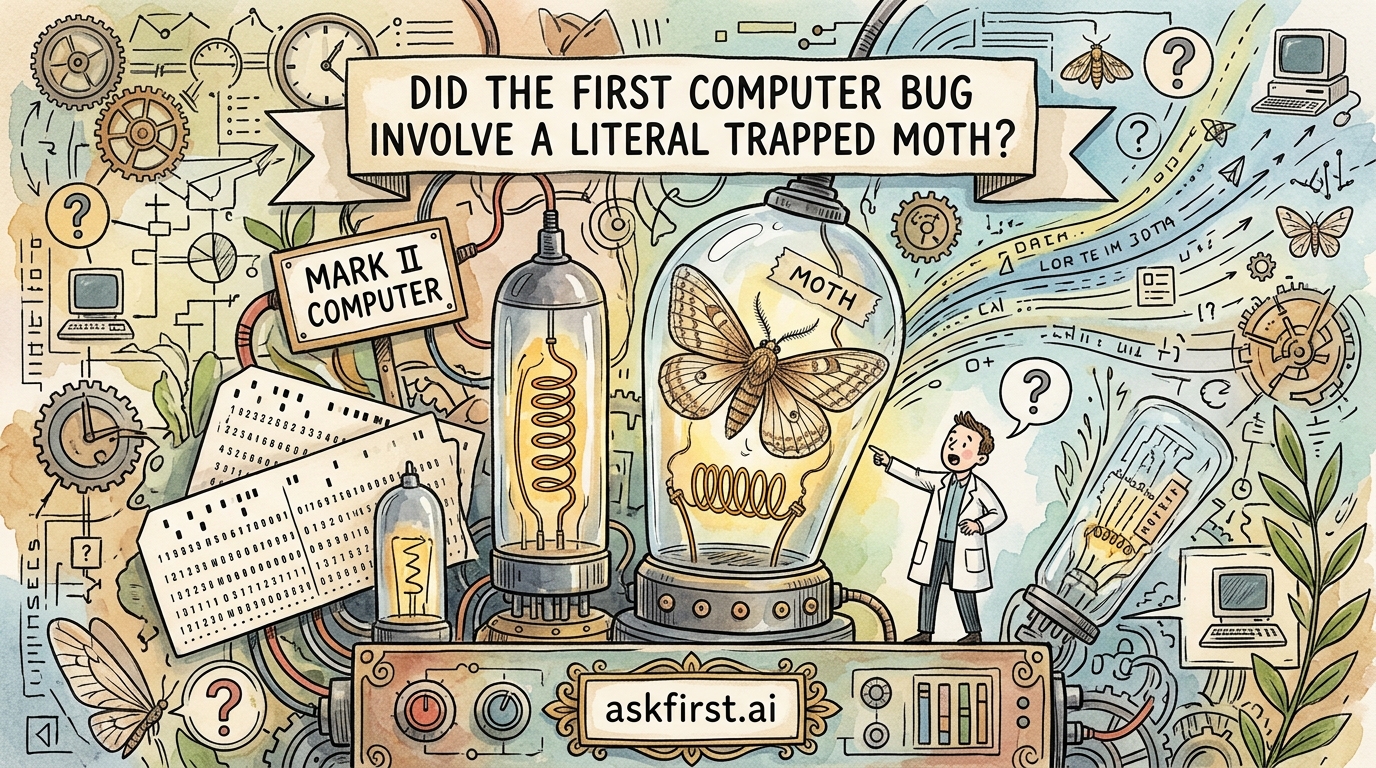
The story centers on September 9, 1947, at Harvard University. Engineers working on the Harvard Mark II computer discovered a significant malfunction that rendered the machine inoperable. Upon physical inspection, they found a live moth trapped within the contacts of Relay #70, Panel F. The team, which included the legendary pioneer Grace Hopper, famously taped the insect into the machine's logbook with the notation, "First actual case of bug being found."
Linguistic Roots: The Pre-Moth Era
While the moth story is factually grounded in the historical logbook, it is a common misconception that this incident coined the term "bug" in an engineering context. In truth, the term had been utilized by engineers for decades before 1947. Thomas Edison, for instance, used the word "bug" in his personal correspondence during the 1870s to describe technical glitches and flaws in his prototypes. In engineering jargon, a "bug" was already established as a colloquialism for a mysterious technical obstacle.
Why the Confusion Persists
The confusion survives because the 1947 incident provides a tangible, almost humorous origin point for an otherwise abstract concept. The term "debugging" is often mistakenly tied exclusively to this moth, when in fact, engineers were already "debugging" hardware by removing stray wires and mechanical impediments long before this incident. The moth incident was essentially a witty, literal interpretation of a word that already existed within the industry vocabulary.
The Evolution of Debugging
Following the incident, the practice of debugging moved from physical hardware maintenance to the systematic refinement of software code. Grace Hopper herself became a leading advocate for accessible programming languages, such as COBOL, which allowed developers to focus on logic rather than hardware constraints. Today, debugging is a critical phase of the software development lifecycle, involving sophisticated static analysis tools, profilers, and integrated development environments (IDEs) rather than tweezers and magnifying glasses.
Conclusion: A Blend of Fact and Lore
The incident with the Harvard Mark II moth remains one of the most famous anecdotes in computer science history, primarily because it offers a perfect metaphorical bridge between the mechanical past and the digital future. While the industry did not derive the word "bug" from this specific insect, the event serves as a symbolic milestone for an industry that has always balanced abstract logic with the messy, unpredictable reality of physical hardware.