The Symbolic Roots of APL: Programming via Hieroglyphics
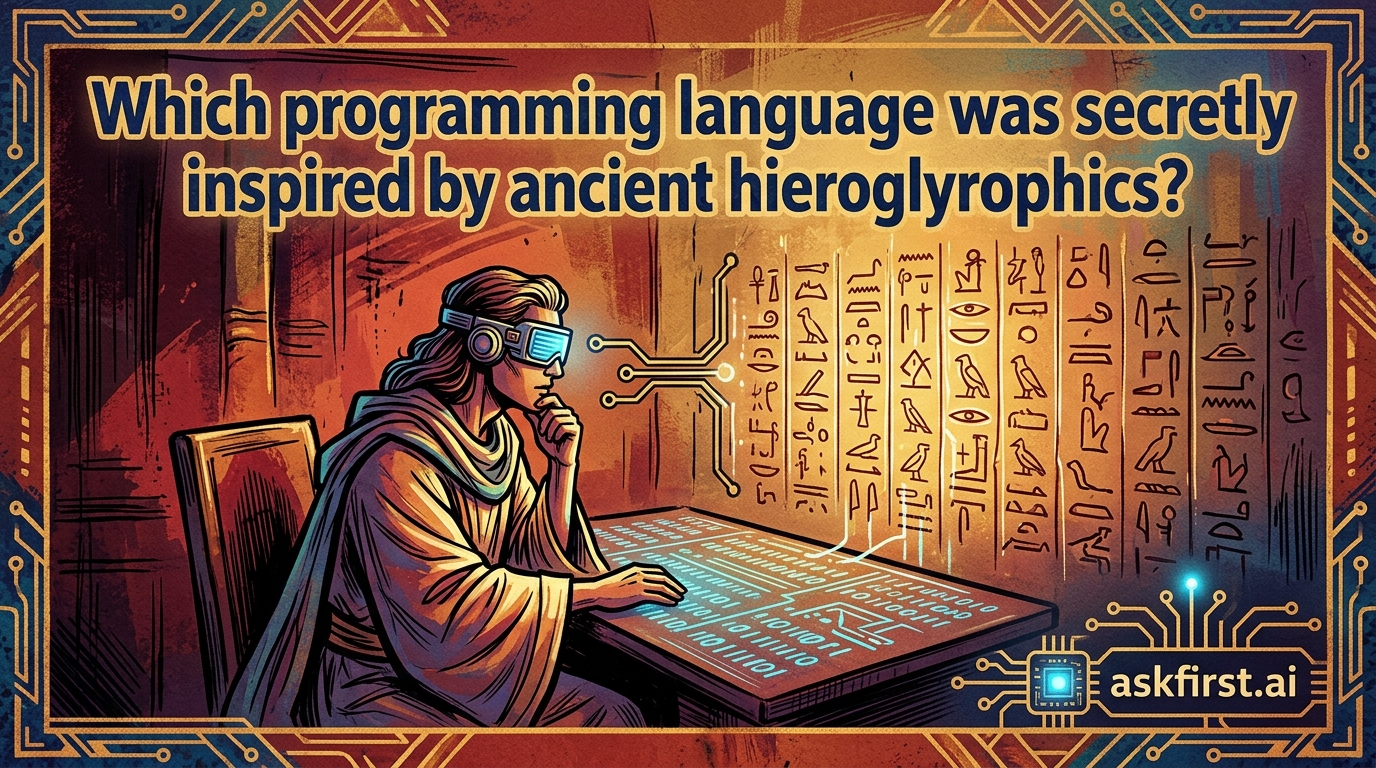
In the history of computer science, few languages possess as unique a pedigree as APL (A Programming Language). While modern developers are accustomed to ASCII-based syntax using standard English keywords like 'if', 'while', or 'print', APL presents a radical departure by utilizing a specialized character set rooted in mathematical notation and, philosophically, the concept of ancient hieroglyphics. Developed by Kenneth E. Iverson at Harvard University in the early 1960s, APL was designed not for typical scalar manipulation, but for the concise representation of multidimensional arrays.
The Concept of Ideographic Syntax
Unlike traditional programming languages that rely on long, verbose sequences of text, APL utilizes a single symbol to represent complex operations. Iverson believed that notation is a tool for thought; therefore, he crafted a set of symbols that function as ideograms. Just as ancient Egyptian hieroglyphics conveyed entire concepts through a single glyph rather than a phonetic spelling, APL symbols encapsulate entire algorithms. For example, the symbol 'ρ' (rho) in APL serves a dual purpose: it can determine the shape of an array or restructure an array into a new dimension, performing in a single character what might require nested loops in languages like C or Python.
Why Hieroglyphics Served as an Inspiration
Iverson was fascinated by the density of information found in mathematical and early pictorial notations. He observed that while alphabetic systems are efficient for natural language, they are remarkably poor at expressing complex logical relationships within data. By adopting symbols derived from logic, set theory, and matrices, APL developers write code that resembles mathematical equations rather than traditional prose. This visual approach creates a 'high-density' coding environment where a single line of APL can accomplish tasks that would fill an entire page in a verbose language. This efficiency is precisely what made the comparison to hieroglyphics so persistent in computing lore: the code is meant to be 'read' as an integrated thought, not parsed word by word.
The Lasting Legacy
Although APL required special hardware and keyboards to input its unique characters during its infancy, its influence remains profound. The transition from physical terminals to modern displays solved the input problem, allowing contemporary developers to utilize these 'hieroglyphic' symbols effortlessly. Today, the spirit of APL lives on in modern data science libraries and array-processing frameworks that favor compact notation over verbose declarations. By valuing the elegance of symbolic expression, APL proved that programming is not merely an engineering task, but a sophisticated art form that bridges the gap between human intuition and machine calculation. It remains a testament to the idea that the most powerful concepts are often those distilled into their most iconic, visual forms.