The Neuroplasticity of Programming: How Coding Rewires the Human Mind
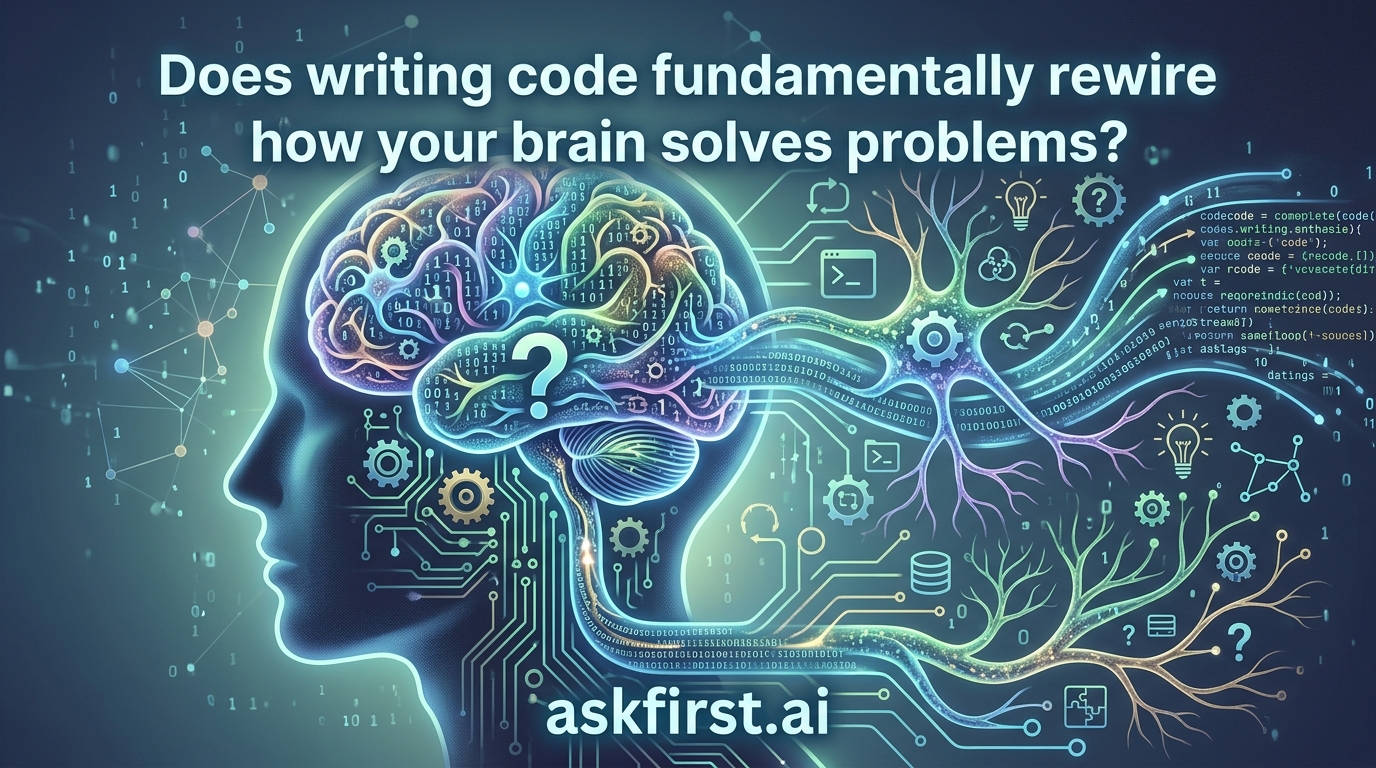
Modern neuroscience suggests that learning to program acts as a profound cognitive workout, fundamentally reshaping neural pathways much like learning a second language or a musical instrument. While coding is often viewed as a purely technical skill, it actually demands a unique convergence of linguistic, logical, and spatial reasoning that alters how the brain organizes information.
The Logic-Language Convergence
Recent studies, including research from MIT, indicate that computer programming does not rely exclusively on the language centers of the brain. Instead, it activates a distributed network that encompasses the left-hemisphere's multiple-demand network—the same system used for complex mathematics and logic. When a programmer debugs a complex script, the brain engages in a process called "executive function switching," where it rapidly alternates between holistic system understanding and granular, syntax-level focus.
- Algorithmic Thinking: Programmers develop an enhanced ability to break massive obstacles into recursive, manageable steps.
- Pattern Recognition: The brain becomes hyper-attuned to detecting structural anomalies in environments far beyond the IDE.
- Working Memory Expansion: Managing complex state transitions in code strengthens the brain's ability to hold multiple active variables simultaneously.
Neuroplasticity in Action
Neuroplasticity is the brain's ability to reorganize itself by forming new neural connections throughout life. Coding is an ideal catalyst for this process. By constantly interacting with formal systems that require absolute precision, the brain undergoes "cognitive scaffolding." This is not merely about memory; it is about building mental models that mirror the architecture of the systems being built. Once these structures are internalized, they often bleed into non-technical domains. A coder might begin to view the processes of cooking, management, or even interpersonal conflict through the lens of conditional logic, "if-then" sequences, and edge-case prevention.
Beyond the Screen: Cognitive Benefits
This cognitive transformation offers long-term benefits in intellectual resilience:
- Increased Tolerance for Ambiguity: Learning to thrive in environments where the outcome is unknown but the logic is sound builds psychological flexibility.
- Optimized Error Correction: The debugging mindset encourages an objective, experimental approach to failure, viewing mistakes as data rather than negative outcomes.
- Synthesized Abstract Thinking: Programming forces the brain to bridge the gap between abstract concepts (objects, classes, functions) and concrete outputs, enhancing one's ability to visualize systemic interactions.
Ultimately, coding does not replace native human intuition but provides a specialized framework for augmenting it. As one masters code, the brain moves from simple memorization to a sophisticated model of logical simulation. This shift ensures that the brain becomes more adept at navigating complex, rule-based systems throughout every aspect of existence, effectively sharpening the mind for the challenges of the modern era.