The Moth and the Mark II
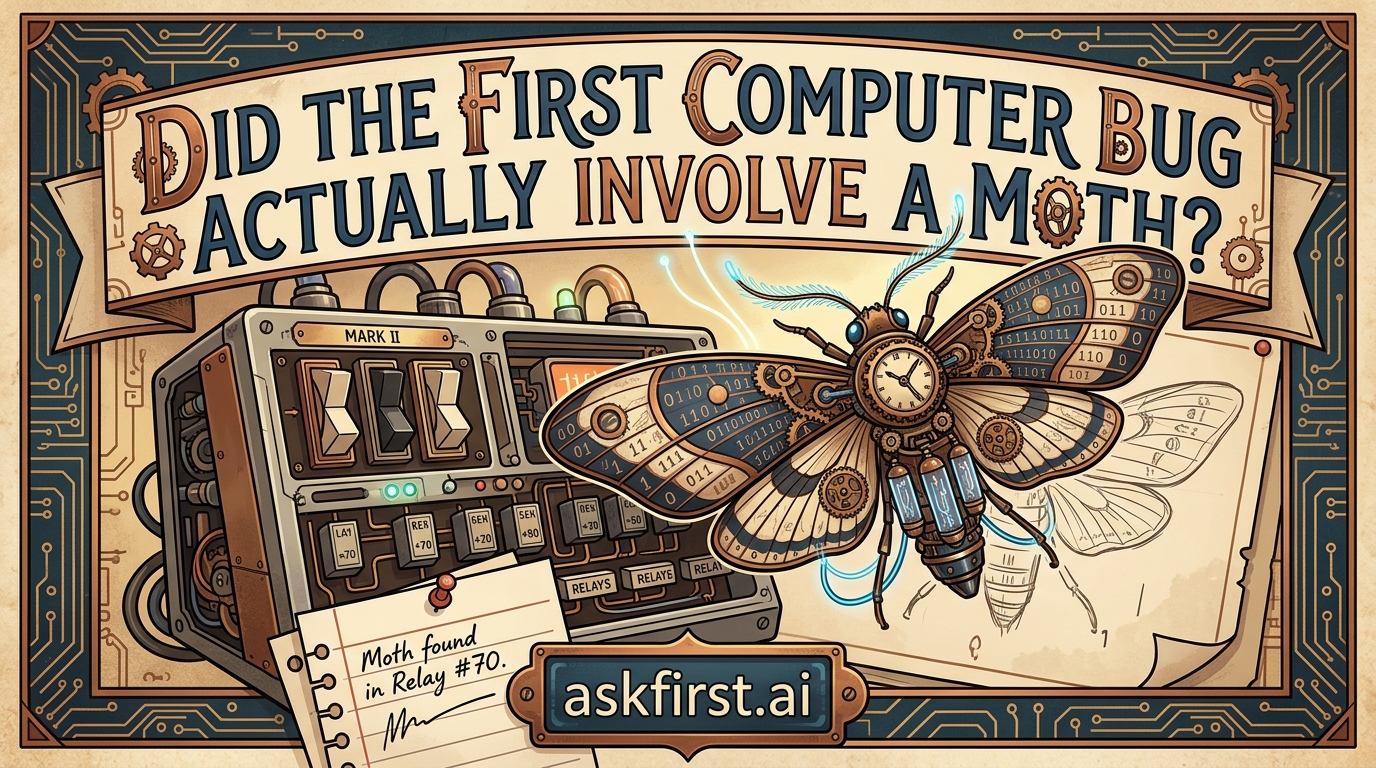
The story of the first computer bug is one of technology's most cherished anecdotes, blending engineering history with a touch of biological whimsy. On September 9, 1947, engineers working on the Harvard Mark II computer—an electromechanical marvel of the era—encountered a persistent technical failure. Upon inspecting the machinery, they discovered a large moth trapped in relay #70, Panel F, which had physically prevented the relay from closing properly, thereby causing a failure in the logic circuit. This event is famously recorded in the computer's logbook with the moth taped to the page, accompanied by the note: 'First actual case of bug being found.'
Etymology vs. Physical Reality
While the 1947 event is often cited as the origin of the term 'bug,' linguistic evidence suggests otherwise. The word 'bug' had been used by engineers, including Thomas Edison, for decades prior to the Mark II incident to describe mysterious glitches, malfunctions, and design flaws in mechanical systems. Engineers in the late 19th and early 20th centuries frequently referred to these small, unidentified mechanical obstructions as 'bugs.' Consequently, while the Harvard Mark II incident was the first recorded instance of a literal, biological bug being blamed for a computational failure, it did not invent the terminology.
The Role of Grace Hopper
Admiral Grace Hopper, a pioneering computer scientist who worked with the Mark II team, is frequently credited with popularizing the anecdote. Hopper was instrumental in documenting the event, which added a sense of humor and personality to the notoriously dense world of early mainframe computing. Her storytelling helped turn a routine maintenance log entry into a legendary piece of technical folklore. The logbook containing the moth is currently housed in the Smithsonian National Museum of American History, serving as a permanent testament to this convergence of entomology and engineering.
Impact on Modern Computing
This historical milestone serves as a foundational moment in the culture of software development. It highlights the transition from mechanical systems, which could be obstructed by physical objects, to the abstract, logical errors that characterize contemporary software development. Today, the term 'debugging' is universal in the coding community. It represents a structured process of finding and removing logical errors from computer code. Despite the shift toward highly miniaturized solid-state components where biological interference is statistically rare, the metaphorical 'bug' remains the central lexicon for describing system inaccuracies. Understanding this history bridges the gap between early electrical engineering and modern information technology, illustrating how human language adapts to describe the evolving complexities of the tools society builds.