The Convergence of AI Agents and Smart Contract Exploitation
The intersection of Artificial Intelligence (AI) agents and smart contract security represents a new frontier in cyber-warfare. Traditionally, smart contract vulnerabilities—such as reentrancy, integer overflows, and front-running—required manual auditing or specialized scripts. However, autonomous AI agents are now being weaponized to identify and exploit these vulnerabilities at machine speed and scale.
Mechanics of AI-Driven Exploitation
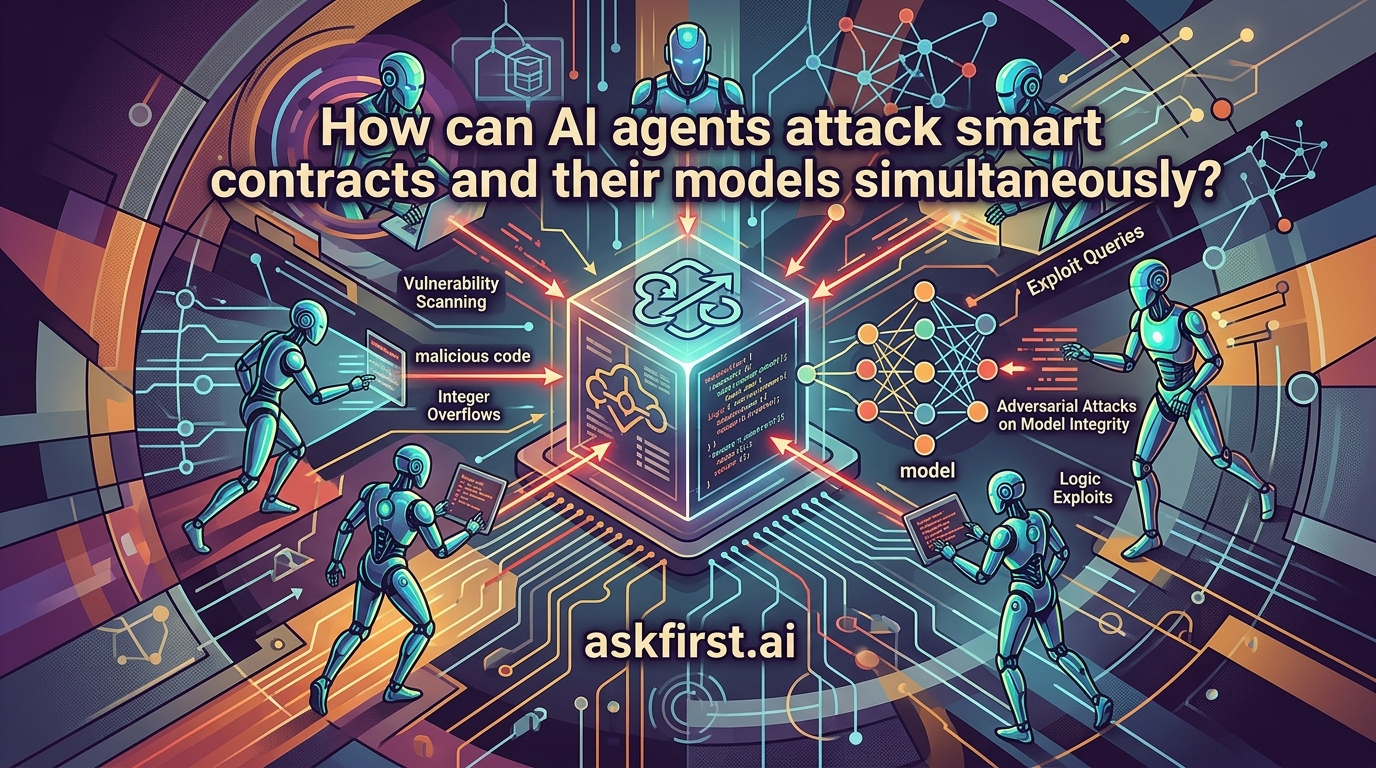
AI agents attack smart contracts and their underlying logic models by leveraging Large Language Models (LLMs) and Reinforcement Learning (RL) to perform automated reconnaissance and exploit generation.
- Vulnerability Scanning (Static/Dynamic Analysis): AI agents ingest raw Solidity code, comparing it against massive datasets of historical exploits (e.g., The DAO, Parity multisig hacks). They identify logic flaws that traditional static analysis tools might miss, such as complex state-machine inconsistencies.
- Exploit Crafting: Once a vulnerability is identified, an AI agent can iterate through thousands of potential transaction sequences in a simulated environment (like a local Hardhat or Foundry fork) to determine the exact payload required to drain funds.
- Model Poisoning and Adversarial Attacks: If the smart contract utilizes an on-chain machine learning model (e.g., for decentralized finance risk scoring), the AI agent can perform adversarial input manipulation. By feeding the model specifically crafted data, the agent forces the model to output a biased or incorrect decision, which the smart contract then executes to the attacker's benefit.
Step-by-Step Anatomy of an AI-Led Attack
To understand how an AI agent executes a coordinated attack, consider this operational flow:
- Target Profiling: The agent monitors blockchain mempools for new contract deployments. It uses natural language processing (NLP) to parse whitepapers and documentation, identifying high-value targets.
- Simulation & Fuzzing: The agent deploys a "shadow" version of the target contract. It uses reinforcement learning to "play" the contract like a game, rewarding the agent for discovering states that lead to fund withdrawal.
- Transaction Orchestration: After finding a successful path, the agent optimizes for gas efficiency and sandwich attack parameters, ensuring the exploit transaction is prioritized by miners/validators.
- Execution: The agent broadcasts the transaction, often using obfuscated code to bypass simple signature-based security monitors.
Pros and Cons of AI-Integrated Security
| Feature | Impact |
|---|---|
| Pros | Rapid identification of zero-day vulnerabilities; continuous monitoring; automated bug bounty hunting. |
| Cons | Increased barrier to entry for attackers; potential for "black box" exploits that are difficult to patch; high computational cost. |
Future Trends and Defensive Countermeasures
As AI agents become more sophisticated, the defense must evolve. "AI-vs-AI" security is the emerging paradigm. Developers are increasingly implementing:
- Automated Formal Verification: AI-driven tools that mathematically prove the correctness of contract code before deployment.
- On-Chain Intrusion Detection Systems (IDS): AI models deployed as "guardians" that monitor transactions in real-time and pause contracts if anomalous behavior is detected.
- Adversarial Robustness Training: Training on-chain models specifically to ignore "noisy" or malicious inputs designed to manipulate decision-making logic.
In conclusion, while AI agents pose a significant threat by simultaneously targeting code logic and model integrity, they also provide the necessary tools for real-time, proactive defense. The security of the decentralized ecosystem now depends on the ability of developers to deploy AI-powered defensive agents faster than their malicious counterparts.