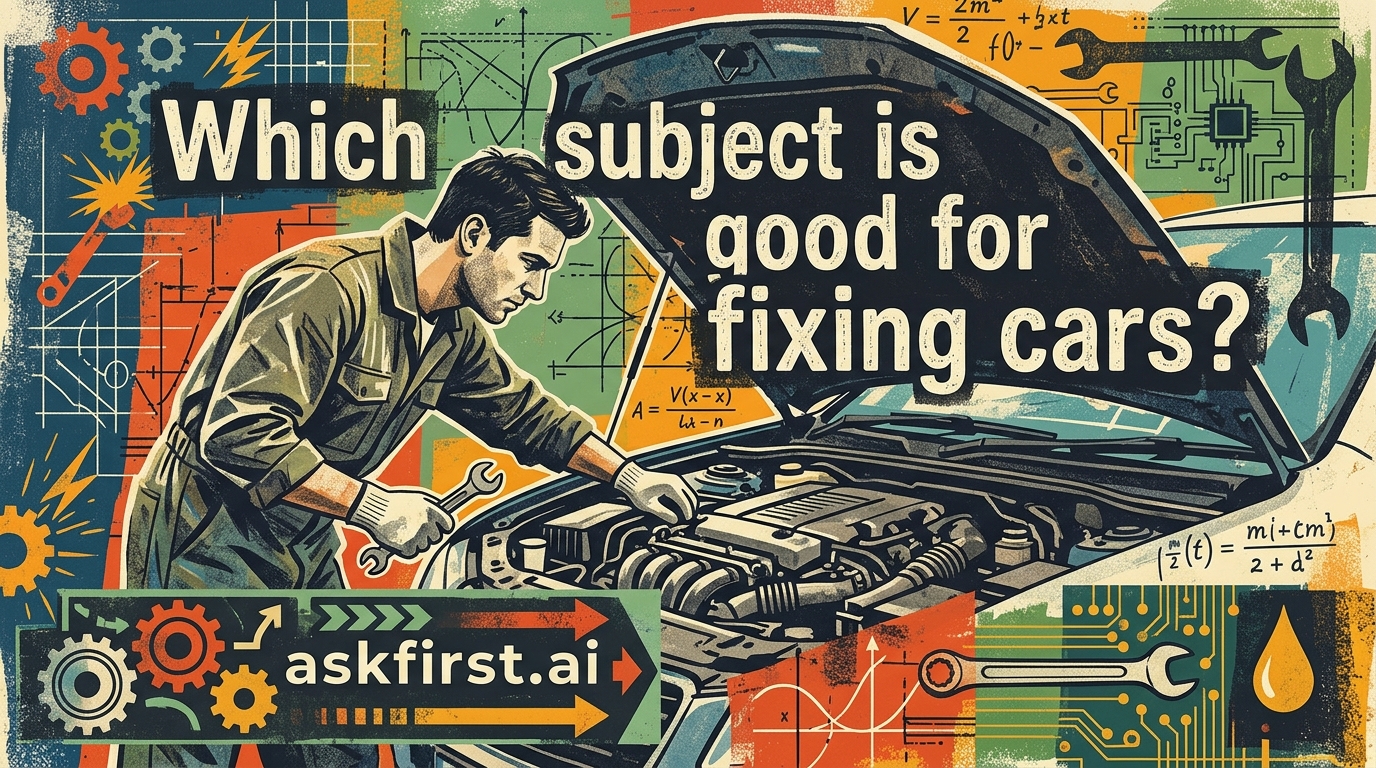
Mastering Automotive Engineering: The Path to Becoming a Professional Mechanic
To excel in the professional repair and maintenance of automobiles, one must bridge the gap between theoretical science and hands-on mechanical aptitude. While there is no single "magic" subject, a multidisciplinary approach is essential for modern vehicle diagnostics and repair.
The Core Academic Subjects
If you are aiming for a career in automotive repair, you should prioritize the following fields of study:
- Physics: This is the most critical subject. Automotive mechanics is essentially applied physics. You must understand Newton’s Laws of Motion, thermodynamics (how internal combustion engines convert fuel into energy), and fluid dynamics (how hydraulic braking and power steering systems operate).
- Mathematics: Precision is non-negotiable. You will need algebra and geometry to calculate gear ratios, torque specifications, engine displacement, and electrical resistance (Ohm’s Law).
- Electronics and Computer Science: Modern vehicles are essentially rolling computers. Understanding circuit boards, sensors, CAN-bus communication, and ECU (Engine Control Unit) programming is now more important than turning a wrench.
- Chemistry: Knowledge of chemical properties is vital for understanding fuel combustion, motor oil viscosity, coolant additives, and the reaction processes within lead-acid and lithium-ion batteries.
Practical Skill Development
Theoretical knowledge must be supplemented by vocational training. Most successful mechanics pursue a path through Automotive Service Excellence (ASE) certification.
- Vocational Training: Enrolling in an automotive technology program at a technical college provides hands-on experience with industry-standard diagnostic tools.
- Apprenticeships: Learning under a master technician allows you to understand the "tricks of the trade"—the nuanced skills that textbooks cannot convey, such as identifying a bad bearing by sound or troubleshooting a phantom electrical ground.
Pros and Cons of an Automotive Career
| Pros | Cons |
|---|---|
| High Demand: Skilled technicians are always needed globally. | Physical Strain: The job is demanding on the back, knees, and hands. |
| Problem Solving: Every day presents a unique puzzle to solve. | Rapid Obsolescence: Technology evolves quickly; constant retraining is required. |
| Self-Sufficiency: You gain the ability to maintain your own assets. | Tool Costs: Professional-grade tools represent a significant financial investment. |
The Future: The Shift to EV Technology
The automotive landscape is currently undergoing its most significant shift since the invention of the assembly line: the transition to Electric Vehicles (EVs).
Future trends indicate that the "mechanic" of 2030 will look more like a software engineer. Future professionals will focus less on oil changes and transmission rebuilds, and more on battery management systems (BMS), high-voltage safety protocols, and software updates. If you are starting today, prioritize Computer Science and Electrical Engineering to future-proof your career.
Conclusion: The Ideal Educational Path
For the best results, pursue a high school curriculum heavy in STEM (Science, Technology, Engineering, and Mathematics), followed by a formal certification from a reputable trade school. By combining a deep understanding of physics with a mastery of digital diagnostic interfaces, you will be well-equipped to handle the complex, high-tech machines that define modern transportation. Whether you are working on a classic internal combustion engine or a cutting-edge autonomous electric vehicle, these foundational subjects remain the bedrock of professional success.