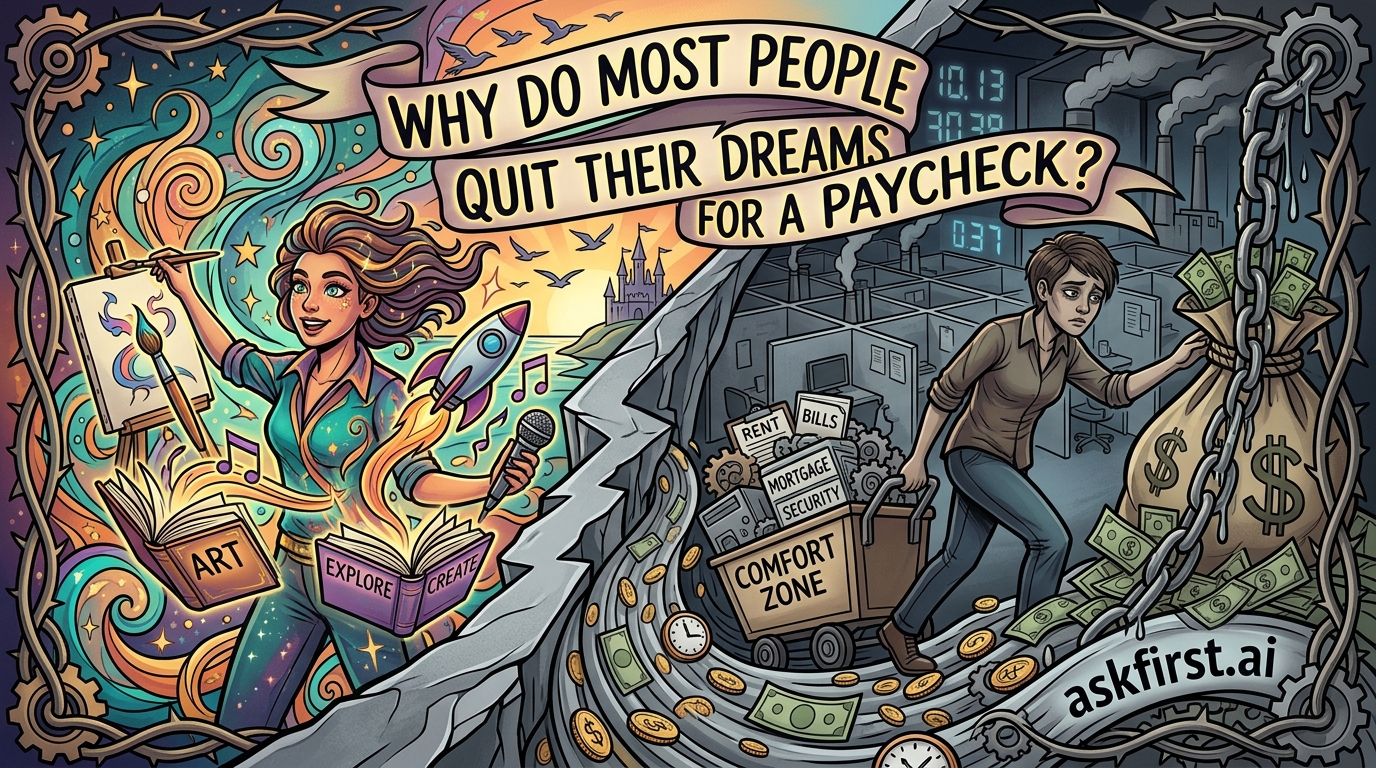
The Hidden Psychology Behind Choosing Security Over Passion
Many individuals find themselves abandoning long-held personal ambitions in favor of the stability provided by a steady paycheck. While often viewed as a simple matter of necessity, this transition is rooted in complex psychological mechanisms that favor short-term survival over long-term self-actualization.
The Survival Bias and Risk Aversion
At the core of this phenomenon lies Loss Aversion, a principle in behavioral economics defined by Daniel Kahneman and Amos Tversky. Humans are biologically wired to fear the loss of what they already possess far more than they value the potential gains of an uncertain future. A paycheck represents immediate security, food, and shelter—primary physiological needs according to Maslow’s Hierarchy. Consequently, the brain flags the pursuit of an uncertain, high-risk dream as a threat to current survival, triggering a defensive mechanism that encourages individuals to prioritize the known salary over the unknown reward of a passion project.
The Trap of Comfort and Lifestyle Creep
Once a steady income is secured, many people fall into the trap of "lifestyle creep," where increased earnings lead to increased spending. This creates a reliance on a specific level of income to maintain a standard of living. When the cost of existing life rises to match the paycheck, the individual becomes "golden handcuffed" to their employment. The dream, which once felt like a noble goal, now feels like an expensive risk that could compromise their lifestyle, leading to the rationalization that the dream is simply not practical at this stage in life.
The Role of Social Validation and Conformity
Societal expectations heavily influence career trajectories. There is often immense social pressure to follow a traditional path: education, employment, and retirement. Pursuing an unconventional dream often invites judgment, skepticism, and a lack of immediate social validation. Conversely, a steady job provides a clear social status and an easily understood identity. The human need for social belonging often outweighs the drive for individual expression, causing many to suppress their ambitions to fit into the accepted societal mold.
Practical Strategies for Bridging the Gap
It is possible to pursue a dream without abandoning the stability of a paycheck immediately. Experts suggest several strategies:
- The Side-Hustle Transition: Dedicate specific blocks of time to passion projects outside of standard working hours to validate the idea without financial risk.
- Emergency Fund Building: Financial cushion reduces the fear of loss, allowing for bolder decision-making.
- Incremental Goal Setting: Break massive dreams into small, manageable milestones that do not require full-time commitment initially.
Ultimately, quitting a dream is rarely a singular event; it is a gradual erosion of courage facilitated by the desire for comfort and social conformity. By understanding these biological and psychological biases, individuals can proactively design lives that balance the necessity of income with the pursuit of meaningful work.