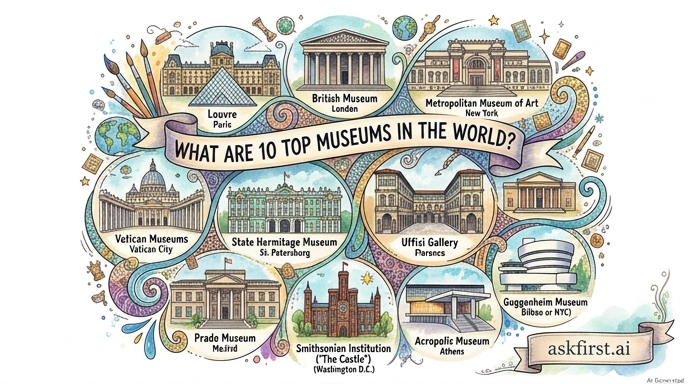
The cultural landscape of the world is defined by institutions that serve as custodians of human history, artistic achievement, and scientific progress. Selecting the top ten museums is a complex task, as it requires balancing historical significance, the breadth of collections, and the architectural impact of the buildings themselves. The following list represents the pinnacle of global museology, where each institution offers an unparalleled window into the collective consciousness of humanity.
1. The Louvre Museum (Paris, France)
Housed in the former royal palace of the French monarchs, the Louvre is widely considered the world's most significant art museum. Its collection spans from ancient civilizations—such as Mesopotamia, Egypt, and Greece—to the mid-19th century. The museum’s most famous resident, Leonardo da Vinci’s Mona Lisa, is joined by masterpieces like the Venus de Milo and the Winged Victory of Samothrace. Its glass pyramid, designed by I.M. Pei, serves as a bridge between classical architectural history and contemporary design.
2. The British Museum (London, United Kingdom)
Dedicated to human history, art, and culture, the British Museum holds a massive collection of some eight million works. It is perhaps best known for the Rosetta Stone, which unlocked the secrets of Egyptian hieroglyphs, and the Elgin Marbles from the Parthenon in Athens. The museum acts as a comprehensive record of the development of human civilization, emphasizing the interconnectedness of global cultures across millennia.
3. The Metropolitan Museum of Art (New York City, USA)
Known colloquially as "The Met," this institution is the largest museum in the Western Hemisphere. Located on the edge of Central Park, its collection includes over two million works spanning 5,000 years of world culture. From the Temple of Dendur, an actual Egyptian temple reconstructed within the museum walls, to its world-class European paintings and medieval armory, The Met offers a sprawling, encyclopedic look at the history of human creativity.
4. The State Hermitage Museum (Saint Petersburg, Russia)
Founded by Catherine the Great in 1764, the Hermitage is one of the oldest and largest museums in the world. It occupies a complex of six historic buildings along the Neva River, including the ornate Winter Palace. The museum houses over three million items, including the world’s largest collection of paintings. Its interior, adorned with gold, malachite, and marble, is as much a work of art as the pieces it contains.
5. The Vatican Museums (Vatican City)
These museums house the immense collection amassed by the Catholic Church over many centuries. The galleries lead visitors through a journey of religious and classical art, culminating in the Sistine Chapel, where Michelangelo’s ceiling frescoes and The Last Judgment reside. The sheer density of historical significance, ranging from Roman sculptures to Renaissance masterpieces, makes this an essential pilgrimage for art historians.
6. The Prado Museum (Madrid, Spain)
The Prado is the primary repository of Spanish art and houses one of the finest collections of European art in the world. It is particularly celebrated for its extensive works by Diego Velázquez, Francisco Goya, and El Greco. The museum provides a profound insight into the Spanish Golden Age, reflecting the complex political and religious history of the Iberian Peninsula through the lens of its most gifted painters.
7. The Uffizi Gallery (Florence, Italy)
Located in the heart of the cradle of the Renaissance, the Uffizi is the definitive museum for Italian Renaissance art. It holds iconic works by Botticelli, including The Birth of Venus, as well as masterpieces by Michelangelo, Leonardo da Vinci, and Raphael. The building itself, designed by Giorgio Vasari, is a masterpiece of Mannerist architecture, reflecting the prestige of the Medici family who originally commissioned the collection.
8. The Rijksmuseum (Amsterdam, Netherlands)
The Rijksmuseum is the definitive center for Dutch art and history. It is most famous for its collection of works from the Dutch Golden Age, featuring Rembrandt’s The Night Watch and Johannes Vermeer’s The Milkmaid. The museum underwent a massive renovation that successfully blended its 19th-century Neo-Gothic architecture with modern, airy design, making the viewing experience both intimate and grand.
9. The National Palace Museum (Taipei, Taiwan)
This museum contains the world’s largest collection of Chinese imperial artifacts and artworks. Many of these items were relocated from the Forbidden City in Beijing during the Chinese Civil War. The collection includes rare ceramics, jade carvings, calligraphy, and paintings that span nearly 8,000 years of Chinese history, offering a rare look at the artistic traditions of the imperial courts.
10. The Smithsonian National Museum of Natural History (Washington, D.C., USA)
While the previous entries focus on fine art and history, this museum stands as the pinnacle of natural science. Part of the Smithsonian Institution, it holds over 145 million specimens of plants, animals, fossils, minerals, and human cultural artifacts. From the Hope Diamond to the vast halls of dinosaur skeletons, the museum serves as a critical research hub for understanding the natural world and the evolution of life on Earth.