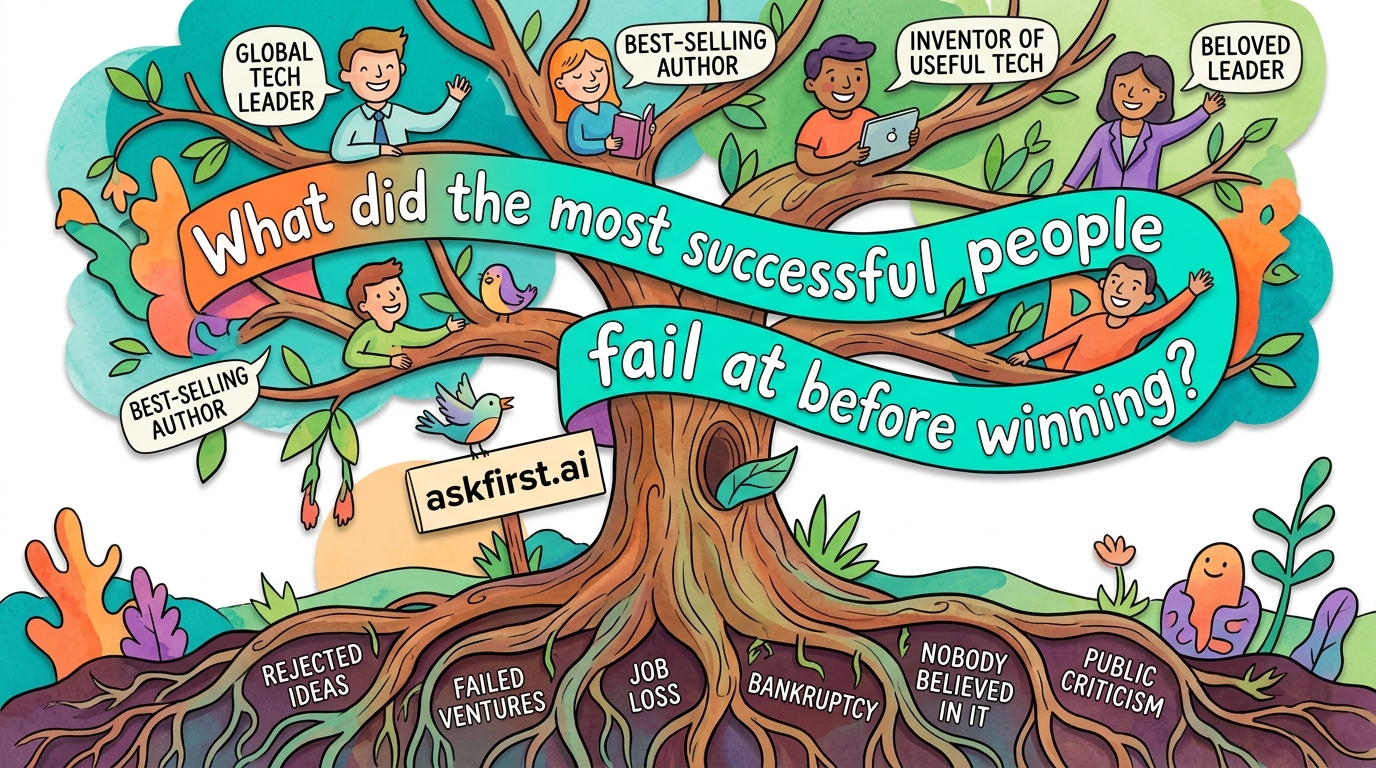
The trajectory of human achievement is rarely a linear ascent; rather, it is a jagged path paved with rejection, bankruptcy, and public humiliation. History’s most influential figures often found their greatest successes only after enduring catastrophic failures that would have crushed the resolve of an average person. Understanding these narratives is not merely an exercise in biography; it is a fundamental study in resilience, iteration, and the eventual mastery of one's domain.
The Misunderstood Visionaries: Walt Disney and Colonel Sanders
Perhaps no figure embodies the concept of "failing forward" more than Walt Disney. Before the global empire of parks and cinema, Disney’s early professional life was defined by insolvency. In his book The Disney Way by Bill Capodagli and Lynn Jackson, the authors detail how Disney’s first animation studio, Laugh-O-Gram Films, went bankrupt in 1923. He was even told by a newspaper editor that he lacked imagination and had no good ideas. Disney didn't just fail; he lost his studio, his equipment, and his reputation. He moved to Hollywood with nothing but a suitcase and a dream, eventually creating Mickey Mouse only after losing the rights to his previous character, Oswald the Lucky Rabbit.
Similarly, Harland Sanders—the face of KFC—did not achieve success until he was in his sixties. In The Colonel: The Untold Story of Kentucky Fried Chicken by Josh Ozersky, we learn that Sanders spent decades failing at various jobs, including steam engine stoker, insurance salesman, and gas station operator. His chicken recipe was rejected by over 1,000 restaurants before a single owner agreed to franchise it. Sanders’ story proves that failure is often a prerequisite for a late-blooming, massive breakthrough.
Intellectual and Creative Rejections: J.K. Rowling and Albert Einstein
The world of literature and science is equally replete with stories of initial dismissal. J.K. Rowling, now one of the most successful authors in history, was a struggling single mother on welfare when she wrote the first Harry Potter manuscript. As chronicled in her own public reflections and biographies like J.K. Rowling: A Biography by Sean Smith, she was rejected by twelve different publishing houses. Editors told her that children’s books didn't sell and that she should keep her day job. She faced "failure" in the eyes of society—unemployed, divorced, and living in a cramped apartment—yet she used that period of isolation to refine a world that would eventually captivate billions.
In the scientific realm, Albert Einstein is frequently cited as a genius, but his path was far from smooth. According to Walter Isaacson’s definitive biography, Einstein: His Life and Universe, the physicist struggled to find a teaching position after graduation. He was even rejected by the Zurich Polytechnic for a doctoral program and spent two years working as a lowly patent clerk in Bern. While he is often mythologized as having failed math, the truth is more nuanced: he failed to secure the institutional validation he craved at the time, which forced him to think outside the rigid structures of academia, leading directly to his Annus Mirabilis in 1905.
The Crucible of Business: Steve Jobs and Henry Ford
Business titans often view failure as a necessary feedback loop. Steve Jobs, the co-founder of Apple, suffered perhaps the most high-profile professional failure of the 1980s: he was fired from the very company he built. In Steve Jobs by Walter Isaacson, it is noted that Jobs described his firing as "the best thing that could have ever happened to me." The "heaviness of being successful was replaced by the lightness of being a beginner again." During his exile, he founded NeXT and Pixar, which were essential in his growth as a leader. When he returned to Apple in 1997, he was no longer the abrasive, inexperienced youth, but a tempered executive who could lead the company to become the most valuable firm in the world.
Henry Ford, the pioneer of the assembly line, also faced significant failure before the Ford Motor Company. His first venture, the Detroit Automobile Company, failed miserably, and his second attempt, the Henry Ford Company, ended in a boardroom coup where he was forced out. As documented in Ford: The Men and the Machine by Robert Lacey, these failures taught him the importance of vertical integration and mass production. He realized that the luxury market was not his path; he needed to build a car for the "great multitude."
The Anatomy of Success Through Failure
The common thread among these icons is not that they failed, but how they interpreted that failure. They viewed defeat not as a permanent state, but as a diagnostic tool.
- Iterative Learning: They treated their failures as data points. When a product failed or a manuscript was rejected, they analyzed the "why" and adjusted their approach.
- Persistence Beyond Reason: Most successful people possess a level of stubbornness that borders on the irrational. They continue to pursue their goals long after others would have pivoted to safer, more conventional paths.
- Internal Validation: They did not rely on the consensus of their peers or society. Whether it was Disney’s cartoons or Jobs’ computers, they held a vision of the future that was not yet visible to the market.
Conclusion
The stories of Disney, Sanders, Rowling, Jobs, and Ford serve as a powerful reminder that failure is the crucible in which success is forged. It is rarely the absence of failure that defines a person’s legacy, but rather the persistence to continue in spite of it. By reframing failure as an essential component of the learning process, these individuals transformed their greatest moments of defeat into the foundations of their greatest triumphs. The next time you face a significant setback, remember that you are in the company of history’s most successful people—you are merely in the middle of a chapter that has yet to reach its climax.