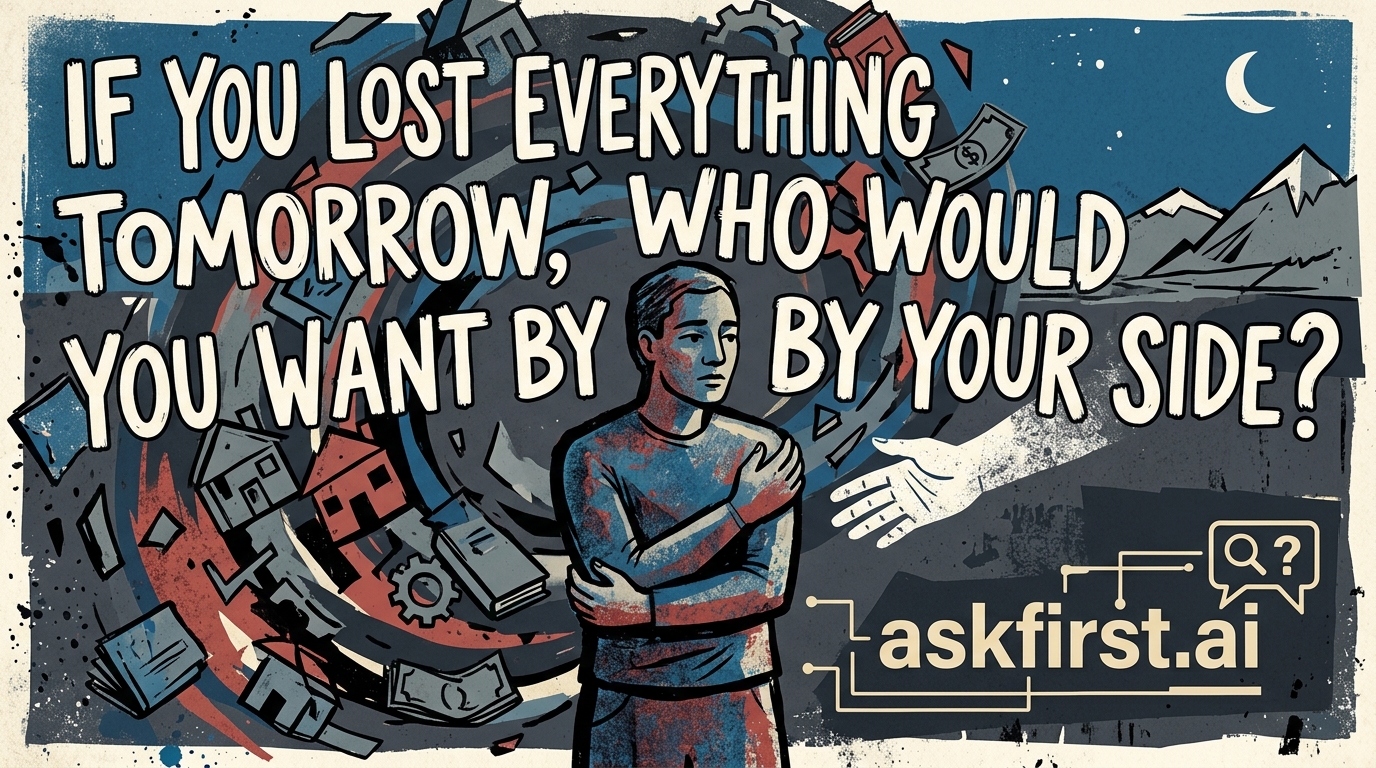
The Architecture of Resilience: Who Remains When Everything Else Fades?
The concept of "losing everything" is a foundational psychological exercise often explored in Stoic philosophy and crisis management theory. When the veneer of material success, professional status, and social capital is stripped away, the question of who remains is not merely a sentimental inquiry; it is a profound test of the structural integrity of your human network. In the high-stakes environment of crisis, you do not need cheerleaders; you need "anchor points"—individuals whose psychological fortitude and functional utility provide a foundation for reconstruction.
1. The Architect of Strategy: The Pragmatic Visionary
When you have lost everything, the immediate danger is emotional paralysis. You require a companion who possesses what author Annie Duke describes in her book Thinking in Bets: Making Smarter Decisions When You Don’t Have All the Facts as "probabilistic thinking." You need someone who does not panic when the variables shift.
This person is the pragmatic strategist. They are the ones who can look at a pile of rubble—whether financial, professional, or personal—and start calculating the steps to rebuild. They are not interested in commiserating; they are interested in the "how." In his seminal work Man’s Search for Meaning, Viktor Frankl, a psychiatrist who survived the horrors of the Nazi concentration camps, emphasizes that those who survived were the ones who could find a "logotherapeutic" purpose even amidst absolute deprivation. You want someone who acts as a mirror to your own latent potential, someone who reminds you that your identity is not tied to your assets, but to your agency.
2. The Emotional Anchor: The Vault of Unconditional Regard
While strategy is necessary for survival, endurance requires psychological stability. You need an individual who acts as a "Vault"—a person characterized by radical empathy and absolute confidentiality. According to Brené Brown’s research on vulnerability, as detailed in Daring Greatly, trust is built in small moments, often called "sliding door moments."
If you lose everything, your ego will likely suffer a catastrophic fracture. You need a confidant who has seen you at your worst and remains unmoved. This is the person who provides the "secure base," a concept central to John Bowlby’s Attachment Theory. This individual does not judge your failure as a lack of character but as a temporary state of affairs. They provide the emotional oxygen necessary to keep your cognitive faculties sharp while you process the trauma of loss.
3. The Functional Catalyst: The Resourceful Networker
In the real world, rebuilding requires more than just grit; it requires access. You need someone who possesses what sociologist Mark Granovetter identified in his foundational paper The Strength of Weak Ties as "bridge-building capacity."
If you have lost your professional standing, you need an ally who is not afraid to leverage their own reputation on your behalf. This is the person who knows the right people, understands the mechanics of the market, and is willing to make the uncomfortable phone calls that you might be too exhausted to initiate. This is not about nepotism; it is about the "social capital" that remains when financial capital evaporates. A true ally in this position is one who views your recovery as a shared project rather than a charity case.
4. The Moral Compass: The Keeper of Your Values
Perhaps most importantly, you need someone who remembers who you were before the loss. When people hit rock bottom, there is a temptation to compromise values for the sake of a quick recovery. You need someone by your side who acts as a moral compass—a person who reminds you that the shortcut you are considering is a betrayal of the person you intend to become.
In The Road to Character, David Brooks argues that we have two sets of virtues: "résumé virtues" (the skills you bring to the marketplace) and "eulogy virtues" (the virtues that are talked about at your funeral). When you lose your résumé, you are left with your eulogy virtues. You want someone who keeps you anchored to your integrity, ensuring that in your haste to regain your status, you do not lose your soul.
Conclusion: The Selection of the Inner Circle
If I were to lose everything tomorrow, the individuals I would want by my side are those who embody the intersection of these four archetypes: the Strategist, the Vault, the Catalyst, and the Compass.
Choosing these people is not about selecting friends who make you feel good; it is about selecting people who make you better. As the philosopher Friedrich Nietzsche famously wrote in Thus Spoke Zarathustra, "You must be ready to burn yourself in your own flame; how could you rise anew if you have not first become ashes?" Having the right people by your side ensures that when you do rise from those ashes, you do so with a foundation that is stronger, more refined, and more authentic than the one that existed before the fall. Your inner circle is your ultimate insurance policy; choose them for their character, their intellect, and their unwavering commitment to your long-term evolution.