The Myth of Palette Ownership: Can You Copyright Color?
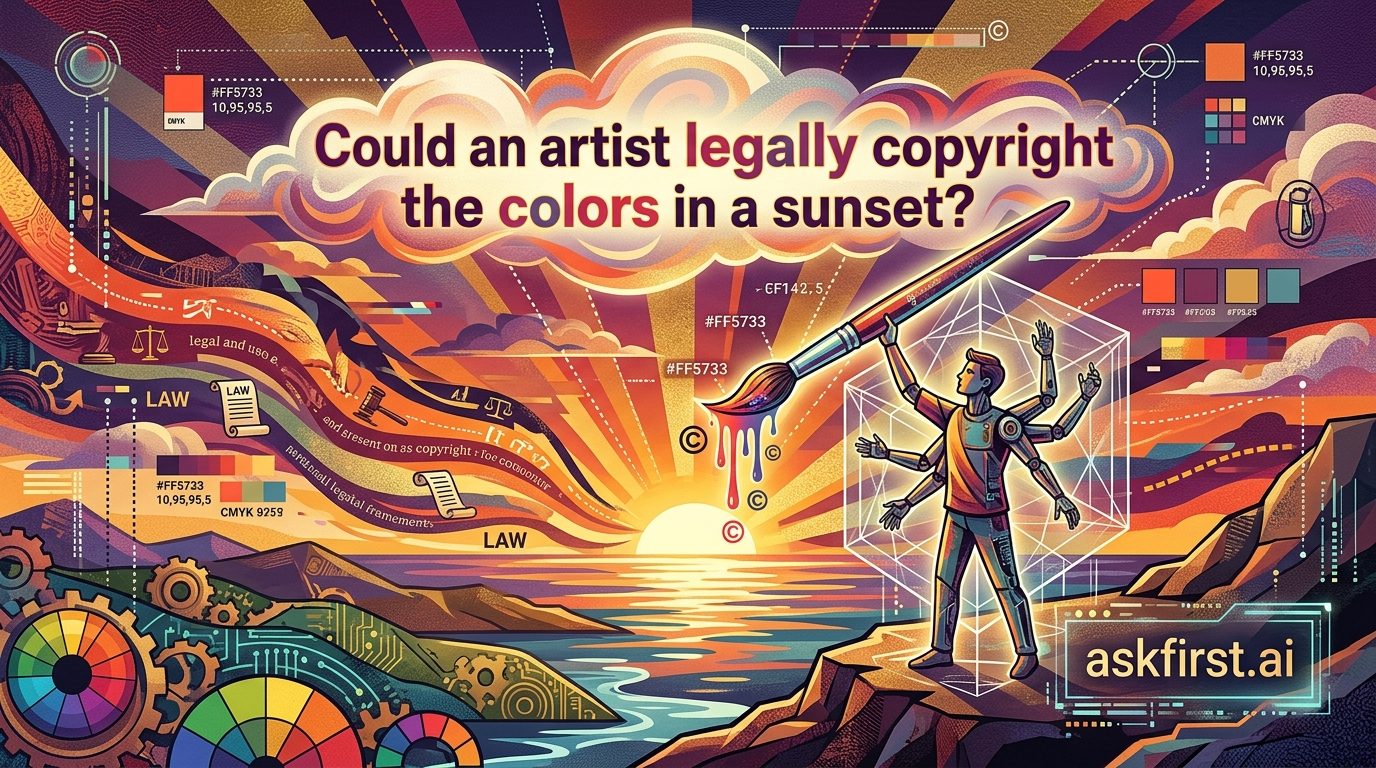
In the world of intellectual property, the notion of owning a specific hue or a combination of natural colors is a subject of frequent debate. While artists often worry about their "signature" palettes being stolen, the legal reality is grounded in the foundational principle that nature cannot be monopolized. Under copyright law, colors in their raw, natural, or isolated state are categorized as building blocks of expression, rather than protectable works of authorship.
The Legal Doctrine of Scenes a Faire
Copyright protection is designed to shield unique expressions of ideas, not the ideas themselves. In legal terms, the doctrine of scenes a faire posits that certain elements are standard or indispensable to a topic. A sunset, by definition, is a natural phenomenon comprised of a spectrum of light. Because a sunset exists in the public domain and is common to human experience, no single artist can claim ownership of the colors contained within that visual event. Attempting to copyright the specific shades of an orange-to-purple twilight would be akin to claiming ownership of the concept of a triangle or the sound of the wind.
Why Single Colors Lack Copyright Protection
According to the United States Copyright Office (USCO) guidelines, copyright does not extend to "familiar symbols or designs" or "mere variations of typographic ornamentation, lettering, or coloring." A single color, no matter how distinctive, lacks the necessary level of original, creative authorship required for copyright registration.
- Originality Requirement: To be copyrightable, a work must be a human-authored expression that possesses a modicum of creativity. A raw color is considered a common element of nature.
- Functionality vs. Expression: Color is often seen as a functional or aesthetic element rather than an expressive one. If artists were allowed to copyright basic colors, the creative landscape would collapse under the weight of thousands of infringement lawsuits.
The Exception: Trademark and Trade Dress
While copyright cannot protect a sunset's colors, other areas of law provide narrow protections in commercial contexts. Companies sometimes secure trademarks for specific colors when those colors act as a "source identifier" for a product. Examples include Tiffany Blue or UPS Brown. This is not copyright; it is a protection against consumer confusion. To achieve this, a brand must prove that the color has gained "secondary meaning" in the marketplace. For a landscape painter, however, this legal avenue is almost entirely irrelevant, as they are not attempting to brand a product line with a specific swatch.
Protecting Artistic Works
Artists maintain protection over the entire composition—the arrangement, brushwork, lighting choices, and creative interpretation of the sunset—but never the individual pigments or the natural light spectrum itself. If another artist creates a painting of a sunset that is strikingly similar in arrangement and style, a claim of infringement might arise based on the whole work, but never merely because they chose to use the same vibrant shades of gold and crimson.