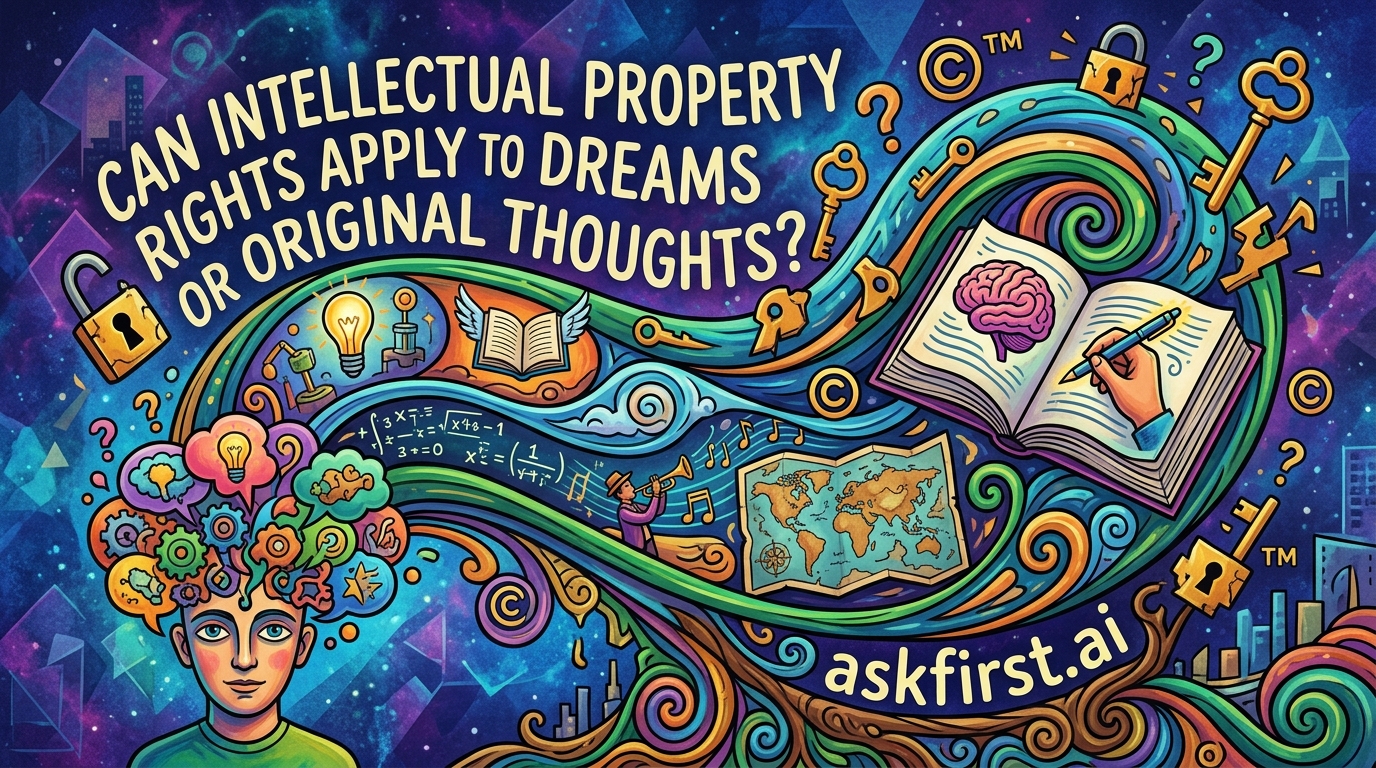
The Ownership of Consciousness: Protecting Thoughts and Dreams
Intellectual property (IP) law operates on a fundamental principle: ideas themselves are not protectable; only the expression of those ideas is. This distinction is the bedrock of global copyright and patent systems. While the human mind produces fascinating phenomena like dreams and innovative thoughts, these entities exist in a state of intangible abstraction that current legal frameworks are ill-equipped to claim as proprietary assets.
The Idea-Expression Dichotomy
In legal theory, the "idea-expression dichotomy" mandates that copyright protects the form in which an idea is communicated—such as a book, a painting, or a software code—rather than the idea itself. A dream, in its raw state, is a private, internal experience. Because it lacks a tangible "fixation" in a medium (a requirement under the Berne Convention for the Protection of Literary and Artistic Works), it cannot be copyrighted. An original thought, even if brilliant, remains unprotectable until it is documented, recorded, or manifested in an external format.
Why Dreams and Thoughts Escape Legal Nets
- Lack of Fixation: For an intellectual property right to arise, the law requires that the creation be fixed in a tangible form. A thought floating in the brain remains volatile and invisible, lacking the necessary physical existence to be legally registered.
- The Burden of Proof: Even if an individual claimed ownership of a specific thought, proving that they were the original author or "inventor" of that thought is scientifically and legally impossible. Intellectual property hinges on clear evidence of origin.
- Utility and Public Domain: If thoughts were privatizable, human progress would grind to a halt. The legal system is designed to promote innovation by allowing ideas to circulate freely. If a thought could be "owned" before it is shared, the creative exchange that fuels art and science would be stifled.
Potential Future Challenges: Neurotechnology
As we advance into the era of Brain-Computer Interfaces (BCIs) and neuro-imaging, the boundaries of IP are being tested. If technology allows us to record, digitize, and export dream data, we approach a new legal frontier. When a dream is recorded as a video file by a machine, it transitions from a "thought" to a "fixated work." In this scenario, the output of the machine could potentially be protected, provided it meets the standard for original authorship. However, even then, the underlying subconscious creation would remain a subject of intense ethical and legal debate regarding "cognitive liberty."
Ultimately, while your deepest insights and nocturnal adventures remain yours alone, they are not property in the eyes of the law. Intellectual property serves as a bridge between your mind and the world; until you build that bridge through expression, your ideas remain free, universal, and unbound by the constraints of corporate ownership.