Did Common Law Really Create Individual Property Rights
Beyond the Common Law: The Ancient Roots of Ownership
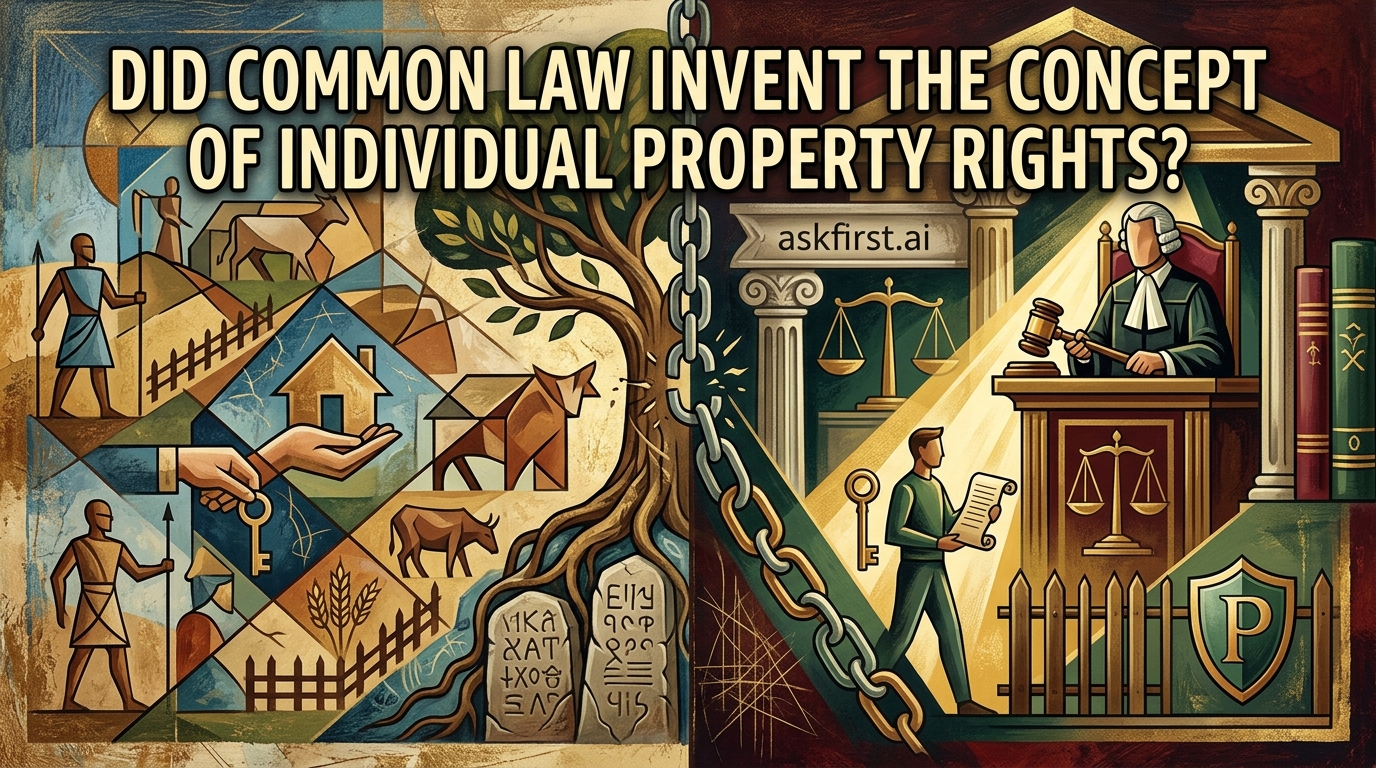
Many assume that individual property rights are a relatively modern invention fostered by the English common law system. However, history reveals that the concept of "mine versus thine" is as ancient as civilization itself. While the common law refined the mechanisms of transfer, tenure, and dispute resolution, it did not invent the core principle of private ownership.
The Pre-Common Law Foundations
Long before the Magna Carta or the development of English common law, complex systems of property rights existed in antiquity.
- Roman Law (Civil Law tradition): Perhaps the most influential precursor, Roman law established the concept of dominium. This provided individuals with broad rights to use, exclude others, and dispose of property. The Roman legal tradition viewed property as a central pillar of individual autonomy, a framework that heavily influenced continental Europe and later Western legal systems.
- Mesopotamian Codes: The Code of Hammurabi (c. 1750 BCE) contained detailed provisions regarding the ownership of land, houses, and livestock. These laws recognized clear individual titles and established penalties for theft or encroachment, proving that formalized property protection predates the Anglo-Saxon era by thousands of years.
- Biblical and Hebraic Traditions: Ancient texts emphasize inheritance, boundaries, and the sanctity of individual holdings, underscoring that societal stability has long been tied to secure property boundaries.
The Role of Common Law
If the common law did not invent individual property, what did it do? English common law, emerging in the Middle Ages, transformed the practice of property. It moved away from vague, status-based feudal relationships toward more predictable, objective rules.
Key contributions included:
- The Writ System: Common law introduced procedural mechanisms that allowed citizens to sue for property disputes in royal courts, ensuring that claims were based on evidence and precedent rather than purely on the whim of a local lord.
- Feudal Tenure Reform: While English law began with the King owning all land, it evolved to create "estates in land." This legal fiction allowed individuals to hold near-exclusive rights for generations, effectively fostering a market for land ownership despite the formal remnants of royal title.
- Adverse Possession: By codifying how one gains title through long-term usage, the law prioritized land productivity and efficiency over idle ownership.
Conclusion: A Collaborative Legal Evolution
The perception that common law is the sole creator of property rights is a historical myth. Property rights emerged organically as civilizations required stability to trade, farm, and grow. English common law should be viewed as an evolutionary bridge—a system that synthesized centuries of earlier legal wisdom and translated it into a standardized, enforceable, and remarkably efficient framework that helped underpin the modern global economic order.