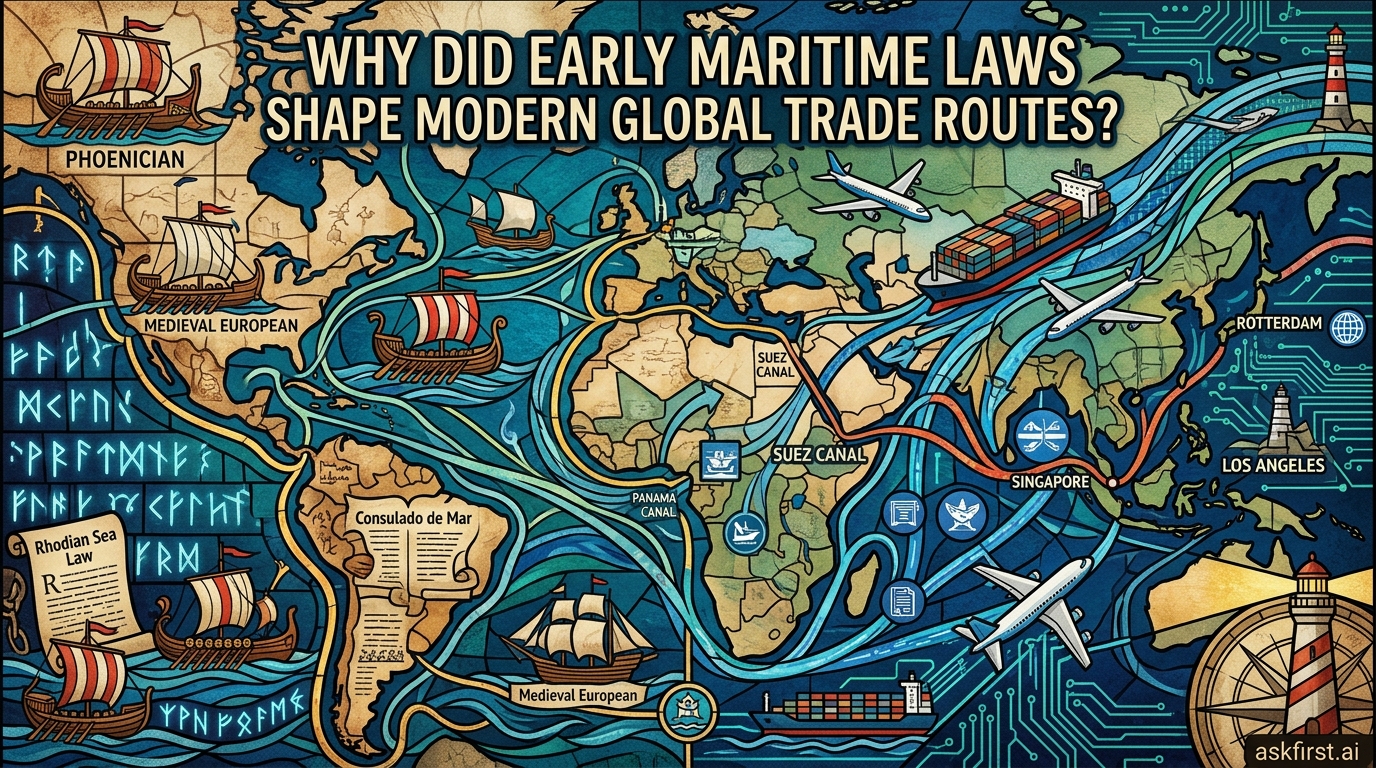
The Foundation of Modern Commerce
Maritime law, often referred to as admiralty law, did not merely evolve as a set of rules for ships; it served as the original legislative framework for global capitalism. By standardizing practices such as 'General Average'—a principle where all stakeholders in a sea venture share the loss if part of a cargo is jettisoned to save the ship—ancient laws created a culture of risk-sharing. This legal architecture provided the essential predictability needed for merchants to invest in transoceanic voyages.
The Rhodian Sea Law and Beyond
The roots of modern maritime logistics can be traced back to the Rhodian Sea Law (Nomos Rhodion Nautikos), which functioned from the 7th to the 9th centuries. By codifying rights regarding shipwreck recovery and collision liability, it reduced the inherent unpredictability of the high seas. When merchants knew their investments were protected by a recognized legal standard, they were willing to venture further, effectively drawing the map of the world through trade hubs rather than random exploration. These ancient mandates prioritized stable access to ports, a practice that directly dictates where modern shipping megaports are located today.
Codifying Consistency in Global Shipping
The development of the 'Lex Maritima' or 'Law Merchant' in the Middle Ages further cemented these routes. By establishing international courts of arbitration, these laws allowed trade to bypass the chaotic patchwork of local jurisdictions. This created a standardized 'highway of the sea.' For instance, the Hanseatic League utilized these legal norms to ensure that ships could navigate between Baltic and North Sea ports without fearing arbitrary seizures or unfair taxes. This consistency allowed specific coastal regions to evolve into permanent economic centers. Today, the geography of global trade is essentially a legacy of where these early, legally protected routes converged.
Why This Matters Today
Modern global trade routes remain tethered to these ancient precedents because they established the path of least resistance. The deep-water ports we utilize in the 21st century are frequently the same natural harbors that offered the best legal and physical security centuries ago. The legal concepts of 'limitation of liability' and 'maritime lien' persist today under international conventions like the Hague-Visby Rules. These rules essentially replicate the ancient philosophy: minimize risk for the financier, ensure the continuity of the supply chain, and favor established transit corridors. Consequently, the world economy moves along tracks laid down by medieval judges and ancient port authorities, proving that while technology has changed, the legal geography of the planet remains remarkably constant and durable for global prosperity.