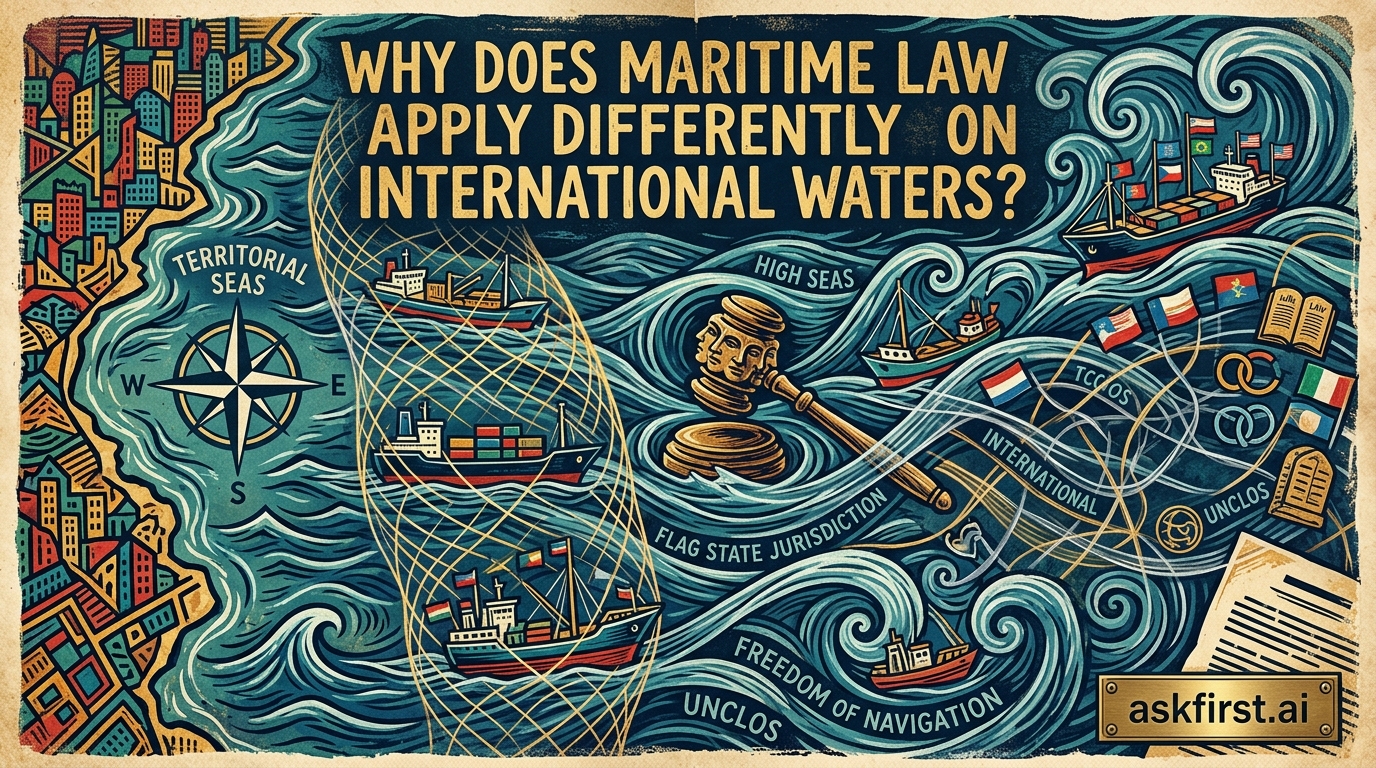
The Legal Status of the High Seas
Maritime law, or admiralty law, operates on a unique jurisdictional framework that fundamentally shifts once a vessel crosses into international waters. Unlike terrestrial borders, where sovereignty is absolute and contiguous, the high seas exist as a global commons, governed by the principle of mare liberum, or 'free seas.' This legal doctrine, championed by Hugo Grotius in the 17th century, dictates that no state may subject any part of the high seas to its sovereignty. Consequently, international waters operate under a distinct set of rules designed to facilitate global navigation and trade without the interference of national territorial claims.
The Principle of Flag State Jurisdiction
When a ship enters the high seas, it remains subject to the exclusive jurisdiction of the 'flag state'—the nation in which the vessel is registered. This creates a legal fiction where the ship acts as an extension of the flag state's territory. This system, codified in the United Nations Convention on the Law of the Sea (UNCLOS), ensures that law and order are maintained even in the absence of a localized government. If a crime occurs on the high seas, the flag state holds the primary authority to investigate and prosecute, effectively preventing a legal vacuum.
Exceptions to the Rule
While the flag state holds primary authority, universal jurisdiction allows for specific interventions that supersede typical maritime autonomy:
- Piracy: Under international law, any nation may seize a pirate ship and arrest those on board, regardless of the vessel's flag. This is based on the idea that pirates are hostis humani generis—enemies of all mankind.
- Slave Trading: Similar to piracy, the international prohibition against the slave trade grants warships the right to board and inspect vessels suspected of trafficking.
- Unauthorized Broadcasting: Nations may take action against vessels engaged in unauthorized radio or television transmissions that interfere with international public communications.
Why This Matters
The complexity of maritime law stems from the necessity to balance state sovereignty with the global requirement for efficient commerce. By relying on the flag state, international maritime law avoids the chaos of competing jurisdictional claims. It creates a predictable environment where shipowners, crews, and cargo interests understand which laws apply to them, regardless of their physical location on the ocean. This structure allows approximately 90% of global trade to flow seamlessly across the planet's vast, stateless waterways, providing a vital, stable foundation for the interconnected world economy. Understanding these principles reveals how the ocean remains one of the few truly shared, regulated spaces on Earth.