The Intersection of Sacred Geometry and Workspace Optimization
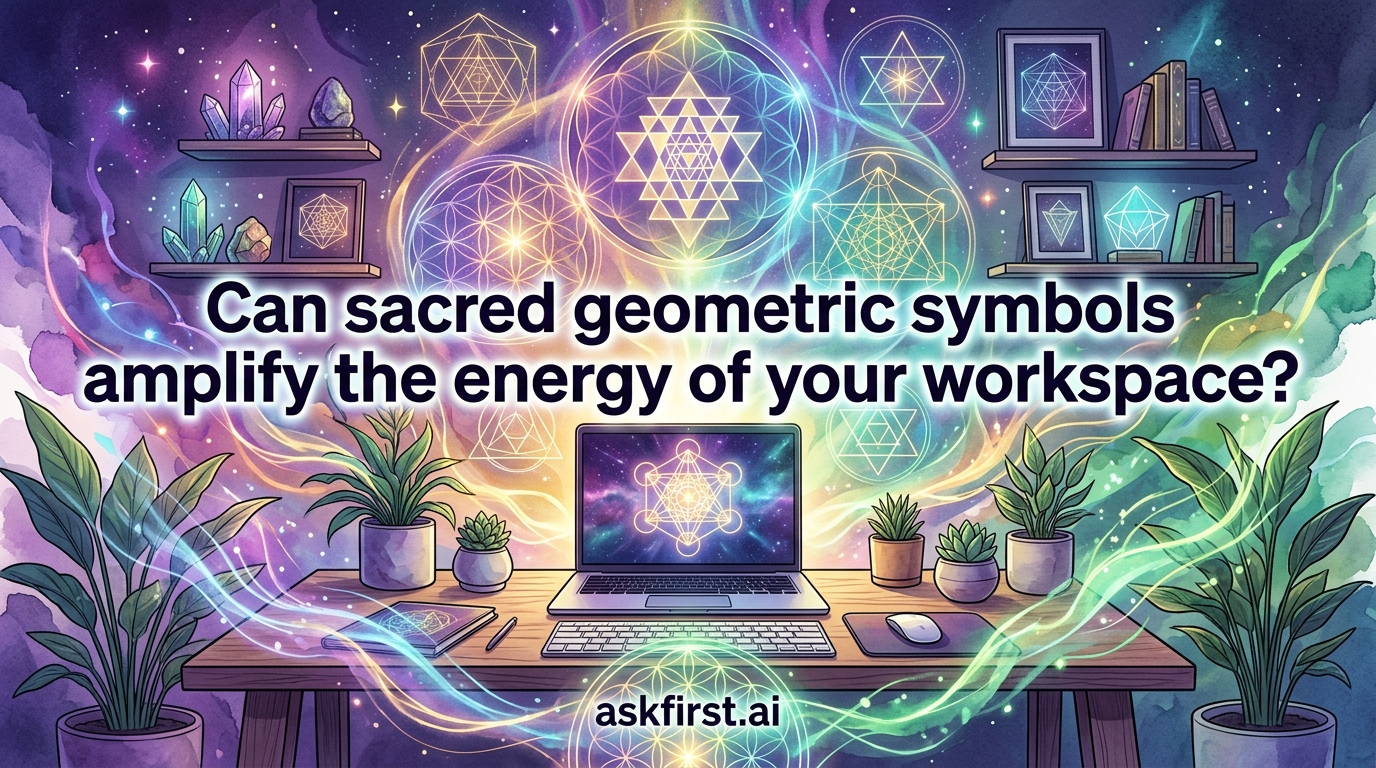
Sacred geometry refers to the belief that certain geometric patterns, proportions, and ratios—such as the Golden Ratio (Phi), the Flower of Life, and the Metatron’s Cube—are fundamental building blocks of the universe. Proponents of these symbols argue that they represent the architectural blueprint of creation. When applied to a workspace, the theory suggests that these symbols act as resonators, potentially "amplifying" or harmonizing the ambient energy of an environment to enhance focus, creativity, and cognitive flow.
Historical Context and Philosophical Foundations
The study of sacred geometry spans millennia, appearing in the architecture of Ancient Egypt, the Vedic traditions of India, and the philosophical inquiries of Plato, who associated specific geometric solids with the elements of nature. In modern holistic design, these symbols are utilized as tools to create "coherent" spaces. The underlying hypothesis is that human biological systems react positively to mathematical symmetry, reducing environmental stress—a concept often aligned with Biophilic Design, which emphasizes our innate connection to nature’s patterns.
Practical Application: How to Integrate Symbols
To integrate these symbols into a workspace, one must consider both aesthetic placement and the psychological intent behind their use.
- The Flower of Life: Often used to promote a sense of unity and interconnectedness. Placing a laser-cut wooden Flower of Life on a desk or as a wall hanging is said to foster a sense of wholeness, which can be beneficial for collaborative workspaces.
- The Golden Ratio (Phi): Incorporating the 1:1.618 ratio into your desk layout or screen composition can create a sense of visual ease. The human brain processes this ratio with less cognitive load, potentially reducing fatigue during long work sessions.
- Platonic Solids: These five 3D shapes (Tetrahedron, Hexahedron, Octahedron, Dodecahedron, and Icosahedron) are often used as desk ornaments. Each is associated with a specific element (Fire, Earth, Air, Ether, Water). For instance, an Icosahedron is often placed in creative areas to stimulate fluidity of thought.
Pros, Cons, and Scientific Reality
While there is no peer-reviewed empirical evidence proving that symbols "amplify" energy in a metaphysical sense, there are measurable psychological benefits to a curated workspace.
- Pros:
- Cognitive Anchoring: Symbols act as visual cues that remind the user of their intention (e.g., focus, creativity), facilitating "flow states."
- Aesthetic Harmony: Symmetrical designs reduce visual clutter, which is clinically proven to lower cortisol levels.
- Placebo and Intention: The ritual of setting up a space with meaningful geometry can increase personal accountability and mindfulness.
- Cons:
- Superstition vs. Science: Relying on symbols as a "quick fix" for poor ergonomics or bad time management is ineffective.
- Distraction: Over-decorating a workspace with complex patterns can lead to visual overstimulation, which is counterproductive to deep work.
Future Trends
The future of workspace optimization is shifting toward "Neuro-Architecture," where environments are engineered to trigger specific brain states. As we move toward 2026 and beyond, we expect to see more integration of subtle, geometrically-inspired furniture and lighting designs that utilize mathematical precision to maximize productivity. By combining ancient geometric wisdom with modern ergonomic science, individuals can create workspaces that are not only functional but also psychologically restorative.