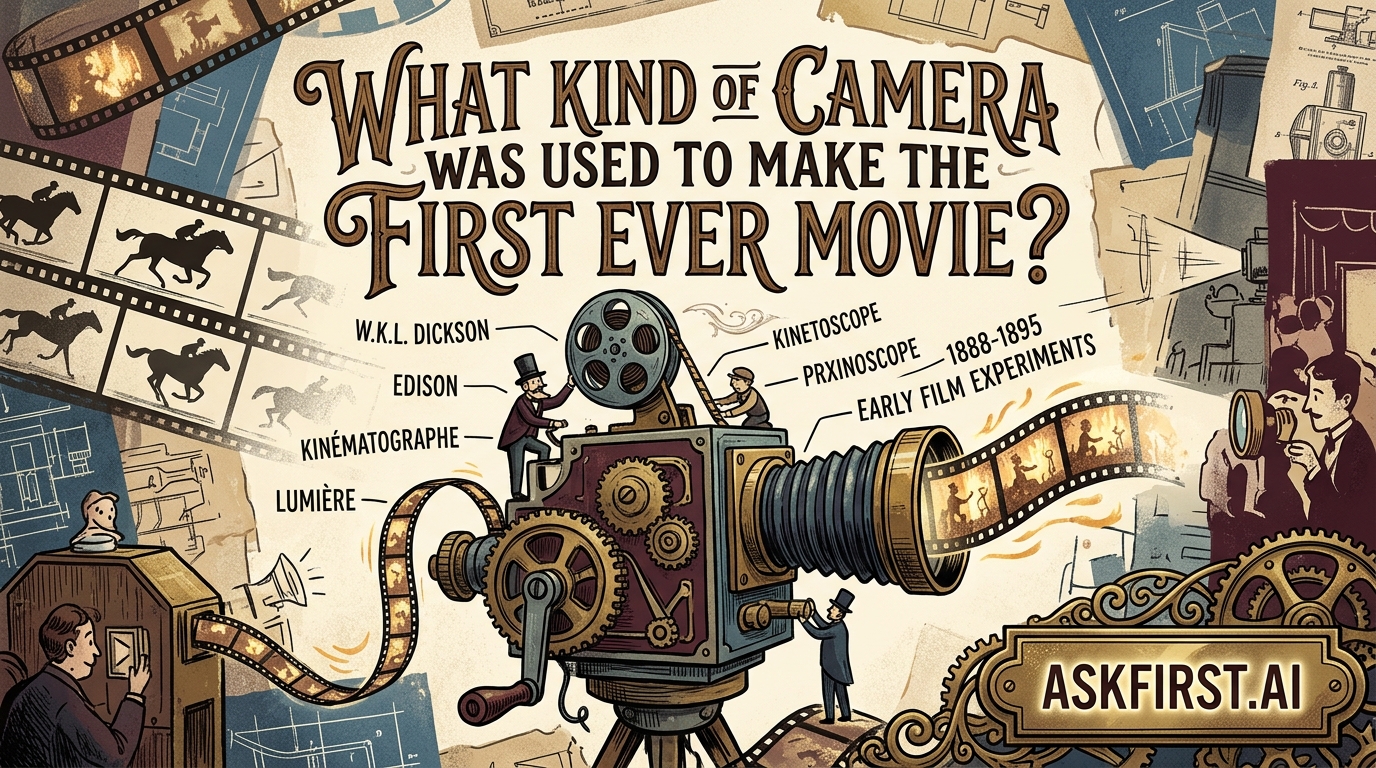
The Kinetograph: The Revolutionary Camera That Invented Cinema
The birth of motion pictures is inextricably linked to the invention of the Kinetograph, the first motion-picture camera capable of capturing sequential images on celluloid film. Developed in the laboratories of Thomas Edison between 1889 and 1892, this device transformed the way humanity perceives time and motion.
The Technical Genesis of the Kinetograph
The Kinetograph was the brainchild of William Kennedy Dickson, a Scottish-American inventor working under Edison’s supervision. Before this invention, inventors like Eadweard Muybridge had experimented with multiple cameras to capture motion, but the Kinetograph was the first to use a single, motorized camera to record a continuous series of images.
Key Technical Specifications:
- Film Format: The camera utilized 35mm celluloid film, a standard that remains the industry benchmark to this day.
- Mechanism: It featured a sophisticated "intermittent motion" mechanism. This allowed the film to stop momentarily behind the lens to be exposed, then advance rapidly to the next frame.
- Power Source: It was powered by a heavy-duty electric motor, distinguishing it from the hand-cranked cameras that would become common in later years.
Historical Context and Development
In the late 1880s, Edison sought to create a visual counterpart to his phonograph. By utilizing the newly available flexible celluloid film developed by George Eastman, Dickson successfully synchronized the camera’s shutter with the movement of the film. The first successful test films, such as Monkeyshines (1889–1890), were crude but established the foundational principles of cinematography.
By 1893, the camera was fully refined, and Edison unveiled the Kinetoscope—a peephole viewing device—to display the footage recorded by the Kinetograph. This created a commercial sensation at the 1893 World’s Columbian Exposition in Chicago.
Practical Guide: How Early Filmmaking Worked
For those interested in the mechanics of early cinema, the process was rigorous:
- Preparation: The camera was stationary and incredibly heavy, requiring a specialized studio—the Black Maria—which rotated on tracks to follow the sun.
- Filming: Actors performed within a small, brightly lit space. Because the film stock was relatively insensitive to light, intense sunlight was required.
- Development: After the roll was finished, the film was manually developed in tanks, a process prone to chemical errors.
- Display: The film was looped inside the Kinetoscope, where a viewer would peer through an eyepiece to see the "flickering" motion.
Pros and Cons of the Kinetograph
Pros
- Standardization: It established the 35mm format and the four-perforation frame, which defined cinema for over a century.
- Innovation: It proved that high-speed sequential photography was viable for mass entertainment.
Cons
- Lack of Portability: Unlike the later Cinématographe Lumière, the Kinetograph was immobile, limiting filmmakers to studio settings.
- Individual Experience: The Kinetoscope was a "one-person" machine, lacking the communal experience of projected movies that would later dominate the industry.
Future Trends and Legacy
While the Kinetograph eventually lost market share to the more portable, dual-purpose cameras developed by the Lumière brothers, its legacy is foundational. It transitioned the world from static photography to the era of the "moving image," paving the way for everything from silent films to modern digital cinematography. Today, the Kinetograph is regarded as the "grandfather" of all modern film equipment, symbolizing the dawn of the global film industry.