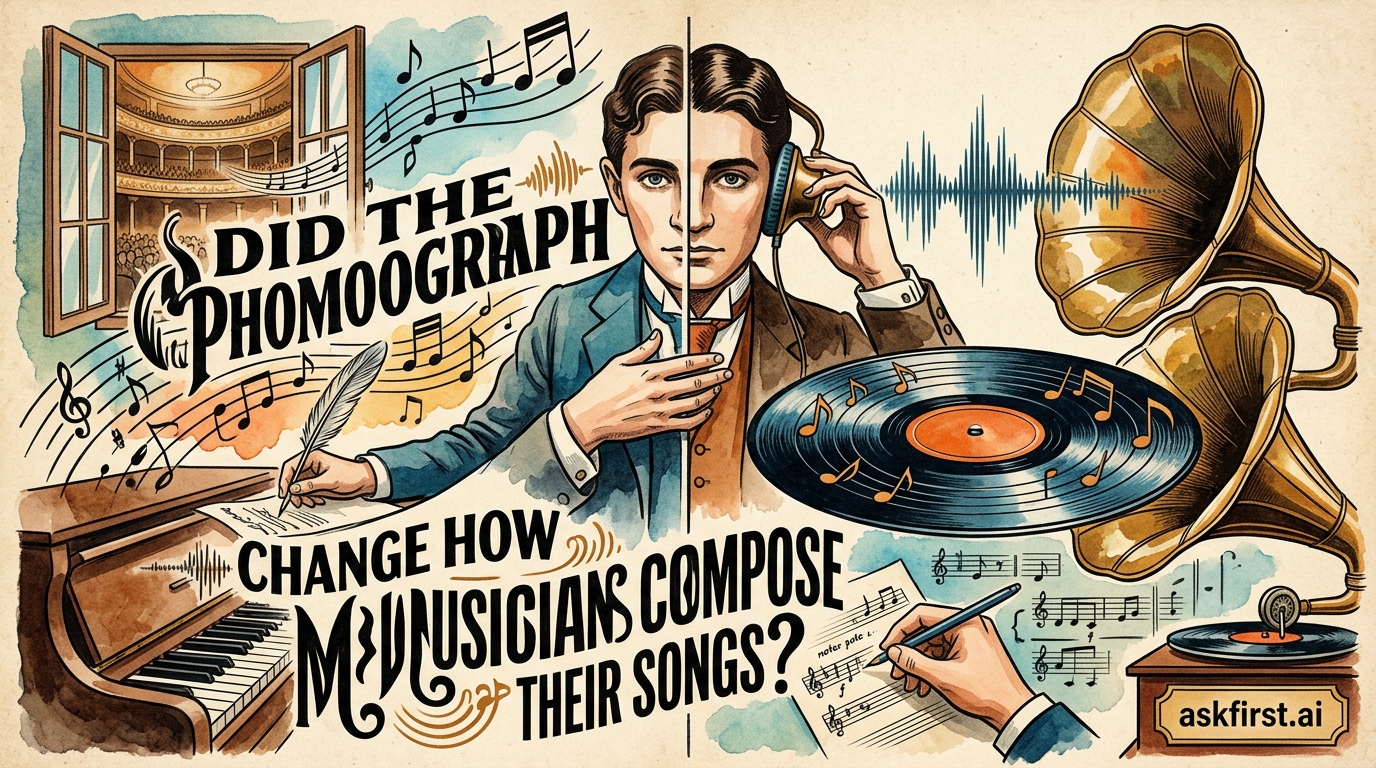
The Sonic Revolution: How the Phonograph Redefined Musical Creation
Before the invention of the phonograph by Thomas Edison in 1877, music existed primarily as a fleeting, ephemeral experience tethered to the moment of performance. Composers wrote for the live stage, and songs were typically structured around the endurance of a human performer and the physical limitations of acoustic environments. The advent of recorded sound fundamentally altered the landscape of musical composition, acting as the primary catalyst for the evolution of modern song structure.
The Era of Constraint
Prior to recording technology, music was largely tied to the constraints of the sheet music medium and the capabilities of the venue. Compositions were often expansive, lacking the tight structural predictability that defines the modern popular song. Because performance was the only way to experience music, there was little incentive to limit song length for a specific, repeatable format.
The Three-Minute Limitation and Structural Discipline
With the introduction of the 78 RPM record in the early 20th century, the physical limitations of the medium forced a revolution in composition. Early discs could only hold roughly three minutes of audio per side. This necessity forced songwriters to become masters of brevity and punchy, memorable arrangements. Musicians began to craft songs with:
- Distinct hooks: Melodies were designed to capture attention instantly.
- Standardized structures: The verse-chorus-verse-chorus-bridge pattern became the industry standard.
- Editing mindset: Songwriters stopped writing continuous flows and began editing content to fit the rigid time constraint of the vinyl medium.
Recording as a Tool for Composition
The phonograph turned the recording studio into an instrument itself. Musicians began composing not just for the ears of a concert audience, but for the specific capabilities of the recording apparatus. Multi-track recording—an extension of early phonographic principles—allowed artists like Les Paul and later The Beatles to layer sounds that would have been impossible to play live. Consequently, composition shifted from a linear performance process to a modular, architectural approach where layers could be built, adjusted, and perfected in post-production.
Democratization and Style Evolution
The ability to hear one’s own performance played back allowed musicians to objectively audit their compositions. This feedback loop led to more sophisticated experimentation with tone, timbre, and arrangement. No longer bound by the need to have a performer present, composers could experiment with studio-only sounds, such as backwards tape loops or ambient textures, which eventually gave birth to entirely new genres like electronic music and hip-hop. The phonograph did not merely capture music; it provided the blueprint for the modern creative process, dictating the very length, structure, and texture of what the world considers a great song today.