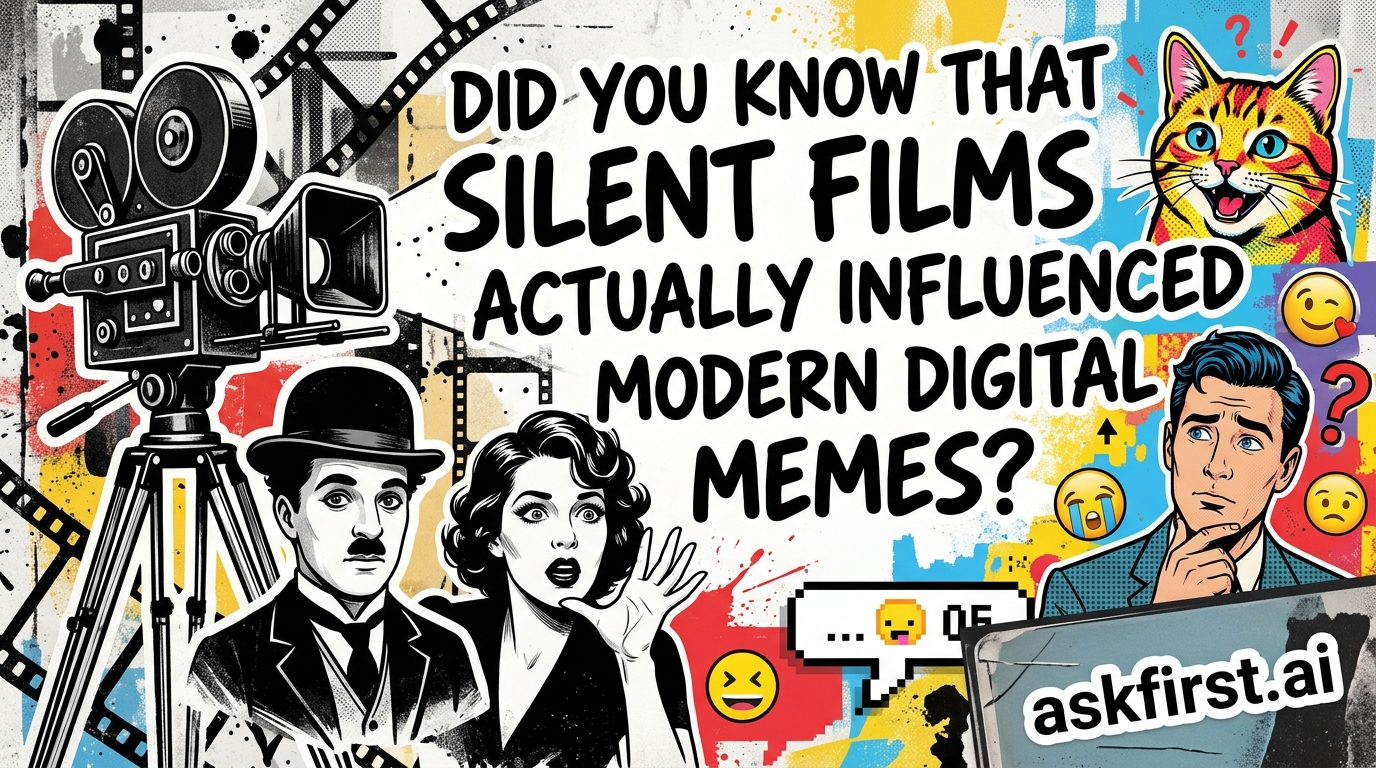
The Silent Ancestry: How Buster Keaton Invented the Meme
It is a common misconception that the internet meme is a product of the digital age, born solely from pixelated images and social media algorithms. In reality, the fundamental building blocks of meme culture—visual hyperbole, repeatable gags, and concise narrative punchlines—were perfected during the silent film era of the early 20th century. Pioneers like Charlie Chaplin, Buster Keaton, and Harold Lloyd were the original 'content creators,' establishing a universal visual language that bypassed linguistic barriers to achieve mass viral appeal.
The Visual Syntax of Humor
Silent films relied on 'visual shorthand' to convey complex emotions or jokes without a single word of dialogue. This necessitated exaggerated facial expressions and physical gestures, a technique that directly mirrors the modern usage of reaction GIFs and facial-expression-based memes. When a modern user selects a clip of a celebrity looking disappointed to communicate a sentiment in a group chat, they are engaging in the same semiotic process as the audience of a 1920s slapstick comedy. These films functioned as templates—the 'Distracted Boyfriend' meme of the 1920s might have been a scene of a character tripping over a banana peel, a visual anchor that audiences understood instantly regardless of their cultural background.
The Mechanics of Iteration
Modern memes rely on 'remix culture,' where an original image is layered with new text or context. Silent films were among the first media formats to utilize standardized 'bit-sized' comedic structures that could be easily adapted. A physical gag—such as a man getting a pie to the face—was not just a one-off event; it was a structural template. Studios would often copy these successful physical gags across dozens of different shorts, essentially creating a 'remix' of the original comedic beat. This iterative process is the ancestor of today's 'meme format,' where the frame remains the same while the punchline evolves to fit current contexts.
Why This Connection Persists
This phenomenon endures because of the human brain’s preference for visual processing. Silent films taught the world that humor is most contagious when it requires minimal cognitive load. By distilling human behavior into predictable, iconic silhouettes and exaggerated reactions, filmmakers like Keaton created a 'code' for comedy that is infinitely reusable. Modern meme culture does not just borrow from this history; it is a direct evolution of the silent era's demand for high-impact, low-text, and universally accessible imagery. Today’s digital landscape is essentially a high-speed, interactive manifestation of the silent screen’s greatest legacy: the ability to turn a singular, relatable moment into a global conversation.