The Shakespearean Linguistic Myth
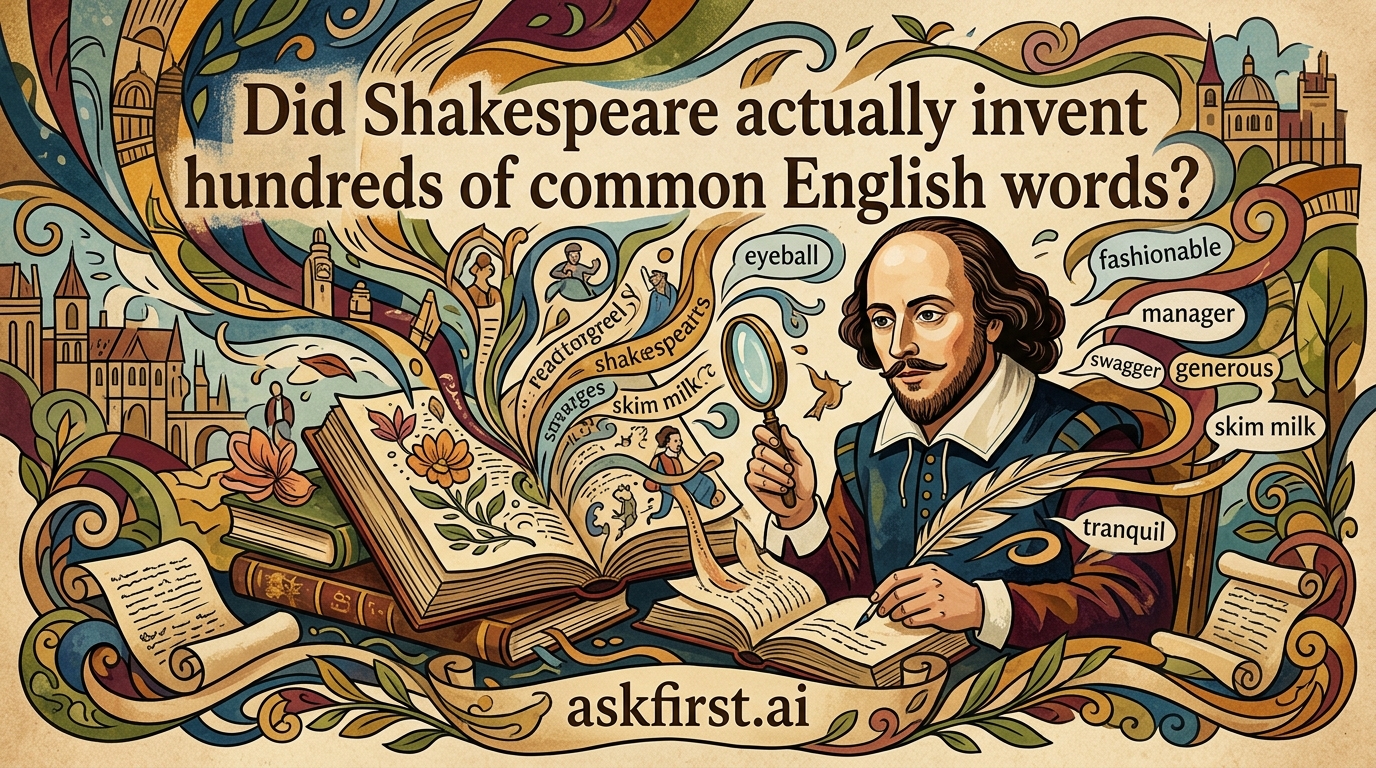
For centuries, the prevailing narrative surrounding William Shakespeare suggests that he single-handedly coined hundreds, if not thousands, of English words. It is common to see lists claiming he birthed terms like 'lonely,' 'eyeball,' 'fashionable,' and 'bedroom.' However, a rigorous linguistic examination reveals that the reality is significantly more nuanced and historically complex. While Shakespeare was undoubtedly a linguistic innovator, the notion that he invented these words from scratch is largely a misunderstanding of how historical records function.
The Role of the OED and Early Documentation
The primary source of this myth is the Oxford English Dictionary (OED). When the dictionary was first compiled, editors relied heavily on literary texts as primary evidence for word usage. Because Shakespeare's works were so thoroughly indexed and widely read, his plays often served as the 'first citation' for many words. This created a selection bias: just because a word appeared in Shakespeare's writing does not mean he was the first person to use it. It simply means that, at the time the OED was being researched, his was the earliest surviving text researchers could definitively date.
Linguistic Evolution and Adoption
Language is a fluid, social phenomenon, not a solitary invention. During the Elizabethan era, the English language was undergoing a period of rapid expansion due to the Renaissance and increasing international trade. Words were entering the lexicon through various avenues, including:
- Borrowing from Latin and French: Scholars and writers frequently adapted foreign vocabulary to fill gaps in the English tongue.
- Derivation and Affixation: Writers regularly added prefixes and suffixes to existing words to create new meaning.
- Oral Tradition: Many words existed in common speech, regional dialects, or non-literary records long before they appeared in a printed book.
Shakespeare as a Master Adaptor
Rather than serving as a primary inventor, Shakespeare acted as a master 'popularizer.' He possessed an uncanny ability to pluck words from the fringes of dialect or academia and weave them into a dramatic context that ensured their survival. When Shakespeare used a word in his plays, he effectively provided it with a permanent platform, cementing its place in the standard English lexicon. He did not necessarily invent 'lonely'; he gave it the emotional resonance that ensured it would remain a permanent fixture in our vocabulary.
Conclusion: Distinguishing Invention from Popularization
In summary, Shakespeare is responsible for the proliferation and standardization of many words rather than their initial creation. By recognizing him as a brilliant adaptor who bridged the gap between niche vocabulary and common usage, one gains a more accurate appreciation of his influence. His genius lay in his unparalleled ability to synthesize the living language of his time into an enduring literary legacy, rather than functioning as a dictionary-creating inventor.