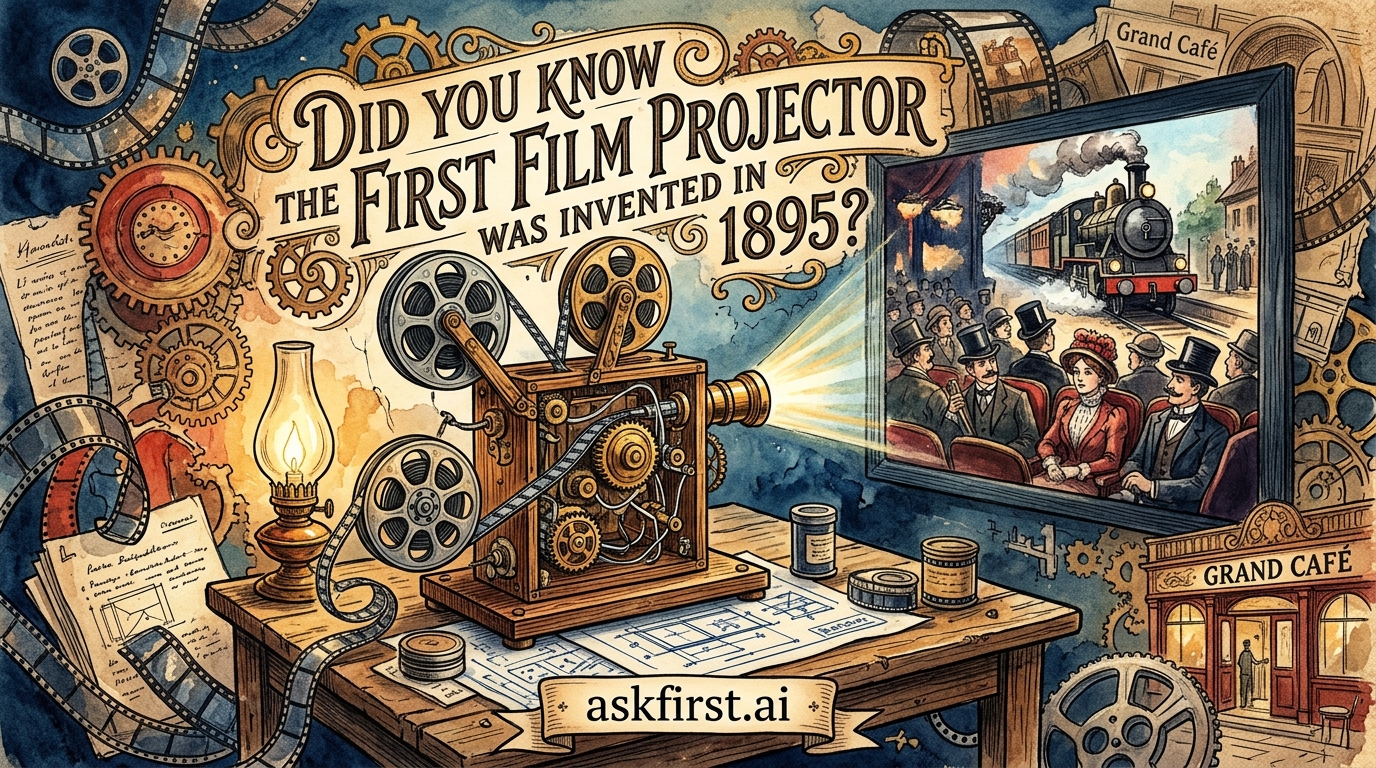
The Dawn of Cinematography: A Technological Revolution
The year 1895 stands as a monumental landmark in the history of human communication and artistic expression. While popular imagination often attributes the birth of cinema to a single moment, the reality is a fascinating tapestry of iterative innovation, engineering prowess, and competitive ambition. The widely accepted milestone occurred in Paris on December 28, 1895, when Auguste and Louis Lumière held the first commercial public screening of cinematographic films.
The Lumière Brothers and the Cinématographe
The Lumière brothers developed the Cinématographe, an all-in-one device that functioned as a camera, printer, and projector. Unlike earlier stationary devices, the Cinématographe was portable, allowing filmmakers to capture the spontaneity of life outside a studio setting. This innovation bridged the gap between static photography and fluid human movement, fundamentally changing how humanity preserved its experiences.
Key Innovations of the Era
- Intermittent Movement: The most critical technical hurdle was creating a mechanism to stop the film momentarily in front of the lens while the shutter opened, then advancing it rapidly to the next frame. This created the illusion of motion.
- Perforated Film: Using standardized, edge-perforated film stock allowed for precise synchronization, a technique pioneered by Thomas Edison and refined by others to ensure steady image projection.
- Public Projection: Before 1895, inventions like the Kinetoscope were largely individual experiences, requiring viewers to peer into a small box. The Lumière projector democratized the experience, transforming it into a communal social event.
Busting Common Myths
It is a common misconception that the Lumière brothers invented the very first moving picture device in a vacuum. Various inventors, including William Friese-Greene and Ottomar Anschütz, experimented with chronophotography and projection systems throughout the early 1890s. However, the Lumière system achieved the specific combination of reliability, portability, and public commercial viability that defined the industry. The 1895 date serves as a symbolic marker for the transition from a laboratory experiment to a global cultural phenomenon.
The Lasting Legacy of 1895
The invention of the film projector did more than entertain; it redefined the limits of human perception. By standardizing the projection speed at roughly 16 frames per second, the pioneers of the late 19th century set the cadence for narrative storytelling that persists today. This invention laid the groundwork for the modern digital era, proving that the human desire to capture and share stories through light and shadow is an eternal pursuit. The legacy of these pioneers is visible in every screen, smartphone, and theater that continues to define our modern cultural landscape.