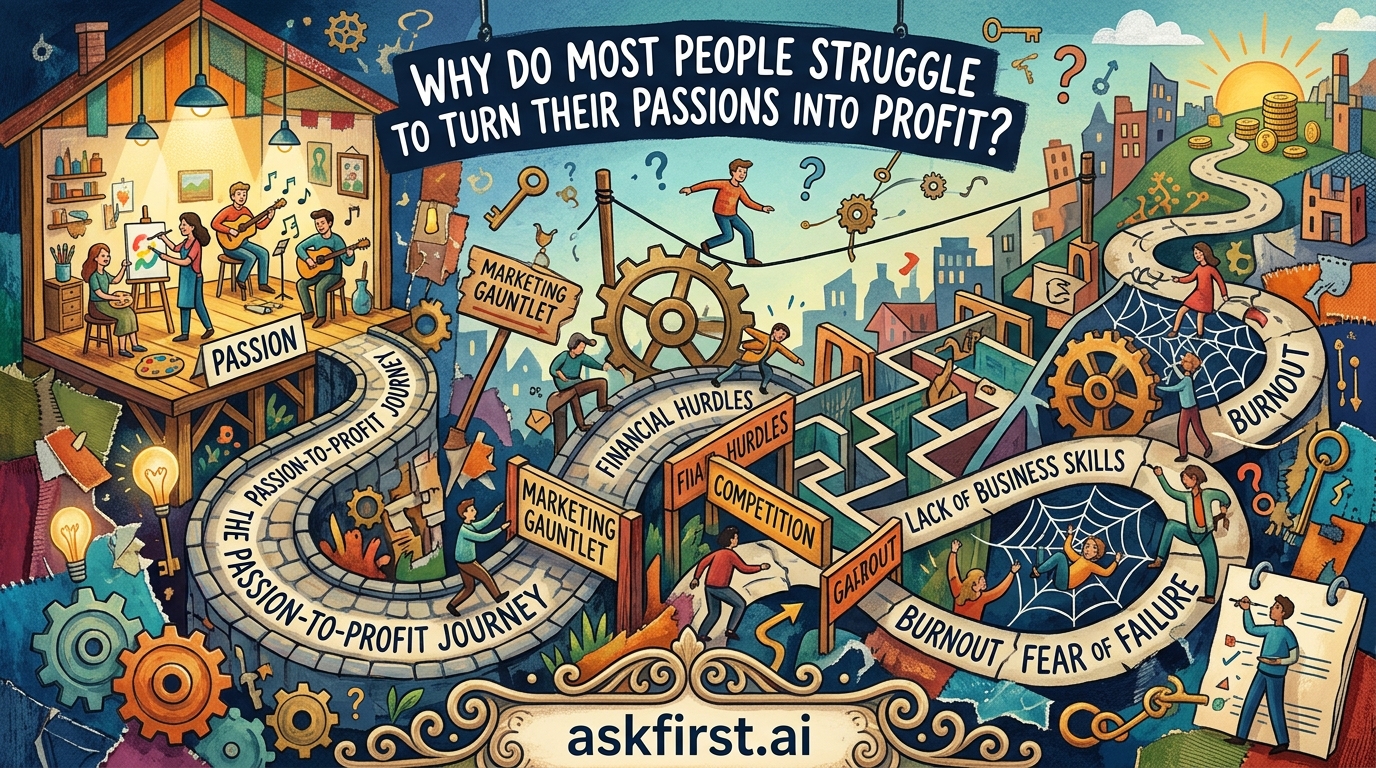
The Passion-to-Profit Paradox: Why Your Talent Isn't Selling
Many individuals harbor the belief that if they love what they do, success will naturally follow. However, the conversion of a passion into a sustainable income stream is not merely a matter of enthusiasm; it is a complex intersection of market demand, operational strategy, and psychological endurance. This guide explores the systemic barriers that prevent creators from achieving commercial viability.
The Market Mismatch Trap
The primary reason passions fail to turn a profit is a lack of market alignment. A common mistake involves assuming that personal interest equals consumer demand. If a hobby serves no functional purpose or fails to solve a specific pain point for others, it remains a leisure activity rather than a business. According to economic principles of value exchange, profit is generated when a service or product reduces friction for a customer. Without identifying a target demographic that is willing to pay for that solution, the venture lacks a foundation for scaling.
The Burden of Professionalization
Turning a passion into a profession necessitates shifting focus from creation to commerce. This transition requires skills that are often antithetical to the hobbyist mindset:
- Marketing and Sales: Creators must learn to articulate the value of their work to strangers.
- Financial Literacy: Managing cash flow and overhead is essential, yet often ignored by creative minds.
- Operational Consistency: Converting an inconsistent burst of inspiration into a reliable service delivery model.
When these business operations are neglected, the quality of the product suffers, leading to inconsistent revenue streams and eventual burnout.
The Myth of 'Do What You Love'
Cultural narratives suggest that passion is the sole prerequisite for entrepreneurship. This myth can be dangerous. As argued in studies by Cal Newport in his work So Good They Can't Ignore You, passion is often a byproduct of mastery rather than a prerequisite. When people try to monetize their passion prematurely, they encounter the 'pressure of performance.' The requirement to produce consistently can strip away the intrinsic joy of the activity. When the joy vanishes, the resilience required to navigate the inevitable challenges of the startup phase often vanishes as well.
Overcoming the Barriers
To bridge the gap between creative expression and profit, individuals must treat their venture as an experiment. This involves:
- Validation: Testing ideas with small, low-risk markets before investing heavily.
- Skill Diversification: Accepting that being a professional requires mastery of the business side as much as the creative craft.
- Long-term Orientation: Recognizing that profitable business models are built over years, not months.
Ultimately, passion is a powerful fuel, but a business engine requires the mechanical components of strategy, market demand, and financial rigor to actually move forward.