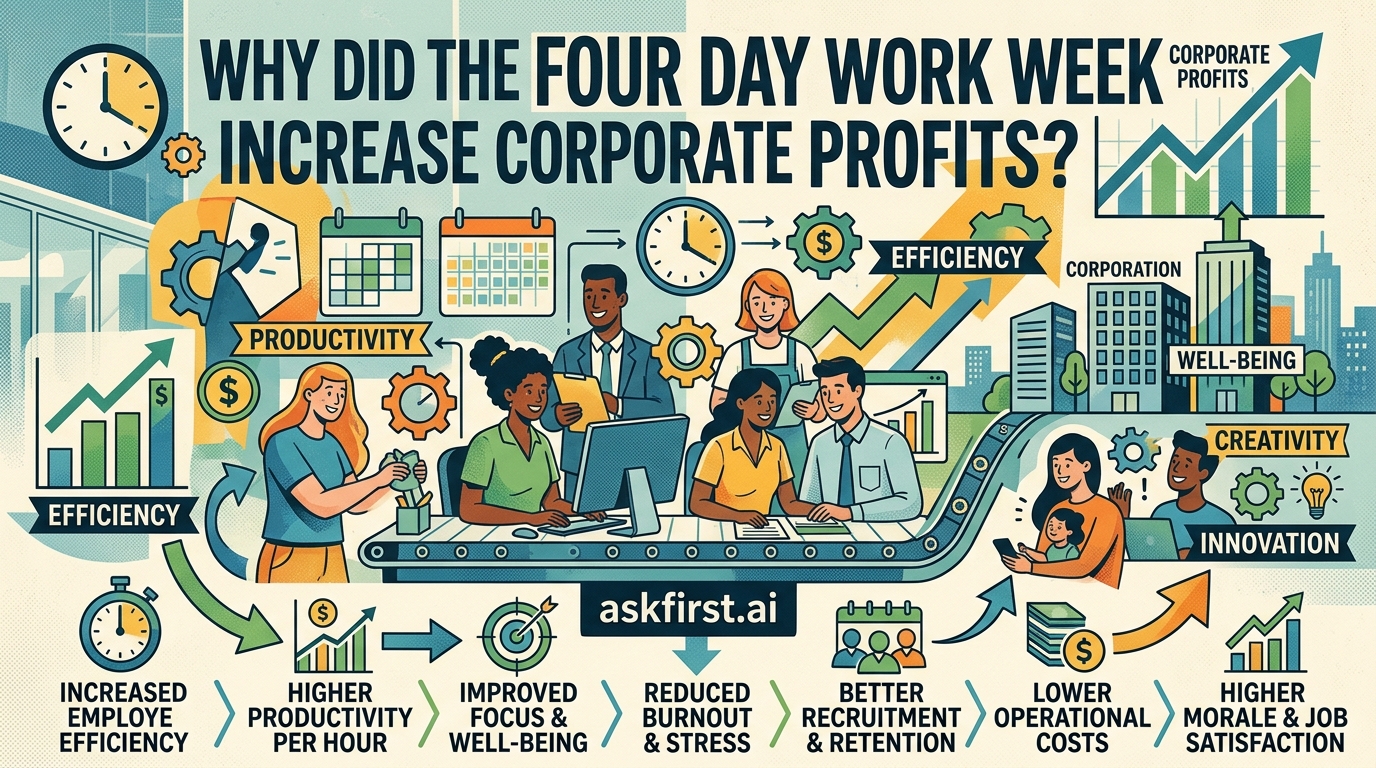
The Profit Paradox: How Shorter Weeks Drive Higher Returns
Transitioning to a four-day work week might seem counterintuitive for companies obsessed with output, yet data from global pilot programs—including those led by 4 Day Week Global—consistently demonstrate a rise in corporate profitability. This phenomenon defies the traditional "hours-in-seat" metric of success, suggesting that organizational value is rooted in intensity and focus rather than sheer duration.
The Efficiency Revolution
The primary driver of increased profits is the radical reduction of Parkinson’s Law: the adage that work expands to fill the time available for its completion. By shortening the week, organizations inadvertently force a prioritization process. Employees shift from performing low-value tasks, such as excessive meetings or redundant email threads, to executing high-impact work. This optimization reduces operational overhead, as unnecessary administrative bloat is surgically removed to accommodate the compressed schedule.
Human Capital and Reduced Burnout
Corporate costs associated with high turnover, absenteeism, and "presenteeism" (being at work while mentally disengaged) represent significant financial drains. A shorter work week functions as a premium retention tool. When employees are well-rested, their cognitive capacity increases. Research suggests that cognitive fatigue impairs decision-making and problem-solving abilities. A three-day weekend provides the necessary restorative period to ensure that when staff return, they operate at peak capacity. This shift manifests in lower recruitment costs, reduced onboarding expenses, and the preservation of institutional knowledge—all of which directly bolster the bottom line.
Enhanced Employee Engagement
The psychological impact of a four-day work week acts as a powerful incentive for efficiency. Knowing they have limited time to complete their objectives, teams become more autonomous and less prone to procrastination. This creates a culture of mutual accountability. Companies often report that their staff members are more invested in the company's success, resulting in higher quality deliverables and increased customer satisfaction. Happy, energetic employees naturally become better advocates for the brand, leading to improved client relations and, consequently, a stronger market position.
Real-World Financial Outcomes
Examples from various sectors show that when companies drop the 40-hour requirement without cutting pay, productivity either remains stable or increases. Because fixed costs—such as office energy consumption, utilities, and office maintenance—can be optimized when the physical workplace operates fewer days, overhead drops. When paired with sustained or improved revenue, profit margins expand. Furthermore, businesses that adopt this model often experience a surge in high-quality talent applicants, allowing them to cherry-pick the best personnel without needing to offer exorbitant salary premiums, effectively optimizing labor costs. Ultimately, the transition serves as a catalyst for cultural evolution, turning time into a currency that, when spent wisely, yields significantly higher dividends than traditional models.