From Clay Tokens to Blockchain: The Secret Origins of the Business Contract
Deep in the cradle of civilization, around 8,000 BCE, ancient Mesopotamians developed a revolutionary accounting system that laid the structural bedrock for every modern business contract. While it may seem like a leap from Neolithic agricultural management to contemporary global finance, the cognitive shift required to track physical assets through symbolic representation marks the true origin of formalized commercial law.
The Evolution of Tokenization
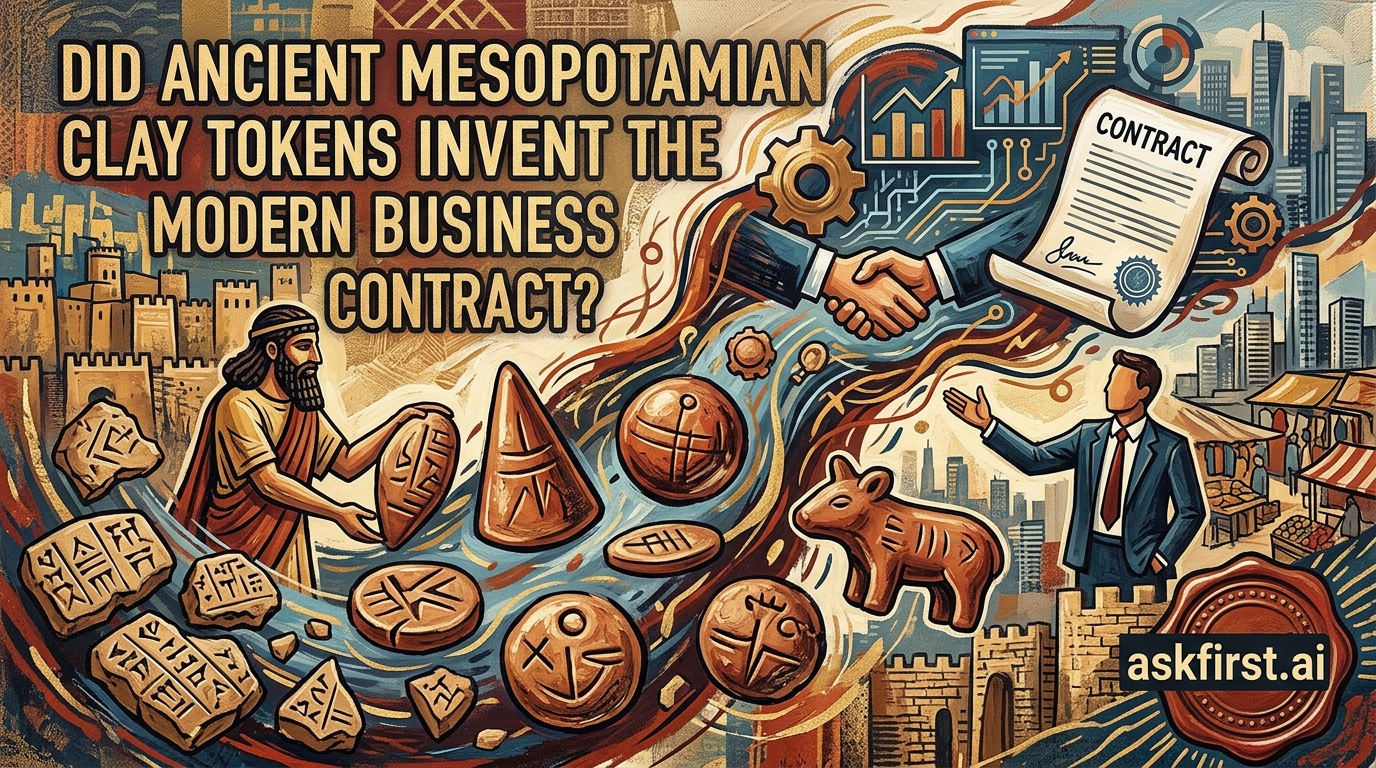
Before the invention of writing, Mesopotamian traders used small, geometric clay shapes—spheres, disks, cones, and cylinders—to represent specific commodities like sheep, grain, or jars of oil. This system, identified by archaeologist Denise Schmandt-Besserat as the "token system," served as a tangible ledger. By placing these tokens inside hollow clay spheres called bullae, parties could ensure that an agreement regarding the delivery or debt of goods remained sealed and tamper-proof during transit. When the shipment arrived, the buyer broke the bulla to verify the contents against the tokens, essentially performing the first audit in history.
Formalizing Legal Intent
This physical method evolved into the "impressed tablet," where tokens were pressed into the exterior of wet clay to show the quantity and nature of the goods. This established three critical pillars of modern contract law:
- Authentication: The physical impression of a token or cylinder seal acted as a personal signature, validating the legitimacy of the record.
- Evidence of Obligation: The permanent record of the token count created a binding promise that a specific transaction was owed or completed.
- Transparency: By sealing the tokens within or on the record, both parties established a neutral third-party verification method.
The Ancestry of Modern Documentation
Are these tokens the direct predecessors to our modern contracts? Conceptually, yes. The modern business contract is fundamentally an instrument designed to mitigate risk and enforce accountability through symbols—just as the tokens were. The shift from physical clay representations to the digital signatures of the 21st century is merely an evolution of medium. Both systems utilize "trusted intermediaries" (whether a Sumerian clerk or a blockchain consensus algorithm) to prove the intent of the parties involved.
This transition from concrete tokens to abstract symbols eventually led to the development of Cuneiform writing itself. Consequently, the legal language used in courtrooms today—clauses regarding liability, quantity, and fulfillment—can be traced back to these ancient efforts to secure agricultural supply chains. The clay token did not merely "invent" the contract; it provided the cognitive framework that allows human beings to trust one another across time and space, enabling the complex trade networks that power the global economy.