Can AI Truly Generate Millions? An Analytical Overview
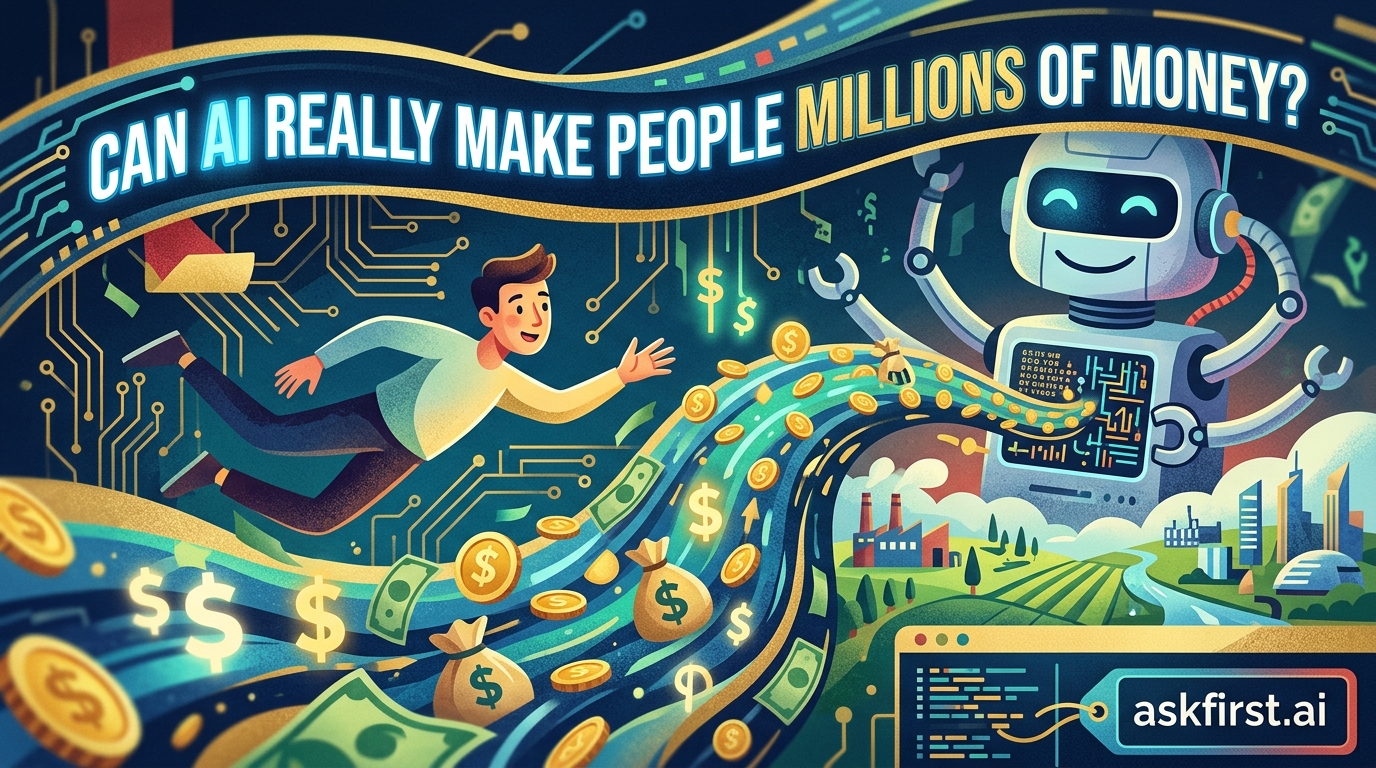
The question of whether Artificial Intelligence (AI) can generate millions of dollars for individuals is a subject of intense modern debate. While the potential for exponential wealth creation exists, it is critical to distinguish between AI as a catalyst for productivity and AI as a "get-rich-quick" scheme.
Historical Context and Economic Shift
Since the public emergence of Large Language Models (LLMs) like GPT-4 in 2022, the economic landscape has shifted. Historically, wealth generation through technology required significant capital for infrastructure. Today, AI democratizes access to high-level technical capabilities, allowing a single individual to act as a "one-person unicorn"—a company with millions in revenue but minimal headcount.
Pathways to Wealth Creation
AI facilitates wealth generation through three primary mechanisms:
- SaaS (Software as a Service) Development: Developers are using AI to write code, debug, and deploy applications in days rather than months. By identifying niche market inefficiencies, an entrepreneur can build a specialized AI agent or plugin that solves a high-value problem for businesses, leading to recurring revenue models.
- Content and Media Scaling: Content creators are leveraging generative AI to produce high-quality video, audio, and written assets at scale. By automating the production pipeline, creators can build massive digital audiences or automated media properties that monetize through advertising, sponsorships, and affiliate marketing.
- Algorithmic Trading and Financial Analysis: While high-frequency trading has long been dominated by institutional firms, retail investors now use AI-driven sentiment analysis and predictive modeling to gain an edge in stock, crypto, and commodity markets.
Practical Guide: The Path to High-Revenue AI Implementation
If you intend to pursue wealth through AI, follow this structural approach:
- Step 1: Identify a "Pain Point." Do not build technology for technology's sake. Find a B2B sector with high labor costs (e.g., legal documentation, medical transcription, or customer support) and design a solution that reduces that cost by 90%.
- Step 2: Build a Minimum Viable Product (MVP). Use low-code tools or AI-assisted coding to build a prototype. The goal is to prove value, not perfection.
- Step 3: Iterate via Data Feedback. The true value of AI lies in proprietary data. As your system learns from real-world usage, it becomes harder for competitors to displace you, creating a "moat."
- Step 4: Scale and Automate. Once the model is profitable, use AI agents to handle marketing, customer acquisition, and operational maintenance.
Pros and Cons of AI-Driven Wealth
Pros
- Efficiency: Drastic reduction in operational overhead.
- Accessibility: Low barrier to entry for non-technical founders.
- Scalability: Digital products have near-zero marginal costs.
Cons
- High Competition: Low barriers to entry mean markets become saturated quickly.
- Regulatory Risk: Rapidly evolving AI laws could render current business models obsolete.
- Platform Dependency: Relying on third-party APIs (like OpenAI or Anthropic) creates existential risk if pricing or policies change.
Future Trends
The next phase of wealth creation will shift from General AI to Vertical AI—systems trained on specialized, proprietary data that general models cannot access. Investors are increasingly looking for companies that own their data pipelines. While AI is a powerful tool, it remains an extension of human intent; the millions are made by those who use AI to solve real, persistent problems, not those who merely chase the hype.