The Ancient Gamble: How Trade Invented Insurance
Long before modern corporations and financial institutions, early merchants faced a terrifying reality: the total loss of their livelihood in a single, unpredictable event. Maritime trade, while highly profitable, was fraught with extreme danger, ranging from sudden storms and piracy to shipwrecks in unknown waters. The invention of insurance was not merely a financial innovation; it was a desperate, brilliant survival strategy that allowed global commerce to persist despite constant peril.
The Birth of Bottomry Contracts
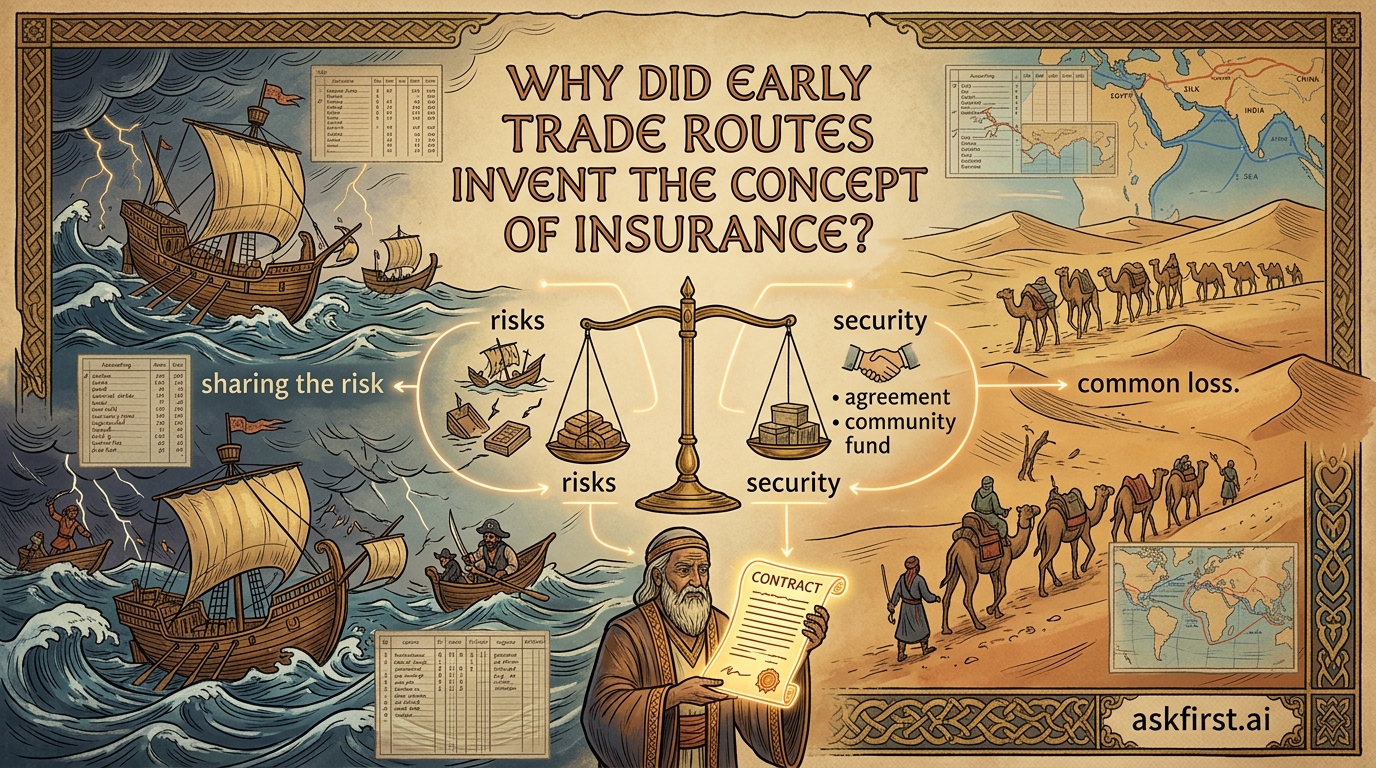
The concept of insurance traces its roots back to ancient civilizations, most notably the Code of Hammurabi around 1750 BCE. Merchants would take out loans to finance their voyages. A specific legal instrument, known as a bottomry contract, stipulated that if a ship reached its destination safely, the merchant would repay the loan with interest. However, if the ship was lost at sea, the debt was completely forgiven. This functioned essentially as a primitive form of maritime insurance, effectively transferring the risk of total loss from the merchant to the lender in exchange for a premium paid as interest.
Diversification and Risk Pooling
As trade routes expanded across the Mediterranean and the Silk Road, merchants realized that individual exposure was too high. They began implementing two core concepts: diversification and risk pooling. Instead of placing their entire fortune on a single ship, merchants would split their goods across multiple vessels. Simultaneously, groups of investors would pool their capital to fund several ventures. This meant that if one ship sank, the losses were cushioned by the profits from the other ships. This collective approach to risk reduction forms the bedrock of every modern insurance company today.
The Catalyst for Exploration
The ability to hedge risk acted as an economic catalyst for the Age of Exploration. Without the assurance that a disaster would not result in absolute bankruptcy, investors would never have funded long-distance voyages to the Americas or the East Indies. The creation of specialized maritime insurance markets, most famously the Lloyd’s of London coffee house, enabled entrepreneurs to shift the uncertainty of the ocean into a calculable cost of doing business. By converting the possibility of ruin into a fixed expense, insurance provided the stability necessary to build global trade networks.
Conclusion: A Legacy of Security
Insurance is not just a modern financial product; it is a fundamental human response to the inherent unpredictability of the world. By inventing mechanisms to distribute risk, early traders transformed dangerous maritime ventures into manageable investments. This historical evolution underscores the human drive for progress, showing that when society protects its innovators against the fear of loss, it empowers them to pursue great achievements that change the course of history.