The Perceptual Illusion of Temporal Acceleration
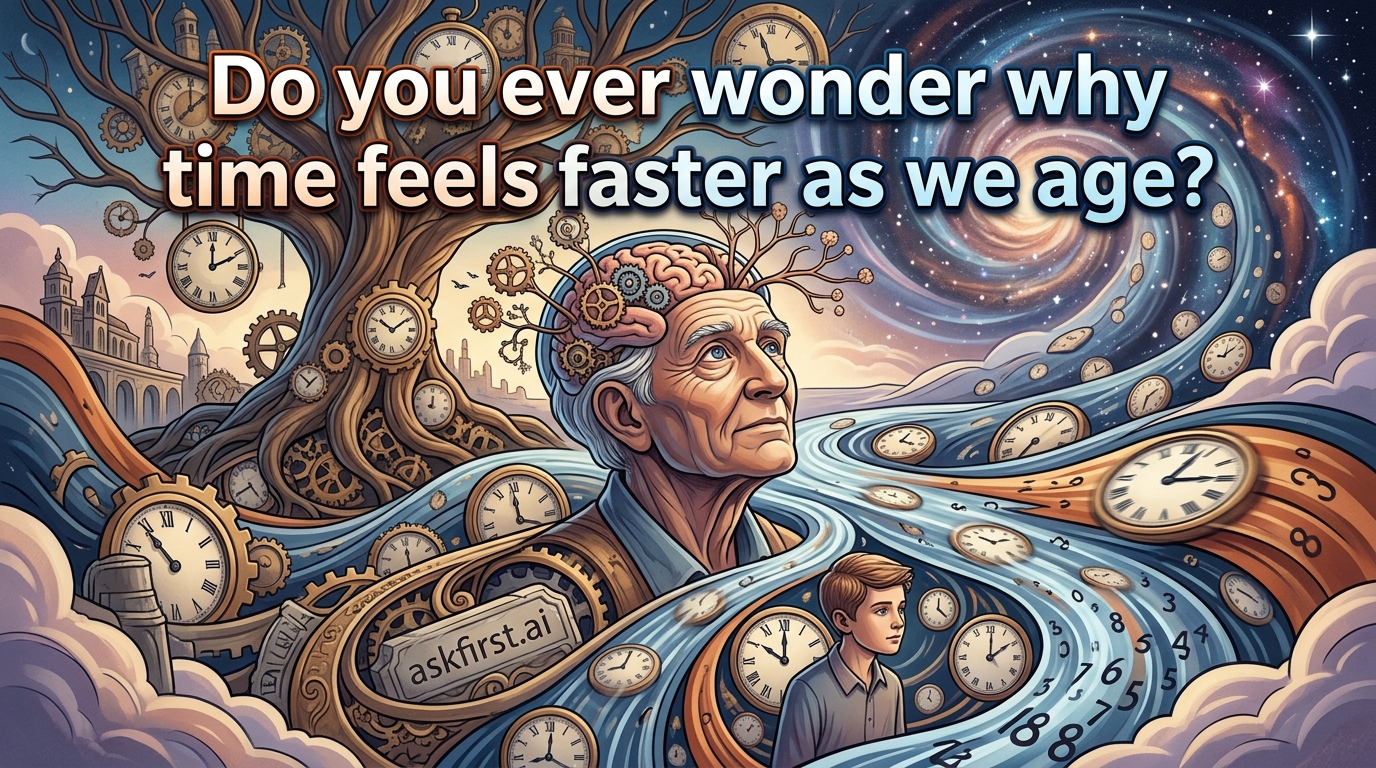
The sensation that time accelerates as the human journey progresses is one of the most pervasive cognitive phenomena in existence. Psychologists and neuroscientists have spent decades dissecting this 'temporal thinning,' revealing that our perception of duration is not a fixed clock, but a dynamic construct influenced by memory density, neural processing speeds, and emotional novelty. Understanding this mechanism allows individuals to effectively 'slow down' their subjective experience of life.
1. The Proportional Theory
One of the most mathematically intuitive explanations is the proportional theory. At age five, one year represents twenty percent of an entire lifetime. By the time an individual reaches fifty, that same year accounts for only two percent of their existence. Because the brain measures the current duration against the total volume of accumulated memories, shorter periods appear objectively smaller in the context of one's total history. As the denominator of one's lifespan grows, the relative 'value' of each year decreases, creating the illusion of a rapidly ticking clock.
2. The Novelty and Memory Density Hypothesis
Perhaps the most influential theory involves memory encoding. During childhood, the world is filled with unprecedented experiences. The brain must dedicate significant cognitive resources to mapping the environment, learning social hierarchies, and mastering new skills. This high volume of sensory data requires intense neural processing. Because the brain records these 'novel' events in great detail, the passage of time during retrospection feels expansive. Conversely, adulthood is often characterized by routine. When one commutes to the same job and follows the same daily schedule, the brain engages in predictive processing—essentially ignoring familiar stimuli to save energy. When looking back on a month of routine, the brain finds fewer unique 'anchor points' or memories to categorize, causing the period to collapse into a shorter, blurrier span of time.
3. The Neural Processing Speed Shift
Recent physiological research suggests that the physical hardware of the brain changes over time. Neuroscientists hypothesize that the rate at which the brain acquires and processes mental images slows down as biological maturity peaks. If a younger brain processes images and environmental cues faster than an older brain, the younger brain effectively experiences 'more' snapshots of reality within a single minute. In essence, the younger brain perceives more frames per second of life, which translates to a perception of longer, more detailed intervals. As neural complexity increases and nerve conduction velocity shifts, the internal processing rate slows, leading to the perception of 'fewer' frames in a given hour.
4. Strategies for Temporal Expansion
Recognizing that this acceleration is largely a product of routine, there are concrete ways to counteract the 'disappearing years' effect:
- Cultivate Novelty: Actively introduce new hobbies, travel to unfamiliar locations, or learn a complex skill. By forcing the brain out of predictive autopilot mode, you increase the density of your memory storage.
- Mindfulness Practices: Engaging in deep, focused awareness of the present moment breaks the habit of 'living in the future.' It forces the brain to encode the current moment with high precision.
- Documenting Progress: Maintaining a daily journal acts as an external storage system for your life, forcing reflection that essentially re-encodes daily events, making them more significant in your long-term narrative.
- Sensory Engagement: Actively focus on the nuances of your senses—scent, texture, and complex flavors. This sensory richness acts as a catalyst for deeper neural activation.
5. Conclusion
Time does not truly speed up; our perception of it merely shifts as we transition from a life of constant discovery to one of established patterns. By understanding that time is measured by the richness and volume of our memories, we gain the power to shape our subjective timeline. To make life feel longer, one must simply refuse the comfort of the routine and embrace the exhilarating, high-definition process of learning and experiencing the new. Life is not merely the seconds that pass, but the vivid imprints those seconds leave behind on the tapestry of the mind.